

What if your computer could build software, fix bugs, and edit videos without needing instructions at every step? Meta’s Muse Spark Open promises a new approach to autonomous AI, but its massive hardware requirements raise an important question: How practical is powerful local AI for everyday users?
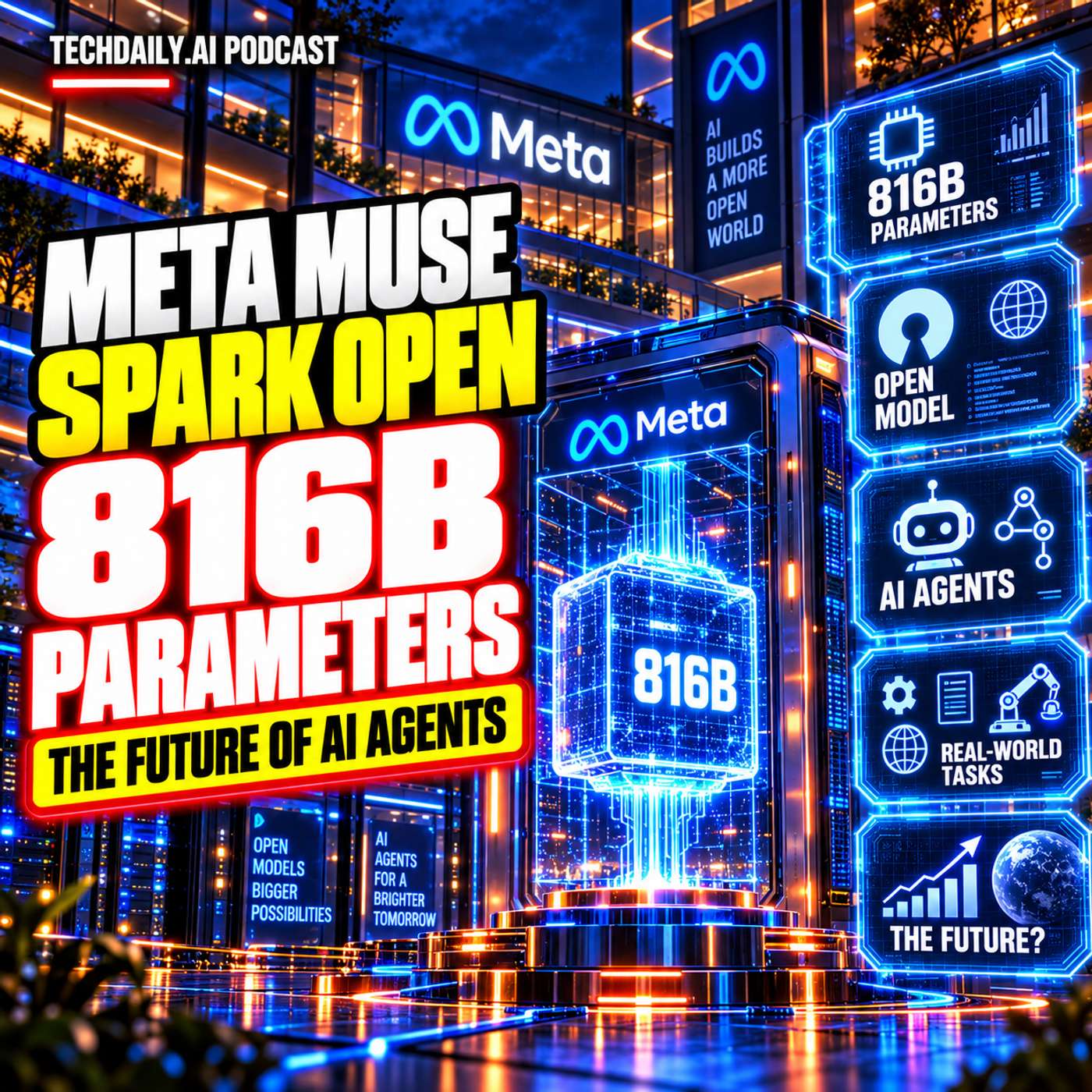
In this episode of TechDaily.ai, host David and guest Sophia explore Meta’s Muse Spark Open, an open-weight AI model described in the discussion as having 816 billion parameters, a 1 million-token context window, and advanced capabilities for autonomous, multi-step tasks.
From AI-powered software development to video editing in DaVinci Resolve, the conversation examines how agentic AI could transform professional workflows, why running massive language models locally demands extraordinary computing resources, and what open-weight AI means for developers, businesses, and the future of personal computing.
What You’ll Discover in This Episode
- How Meta’s Muse Spark Open uses 816 billion parameters to tackle complex AI reasoning tasks.
- Why a 1 million-token context window matters for large codebases, documents, and interconnected information.
- How self-attention mechanisms help AI models work across extensive amounts of context.
- Why local execution is described as requiring up to 1TB of unified memory on high-end Apple hardware.
- How Apple’s unified memory architecture differs from traditional CPU and GPU memory configurations.
- What agentic AI means and how autonomous systems plan, execute, test, and improve their work.
- How Muse Spark Open and Muse Code are described as building software, fixing bugs, and adding features.
- How multimodal AI could assist with video editing and visual tasks in DaVinci Resolve.
- Why open-weight AI models offer opportunities for customization, fine-tuning, and private deployment.
- How cloud API access could make powerful models available without expensive local hardware.
- What autonomous AI agents could mean for software development, creative production, and future desktop computing.
From Chatbots to Autonomous AI Workers
Traditional AI chatbots respond to prompts. Agentic AI systems aim to go further by planning tasks, interacting with software tools, identifying errors, and adjusting their actions based on results.
David and Sophia examine the feedback loops behind autonomous AI workflows, including an example in which Muse Spark Open works with the Muse Code terminal to develop a Mastodon client.
They also discuss how multimodal AI could analyze video footage, identify visual elements, and perform editing operations inside professional software.
These examples raise a larger question: Are we moving toward computers that complete entire projects rather than simply respond to individual commands?
The 1TB RAM Challenge: Is Local AI Worth the Cost?
Running an enormous AI model locally comes with serious hardware demands.
The episode explores why an 816-billion-parameter model requires substantial memory, how model weights and context processing affect performance, and why Apple’s unified memory architecture is presented as a potential solution for high-end desktop AI.
But with hardware requirements far beyond an average laptop, does local AI represent genuine accessibility or a new computing divide?
David and Sophia discuss the trade-offs between expensive local deployment and cloud-based AI services, including privacy, infrastructure control, customization, and cost.
Why Open-Weight AI Matters
Unlike closed AI systems that restrict access to their underlying models, open-weight models provide developers with opportunities to adapt and deploy AI technology for specialized applications.
The discussion explores how businesses could fine-tune Muse Spark Open for industry-specific workflows, run customized deployments on private infrastructure, and reduce dependence on a single AI provider.
From enterprise software development to media production, open-weight AI could give organizations greater flexibility in how they build and manage autonomous systems.
The Future of Personal Computing
As AI agents become increasingly capable, the relationship between people and computers could fundamentally change.
Instead of manually operating every application, users may eventually supervise autonomous systems that handle complex tasks, evaluate their own results, and complete multi-stage workflows.
Will tomorrow’s personal computer remain a tool you operate, or become an AI colleague whose work you review?
Tune in as David and Sophia explore the architecture, possibilities, and practical challenges behind Meta’s Muse Spark Open and the emerging future of autonomous desktop AI.
Support TechDaily.ai
Want to promote your brand to an audience interested in artificial intelligence, software development, and emerging technology?
Sponsor TechDaily.ai for just $25 and have your message featured across major podcast platforms, including Apple Podcasts, Spotify, Amazon Music, and more.
Visit https://techdaily.ai to explore sponsorship opportunities.
Subscribe and Stay Connected
Subscribe to TechDaily.ai for more conversations about artificial intelligence, AI agents, open-weight models, software innovation, and the technology shaping our digital future.
Enjoyed this episode? Share it with a developer, creator, or technology enthusiast interested in the next generation of AI-powered computing.
Keep questioning, keep exploring, and join us next time on TechDaily.ai.