

What if your computer could do more than answer questions? Imagine an AI that can navigate professional software, identify bugs, write new features, build applications, and edit video footage with minimal human guidance. That’s the future Meta’s Muse Spark Open is aiming toward, and its reported capabilities could represent a major shift in how we use artificial intelligence.
In this episode of techaily.ai, host David and expert guest Sophia explore Meta’s Muse Spark Open AI model, described in the episode as an 816-billion-parameter, open-weight system with a massive 1-million-token context window and native multimodal capabilities.
But there’s a catch: Running a model of this scale locally reportedly requires at least 1TB of RAM and specialized Apple hardware.
David and Sophia examine what these hardware requirements mean, why agentic AI is attracting attention, and how Meta’s open-weight strategy could influence the future of software development and AI adoption.
In this episode, you’ll discover:
- What Meta Muse Spark Open is and why its reported 816-billion-parameter architecture is generating attention.
- How a 1-million-token context window could support complex tasks involving large codebases, extensive documentation, and multiple sources of information.
- What native multimodal AI means for processing text, images, video, and software code.
- Why running a massive AI model locally requires unusually powerful hardware, including the reported 1TB RAM requirement.
- How the Apple Mac Studio and M5 Ultra chip fit into the episode’s discussion of high-performance local AI.
- How Muse Code, Meta’s AI coding terminal described in the conversation, enables autonomous software development workflows.
- How AI agents were reportedly tested on a Mastodon client to identify bugs, implement features, and complete software builds.
- How agentic AI could interact with DaVinci Resolve to review footage and perform video cropping tasks.
- Why autonomous AI agents represent a shift from traditional chatbots toward software capable of executing multi-step workflows.
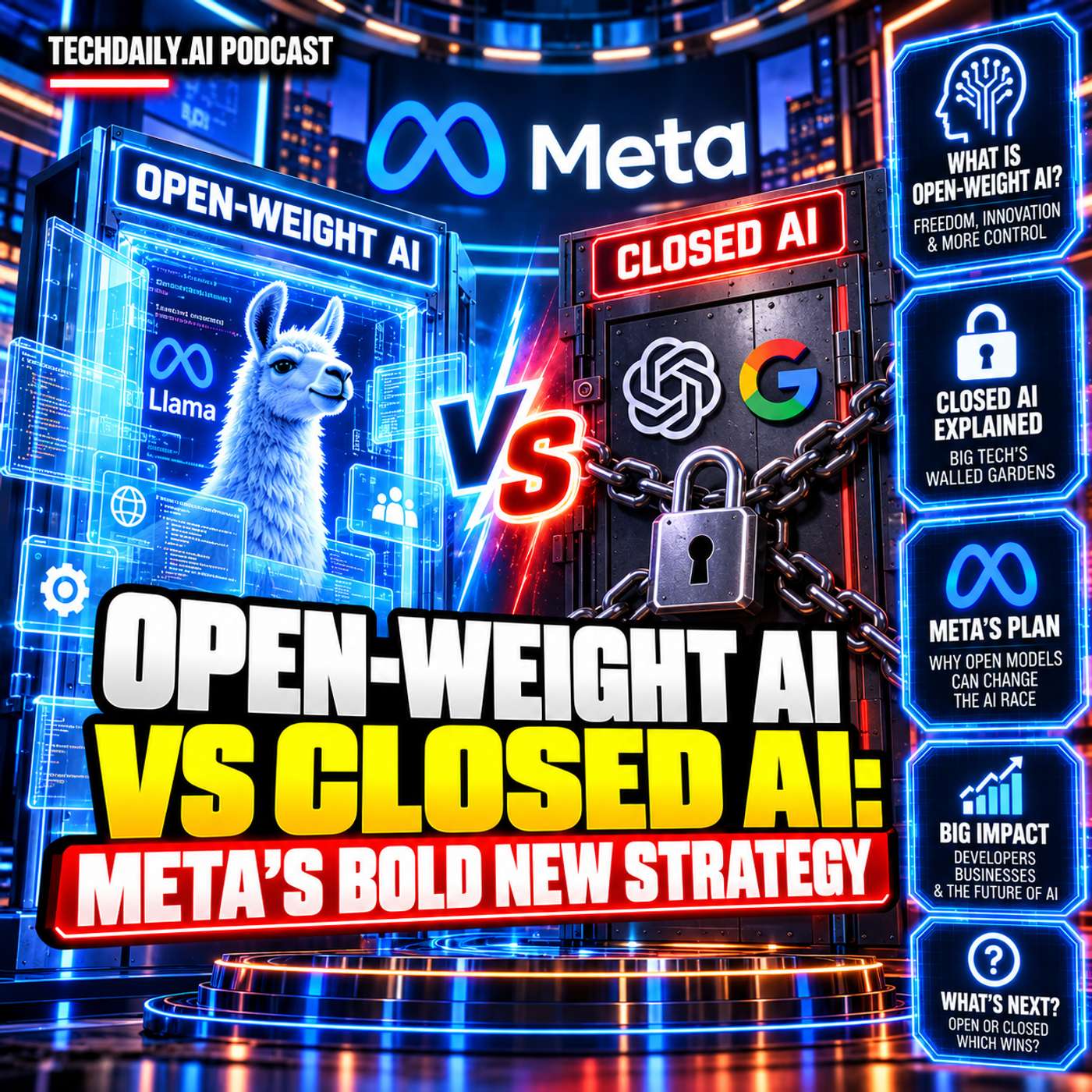
- How open-weight AI models differ from closed proprietary systems in customization, deployment, and developer control.
- Why Meta might benefit from making powerful AI models widely accessible rather than relying exclusively on closed systems.
- What increasingly capable local AI agents could mean for developers, businesses, and everyday computer users.
The conversation also examines the strategic importance of open-weight artificial intelligence. Rather than treating AI models as products that must remain locked behind proprietary platforms, Meta’s approach, as discussed by David and Sophia, focuses on encouraging developers to build within a broader AI ecosystem.
The potential applications extend beyond generating text or answering questions. Imagine assigning an AI a software development objective and allowing it to navigate the codebase, implement changes, troubleshoot errors, and complete a working build. Or asking an AI agent to review video footage and make editing decisions directly inside professional software.
These examples highlight a major question facing the technology industry: Are computers evolving from tools we operate into intelligent agents we manage?
David and Sophia also explore the limitations of today’s local AI systems, particularly the memory and processing requirements needed to run extremely large models without relying entirely on cloud infrastructure.
And they leave listeners with one final possibility worth considering: If powerful autonomous AI systems require specialized desktop computers today, what happens when future hardware becomes efficient enough to bring similar capabilities to personal devices?
Listen to this episode of techaily.ai for a closer look at Meta Muse Spark Open, the potential of open-weight AI, the rise of autonomous coding agents, and the future of local artificial intelligence.
Subscribe to techaily.ai for more conversations about AI breakthroughs, emerging technologies, software innovation, and the developments shaping the digital world. Share this episode with a developer, AI enthusiast, or technology professional interested in where autonomous artificial intelligence could be heading next.