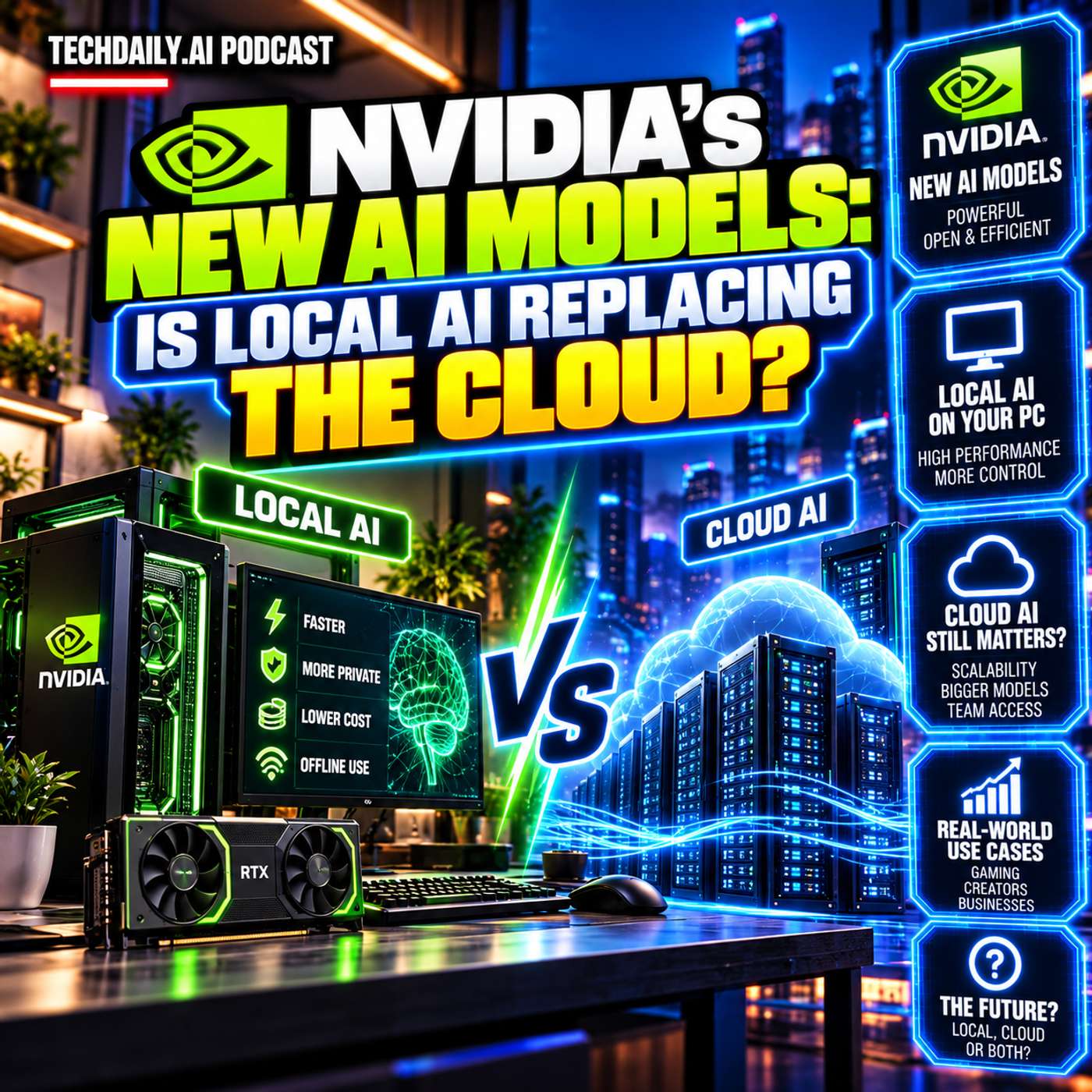


What if your most powerful AI assistant didn’t need the cloud? Imagine an artificial intelligence system that could analyze confidential documents, manage sensitive information, automate complex workflows, and operate directly on your own hardware without constantly sending data to remote servers.
In this episode of TechDaily.ai, host David and expert Sophia explore NVIDIA’s reported October 2026 launch of new open-weight AI models, including the 120-billion-parameter Nemotron 3.5 SuperVL and its smaller Bolt models designed for local AI computing.
The discussion examines a major potential shift in artificial intelligence: moving powerful AI agents away from centralized cloud infrastructure and into private enterprise data centers, professional workstations, and personal computers.
But why would NVIDIA release powerful open-weight AI models while encouraging businesses and consumers to invest in more local computing hardware?
David and Sophia break down the technology, economics, and business strategy behind this move.
In this episode, you’ll discover:
- How NVIDIA’s Nemotron 3.5 SuperVL uses a reported 120-billion-parameter architecture to support enterprise AI agents.
- Why smaller, more efficient AI models could offer competitive performance while reducing the hardware requirements and cost of inference.
- How model pruning and synthetic data distillation are discussed as techniques for improving AI efficiency.
- Why the episode claims Nemotron 3.5 SuperVL performs competitively against proprietary AI models on enterprise-focused tasks.
- How businesses could deploy open-weight AI models within private data centers to maintain greater control over sensitive information.
- Why organizations handling financial records, cybersecurity operations, and confidential documents may prioritize local AI deployment.
- How NVIDIA’s reported Nemotron 3.5 Bolt 74B-A9B 24GB model is positioned for locally running AI agents.
- What smaller Bolt models could mean for real-time conversational AI and personal productivity.
- How NVIDIA RTX Spark and DGX Spark hardware fit into the company’s local AI strategy.
- Why running AI agents on personal hardware could reduce reliance on cloud-based processing for sensitive workflows.
- How locally deployed AI could support document analysis, coding, scheduling, and other personal or professional tasks.
- Why NVIDIA’s open-weight strategy may also create additional demand for its GPUs, workstations, and AI infrastructure.
- What a shift toward edge AI and on-device computing could mean for the economics of traditional cloud AI services.
The conversation also examines the privacy concerns that arise when AI assistants need access to personal emails, financial documents, medical information, or confidential corporate systems.
Cloud-based AI services can offer powerful capabilities, but sharing sensitive information with remote infrastructure introduces additional questions about data handling, security, and control.
Locally deployed AI offers a different approach, allowing certain workloads to run within systems controlled by the user or organization. David and Sophia discuss why this distinction matters for industries where confidentiality, compliance, and data sovereignty are major priorities.
Beyond privacy, the episode explores NVIDIA’s broader business strategy.
As major AI companies develop custom chips and alternative computing infrastructure, NVIDIA has an incentive to expand its customer base beyond large cloud providers. Making capable open-weight models available for local deployment could encourage more businesses and individuals to invest in specialized AI hardware.
The result could be a very different computing landscape, where AI intelligence increasingly operates inside private networks and personal devices rather than relying exclusively on centralized data centers.
And that raises a fascinating question: If powerful AI agents eventually run entirely offline, what happens to the cloud AI industry built around providing intelligence as a remote service?
Listen to this episode of TechDaily.ai as David and Sophia explore NVIDIA’s reported Nemotron 3.5 launch, the growing role of local AI, the economics of open-weight models, and the future of private artificial intelligence.
Subscribe to TechDaily.ai for more discussions about artificial intelligence, emerging technologies, semiconductor innovation, and the business strategies shaping the future of computing. Share this episode with a developer, IT professional, or technology enthusiast interested in local AI and the future of cloud computing.