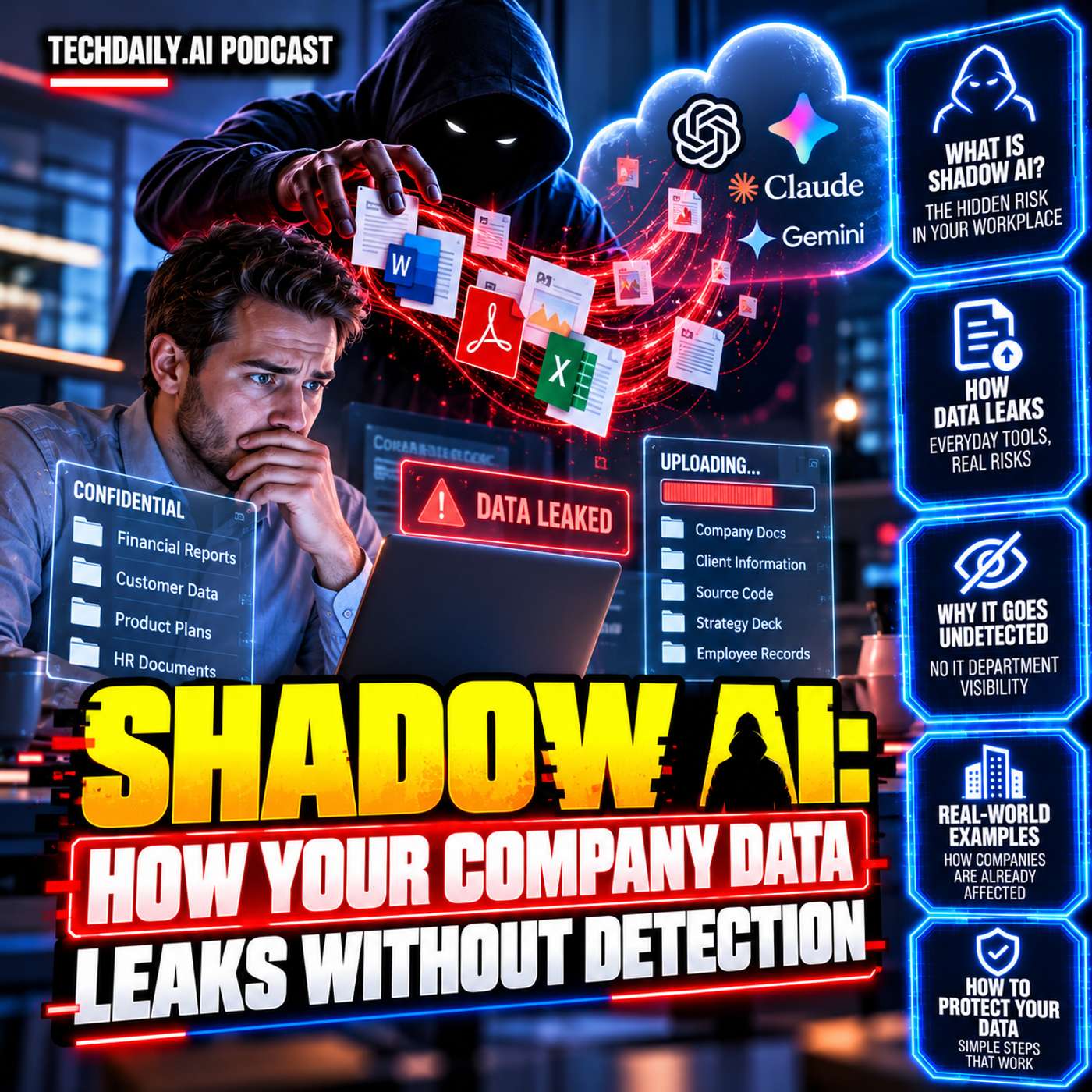


What if your company’s most sensitive information was leaving its secure environment without triggering a single security alert? An employee uploads a confidential spreadsheet into an AI chatbot, receives a helpful summary in seconds, and moves on with their day. But where does that information go next, and can your existing cybersecurity tools actually track it?
In this episode of TechDaily.ai, host David and expert Sophia explore the growing cybersecurity challenges surrounding shadow AI, enterprise data leakage, and the increasing use of autonomous AI agents in everyday business operations.
The conversation begins with a striking statistic cited in the episode: 31% of organizations have reportedly experienced a privacy violation connected to an AI-related incident. David and Sophia examine why the rapid adoption of generative AI is creating blind spots for traditional data loss prevention (DLP) systems and how sensitive business information can move through AI workflows without being detected.
From public AI chatbots and unauthorized tools to retrieval-augmented generation (RAG), vector databases, and interconnected AI agents, they break down the complex paths that enterprise data can follow.
In this episode, you’ll discover:
- What shadow AI is and why employees using unauthorized AI tools can introduce serious enterprise security risks.
- How sensitive financial documents, customer records, proprietary code, and confidential business information can be exposed through AI prompts and file uploads.
- Why traditional data loss prevention (DLP) systems may struggle to identify sensitive information after AI tools summarize, rewrite, or transform it.
- How AI data flows across training data, user prompts, RAG pipelines, system instructions, external tools, and autonomous agents.
- Why retrieval-augmented generation and vector databases introduce additional data access and monitoring challenges.
- How prompt injection attacks can target hidden system instructions and sensitive information within AI applications.
- How AI agents and connected tools, including MCP integrations, can move information across multiple services and workflows.
- Why tracking data transformations is essential when sensitive content no longer resembles its original file.
- How the workload stream and workforce stream provide two different perspectives on enterprise AI data movement.
- Why endpoint DLP, AI platform monitoring, and cloud data discovery each provide only part of the security picture.
- How data lineage helps security teams trace sensitive information from its original source through AI-generated outputs and downstream applications.
- Why continuous data classification and unified monitoring could improve incident investigation and risk detection.
- How AI data governance connects to compliance requirements such as GDPR, the EU AI Act, SOC 2, ISO 27001, and HIPAA.
One of the central challenges discussed is the transformation of sensitive data.
A confidential spreadsheet might enter an AI system as a detailed financial document and emerge as a short executive summary. While the format has changed, the summary may still contain proprietary figures, strategic information, or other confidential details.
Traditional security tools designed to identify recognizable file patterns or specific data formats may fail to detect these transformed outputs.
David and Sophia explain why enterprise security teams increasingly need to follow the origin, movement, and transformation of information rather than relying exclusively on file names, keywords, or predefined patterns.
The discussion also explores the growing complexity of agentic AI systems. When AI agents retrieve internal documents, invoke external tools, or delegate tasks to additional agents, sensitive information may cross multiple systems with different levels of security oversight.
To address these challenges, the episode examines the value of connecting AI workload visibility, employee endpoint monitoring, and cloud or on-premises data discovery into a unified approach to AI security.
The goal isn’t simply to prevent employees from using artificial intelligence. It’s to help organizations adopt AI productively while maintaining visibility and control over sensitive information.
As generative AI becomes embedded in daily business workflows, a critical question emerges: Can your organization confidently explain where its sensitive information travels after an AI tool processes it?
Listen to this episode of TechDaily.ai as David and Sophia explore shadow AI risks, enterprise data loss prevention, AI data lineage, and the security challenges created by increasingly connected AI agents.
Subscribe to TechDaily.ai for more conversations about artificial intelligence, cybersecurity, enterprise technology, and the risks shaping the digital workplace. Share this episode with an IT leader, security professional, or colleague responsible for protecting sensitive business information.