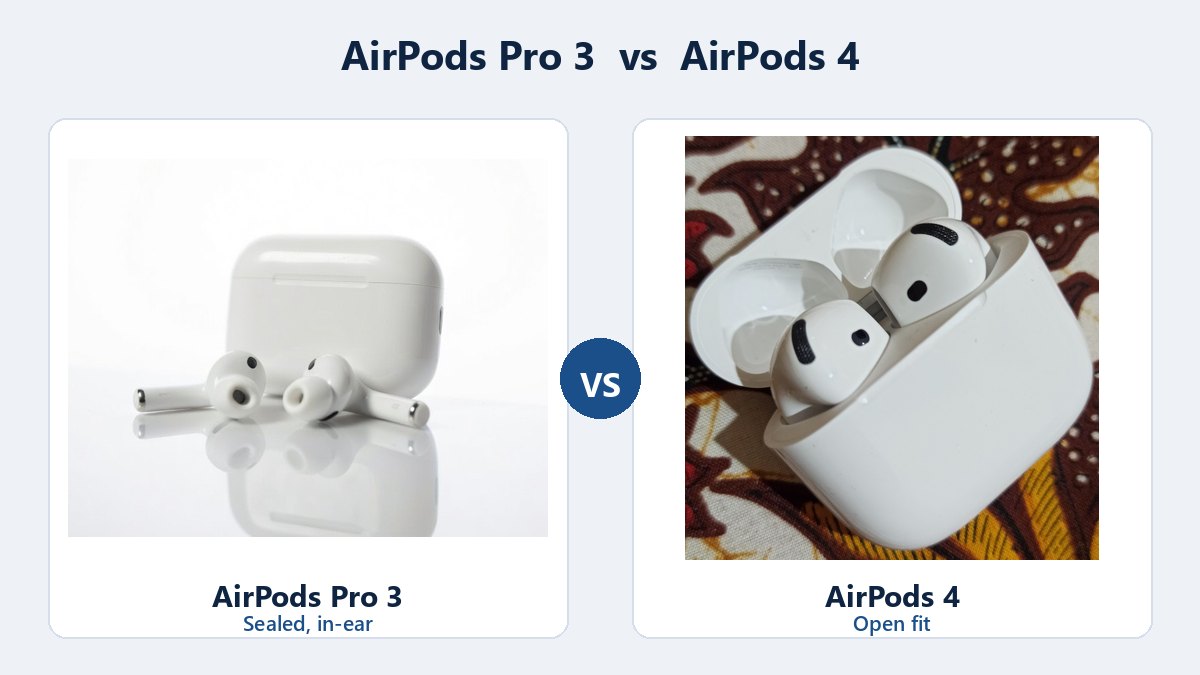
Everyone wants this to be a spec fight, with a winner, a loser, and a number you can screenshot. It isn’t. Picking between the AirPods Pro 3 and the AirPods 4 comes down to one simple question, and it has nothing to do with spec sheets: do you want something sealed inside your ear canal, or resting at the edge of it?
That one choice drags everything else along with it. Seal your ear with the Pro 3’s silicone tip, and you unlock Apple’s best gear: noise cancellation that can erase a plane cabin, bass you can actually feel, a heart-rate sensor, and a sweat-and-rain rating built for the gym. Leave your ear open with the AirPods 4, and you get the opposite. It’s airy, light, and lets you hear the world — and it costs a hundred dollars less. Neither choice is wrong. But pick the wrong fit, and you’ve wasted the price gap on a feature you’ll switch off or a comfort you’ll never feel.
Disclosure: TechDaily may earn an affiliate commission if you buy through links in this guide. It never changes which earbuds we recommend or what we say about them.
- The real split between the Pro 3 and the AirPods 4 is fit, not quality. The Pro 3 seals your ear canal. The AirPods 4 sits open at the edge. That one difference decides the ANC, the bass, and the comfort — all at once.
- Get the AirPods Pro 3 — the pricier pick — if you want noise cancellation that actually quiets a commute, a heart-rate sensor for workouts, and an IP57 seal that shrugs off sweat.
- Get the AirPods 4 — the cheaper, open-fit pick, with an optional ANC version — if the plugged-up in-ear feeling drives you crazy, you run outdoors and need to hear traffic, or you just don’t want to spend Pro money.
- Open-fit AirPods 4 do have real ANC now. But with no seal, it can only trim office chatter and hiss — not the low rumble of a plane or a train.
- The Pro 3 lasts longest per charge (8 hours). The plain AirPods 4 carries the most total playtime (30 hours with the case).
- If a pair almost fits but the bass feels thin, try a better ear tip first. You may not need a full upgrade.
Which fit suits your ears?
★ Your pick: AirPods 4
The H2 chip and Apple magic at the lower price, open-fit comfort.
★ Your pick: AirPods Pro 3
A sealed fit that actually shuts out a plane or a train — plus the deepest bass.
★ Your pick: AirPods 4
No silicone tip in your ear — the pair you forget you’re wearing.
★ Your pick: AirPods Pro 3
The heart-rate sensor and top fitness features live here.
👑 Our Top Pick — Best Overall Value
AirPods 4
Best value: most of the AirPods experience — great sound, H2 chip — for far less, if you’re happy with an open fit.
Opens on our Top Pick. Tap an option to see the best match for you.
The Verdict Before You Read a Single Spec
Here’s the whole guide in one breath, so you can leave now if you want to. Buy the AirPods Pro 3 if you need the best noise cancellation, you track workouts, or you want one pair that does everything and money is a side concern. Buy the AirPods 4 if the in-ear feeling makes you miserable, you need to stay aware of the world, or you just don’t want to pay Pro-level money for earbuds.
That’s it. Everything below is me showing my work. “Just trust me” is how people end up returning premium earbuds they couldn’t stand wearing.
Notice that price is almost never the deciding factor, even though it’s the first number everyone checks. The gap between the base AirPods 4 and the Pro 3 is real — commonly somewhere between $90 and $150, depending on the seller and which AirPods 4 you compare. But that gap isn’t what should sort you into one camp or the other. Your ears do that. I’ve watched people who “wanted to save money” buy the AirPods 4, hate the thin bass, and rebuy the Pro 3 a month later. They ended up spending more than if they’d bought right the first time. I’ve also watched people spend Pro-level money on Pro 3s, only to leave the tips in a drawer because the seal made them feel underwater. Match the hardware to your ears and your life, and the price takes care of itself.
What Actually Separates These Two AirPods
Forget chips and codecs for a second. There’s one physical difference between these earbuds: what touches your ear. And it explains roughly 90% of everything else.
The AirPods 4 use an open fit. The earbud is a smooth, hard nub that sits in the bowl of your ear, near the canal but never sealing it. Air moves freely, so sound from your music and sound from the room mix together on the way to your eardrum. It’s the same shape Apple has used since the first AirPods. People either find it the most comfortable thing on earth, or slightly too loose.
The AirPods Pro 3 use a sealed fit. A soft silicone tip pushes gently into your ear canal and plugs it, like a cork in a bottle. That seal is the whole ballgame. It lets the Pro 3 block outside noise before any electronics even switch on. It traps low-end bass instead of letting it leak out. And it holds steady while you sweat and move. It’s also what some people can’t stand — that faint pressure and the muffled, underwater feeling doctors call occlusion.
Keep in mind: A seal isn’t optional on the Pro 3 — it’s how the noise cancellation and bass work at all. If the tip doesn’t seal, you get thin sound and weak ANC, and you’ll wrongly blame the earbuds. Apple ships the Pro 3 with five tip sizes (XXS, XS, S, M, L) for exactly this reason. Getting the size right is step one, not an afterthought.
Once you understand that fit fork, the rest of this comparison is just fallout. A sealed fit gives you power and quiet, at the cost of that in-ear feeling. An open fit gives you comfort and awareness, at the cost of ANC and bass. Now let’s put real products and real numbers on it.
The Products, Priced by the Job You Need
There are really only three things to buy here: the do-everything pair, the comfort-first pair, and the cheap fix that saves a lot of people from buying the wrong one. Prices are current Apple US pricing; street deals move them around, so treat them as the sticker, not the floor.
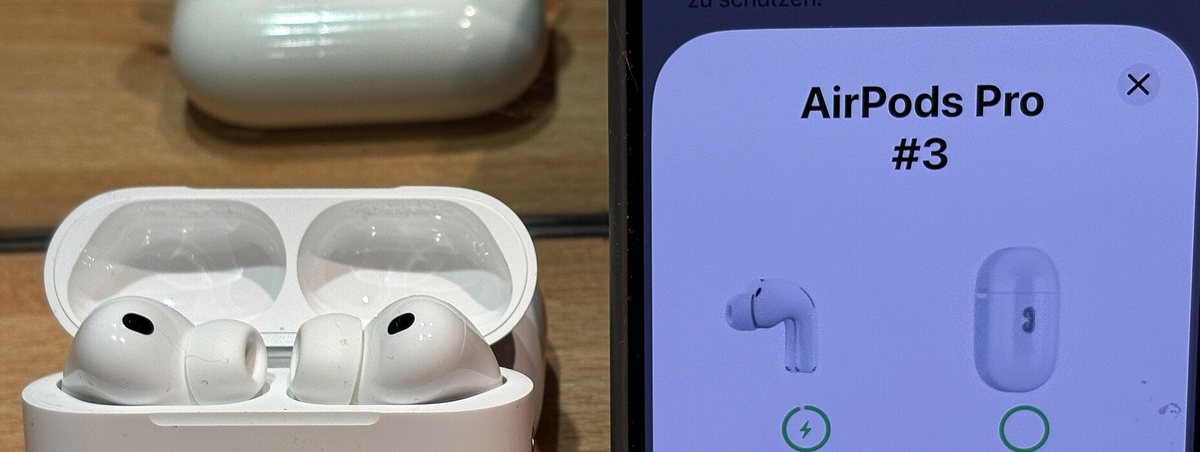
1. AirPods Pro 3 — Best for ANC, Health Tracking, and Doing Everything
$230–$270Sealed in-ear fitHeart-rate sensorANC + IP57
The AirPods Pro 3 are the pair to buy if you want to stop thinking about earbuds. The sealed fit, plus Apple’s H2 chip, gives you the strongest noise cancellation Apple has ever shipped in an earbud. It can turn a droning flight into a quiet one, and an open-plan office into a library. Battery runs up to 8 hours of listening with ANC on — the best single-charge number in this whole comparison — plus 24 hours total with the case.
Then come the extras the AirPods 4 simply don’t have. A heart-rate sensor reads your pulse during workouts and feeds the Fitness app, so for a lot of people the Pro 3 quietly replaces a fitness band on easy runs. The IP57 rating means dust, sweat, and even a dunk won’t kill them, which matters more at the gym than any spec sheet. Foam-lined silicone tips grip better when you move. Live Translation can even turn the buds into a rough interpreter when you travel. If your honest answer to “what will I use these for” is “everything,” this is the pair.
Pros
- Class-leading noise cancellation that actually silences low-frequency rumble.
- Built-in heart-rate sensor for workouts, unique to this pair.
- IP57 sweat and water resistance, plus the longest single charge at 8 hours.
- Deep, full bass thanks to the sealed tip.
Cons
- The most expensive option of the three.
- The in-ear seal causes pressure or an “underwater” feeling for some people.
- You have to get the tip size right, or the whole experience falls apart.
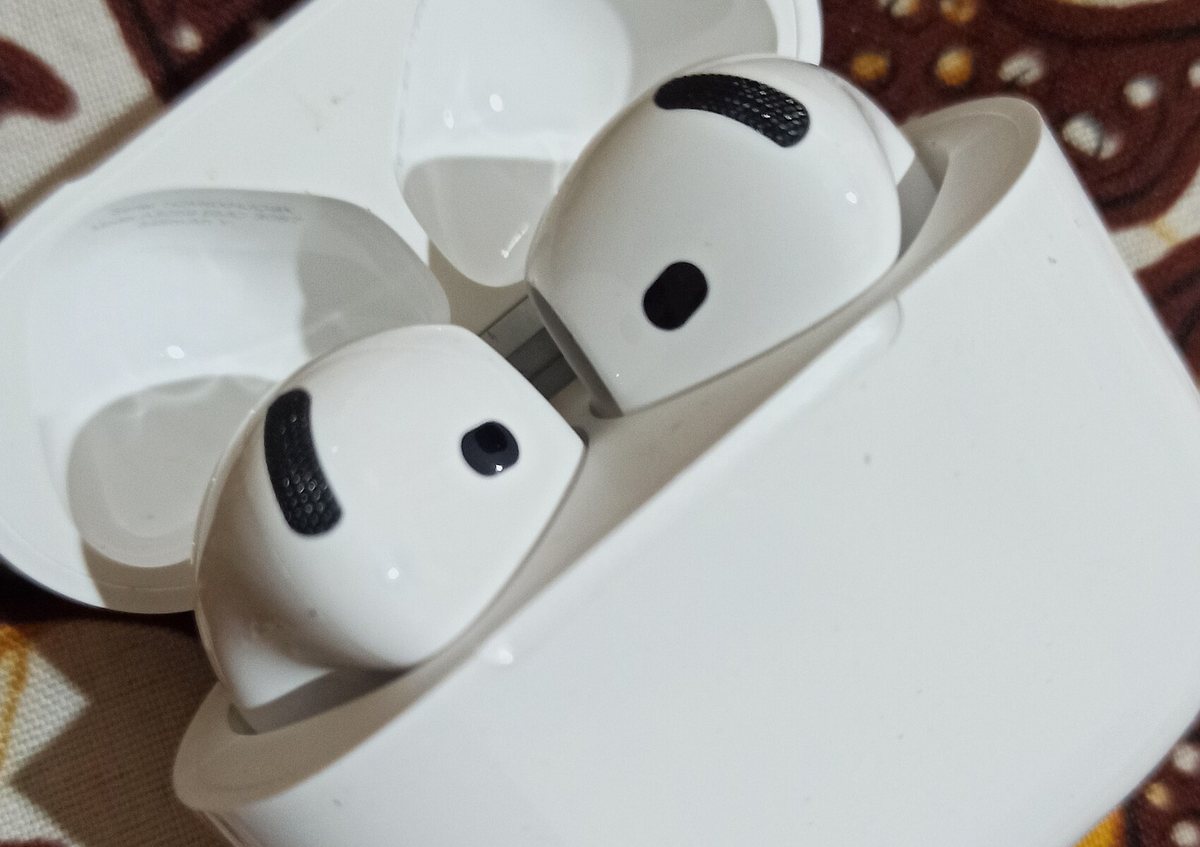
2. AirPods 4 — Best for Open-Fit Comfort and a Lower Price
$115–$140, or $165–$190 with ANCOpen fit, no tipsH2 chipIP54
The AirPods 4 are the pair for people whose ears reject silicone tips, full stop. Same H2 chip as the Pro 3, same clean Apple pairing, same Spatial Audio — but in the light, open shape that never plugs your ear. If you’ve happily worn the classic AirPods for years and just want the newer, better-sounding version, this is it. The base model even costs less than a good dinner out.
Apple sells it in two flavors, and the split matters. The base AirPods 4 has no noise cancellation and a plain USB-C case. The AirPods 4 with Active Noise Cancellation costs more and adds real, if limited, ANC in an open earbud — a genuine first — plus a case that charges wirelessly and packs a Find My speaker. Battery runs up to 5 hours per charge on the base model, and about 4 hours with ANC running on the pricier one. The base version stretches to a huge 30 hours total with the case. What you never get, at either price, is a seal. So bass stays polite, and the ANC has hard physical limits we’ll get into below.
Pros
- The open fit is genuinely comfortable for people who hate ear tips.
- Starts at a lower base price, or costs more for the version with noise cancellation.
- Lets you stay aware of traffic, announcements, and people around you.
- Base model has the most total battery here, at 30 hours.
Cons
- No seal means weaker bass and much weaker ANC than the Pro 3.
- No heart-rate sensor, and only IP54 water resistance.
- The ANC version costs noticeably more, closing much of the gap to the Pro 3.
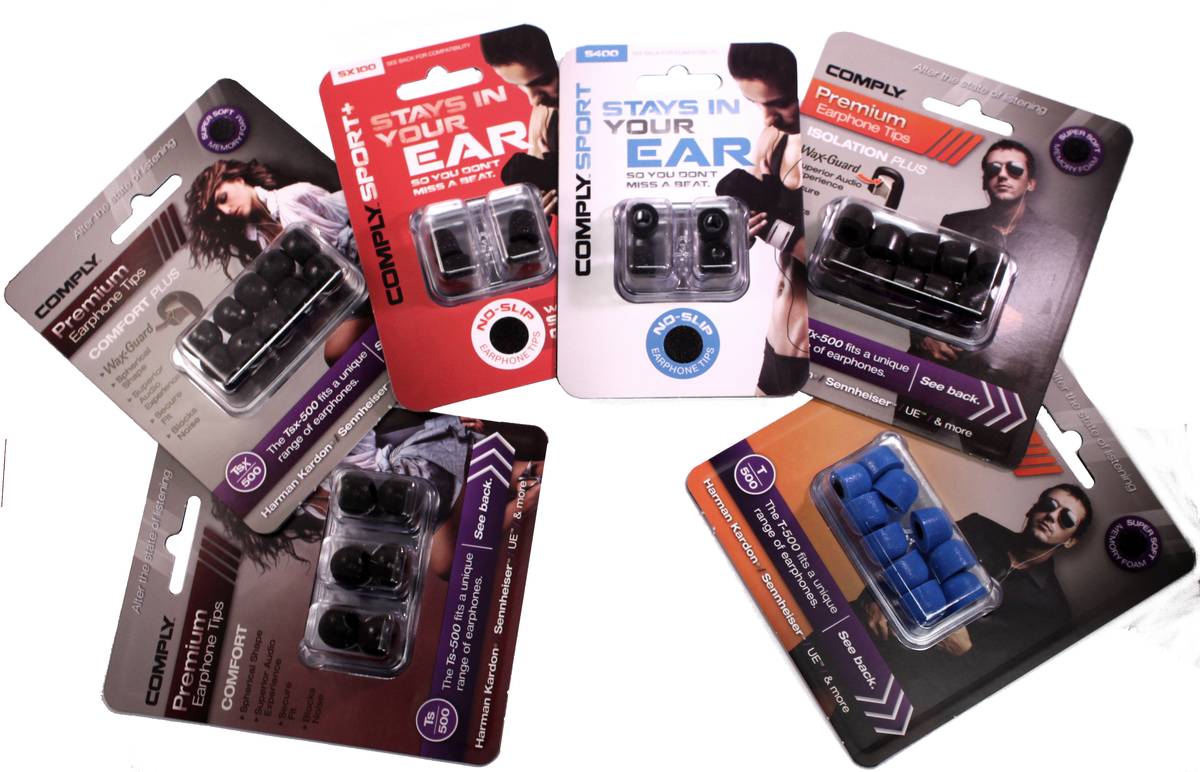
3. Foam and Silicone Ear Tips — Fix the Seal Before You Blame the Buds
~$15–30Fixes a weak sealRestores bass and ANCFor Pro 3 / Pro 2
This is the cheap fix that saves people from an expensive mistake. If you buy the Pro 3 and the bass sounds thin, or the ANC feels weak, nine times out of ten the tip just isn’t sealing. The earbuds aren’t bad — your ear canals just aren’t the “medium” size that ships pre-installed. Before you return anything, or talk yourself into the AirPods 4, swap the tips.
A set of memory-foam tips (Comply makes the best-known ones), or a fresh pack of the right-size silicone tips, costs a fraction of the earbuds and often transforms them. Foam expands to fill your exact canal. That improves the seal, deepens the bass, and boosts passive noise blocking before the electronics even switch on. It’s the single highest-value accessory in this whole category, and most buyers never think to try it.
Pros
- Cheapest possible fix for thin bass or weak noise cancellation.
- Foam tips mold to your exact ear for a better, more comfortable seal.
- Can make a “not sealing” pair feel like a brand-new product.
Cons
- Only helps the sealed Pro 3, not the open-fit AirPods 4.
- Foam tips wear out and need replacing every few months.
- Won’t help if you simply dislike any in-ear fit.
How the Noise Cancellation Really Compares
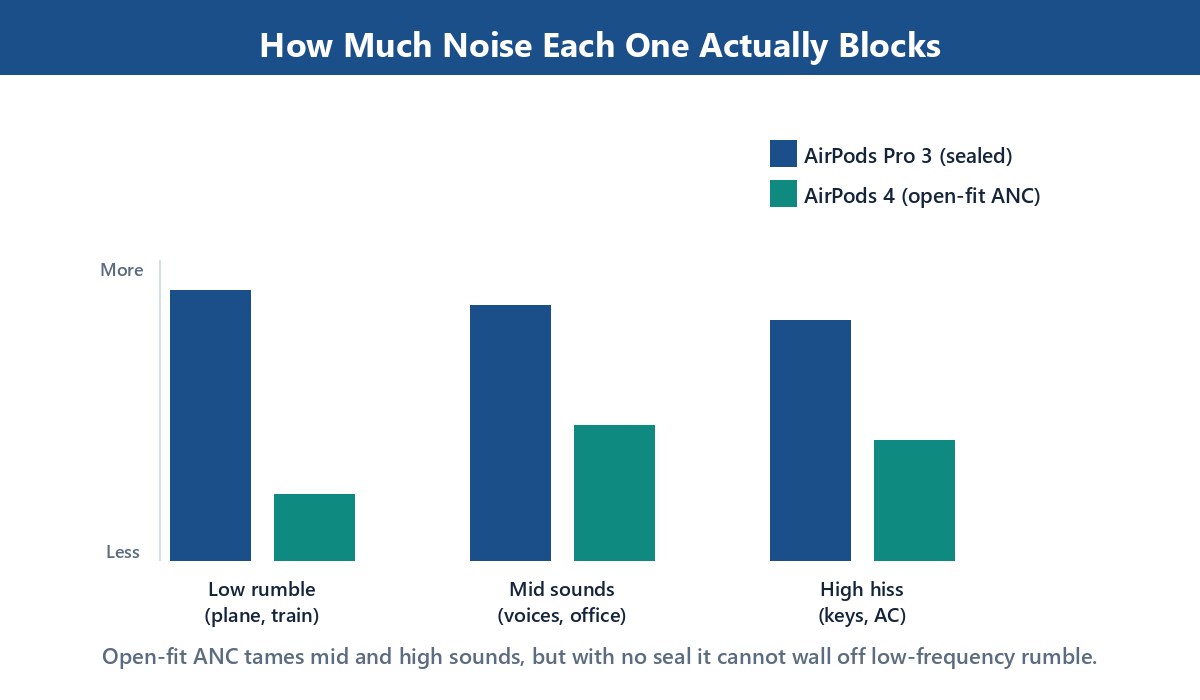
This is the part marketing likes to blur, so let’s be blunt. Yes, the pricier ANC AirPods 4 now has active noise cancellation. And yes, it really works. But “it works” and “it works as well as the Pro 3” are two very different claims. The gap comes straight back to the seal.
Noise cancellation has two jobs. The first is passive: block sound with the earbud itself. The second is active: use microphones to hear incoming noise, then fire back an opposite sound wave to cancel it out. The sealed Pro 3 does both. Its tip walls off a big chunk of noise before the electronics even fire, and the ANC mops up the rest. The open-fit AirPods 4 skips the first job entirely. There’s no seal, so its ANC has to fight the whole noise war alone, with room noise pouring in around the earbud.
That’s why the two land so far apart on the low end. Deep, droning sounds — a jet engine, a train, a bus, an air conditioner — are exactly what a good seal plus ANC kills. They’re also exactly what open-fit ANC struggles with most. The AirPods 4 can take the edge off office chatter and high hiss. It cannot wall off the low rumble of a commute the way the Pro 3 can.
The catch: If your main reason for buying is “I want quiet on planes, trains, and buses,” the open-fit AirPods 4 will let you down no matter how good the reviews sound. No firmware update will fix that — it’s physics, not software. That single use case is the clearest reason to pay up for the Pro 3.
Sound Quality, Bass, and Where the Seal Wins
For sound quality, the honest ranking depends on what you listen to. For podcasts, audiobooks, and most pop and vocal music at a desk, the two are far closer than the price suggests. Both run Apple’s H2 chip. Both do Spatial Audio. And the AirPods 4 sounds genuinely excellent for an open earbud. If your day is mostly talk and mid-range music, you aren’t missing much for the money.
Bass is where they split, and it’s not subtle. A sealed ear canal acts like a pressurized chamber, and low frequencies need that pressure to feel like anything. Plug your ear with the Pro 3, and bass lands with real weight and body. Leave it open with the AirPods 4, and the low end escapes into the room before it can build. You still hear the bass notes; you just don’t feel them. On a hip-hop or electronic track, that gap is obvious in the first five seconds.
There’s a quieter factor too: the world around you. In a quiet room, the AirPods 4 sounds airy and pleasant. On a noisy street or a rumbling train, its lack of a seal means outside noise competes with your music. So you crank the volume, and the whole experience falls apart. The Pro 3 seals the noise out, so it sounds the same in a library or on a subway platform. That kind of consistency is a real, underrated part of sound quality — one no spec sheet ever captures.
Which Pair Is Better for Running and the Gym
This is one place where the answer flips depending on where you train, so don’t trust a one-word verdict. Fitness is the one category where the “cheaper” AirPods 4 is sometimes the smarter buy — and sometimes exactly the wrong one.
Running Outdoors on Roads and Trails
For running on open roads, the AirPods 4 has a real safety edge: the open fit lets you hear cars, cyclists, and the person about to pass you on your left. Runners who’ve been startled by a silent e-bike know why hearing your surroundings isn’t a small thing. If most of your miles are outdoors near traffic, the open fit is a feature, not a compromise. It’s why plenty of experienced runners choose open earbuds on purpose.
Training in the Gym and on the Treadmill
Indoors, the logic flips. A gym is loud — clanging plates, other people’s music, the treadmill’s hum — and the Pro 3’s seal shuts all of that out, so your music actually motivates you. You’ll also run the Pro 3 at a lower, healthier volume, since you’re not fighting the room. For treadmill sprints and indoor cardio, the sealed fit wins comfortably.
Tracking Heart Rate and Surviving Sweat
Here the Pro 3 has features the AirPods 4 flatly lacks. Its built-in heart-rate sensor turns the earbuds into a workout tracker, feeding the Fitness app with no watch or strap needed. The IP57 rating shrugs off heavy sweat and rain, where the AirPods 4’s IP54 is more “sweat-resistant” than “sweat-proof.” A tip that locks into a sealed ear also stays put through burpees far better than an open nub does. If your workouts run sweaty, intense, or data-driven, the Pro 3 is built for it, and the AirPods 4 isn’t.
Comfort and the In-Ear Feeling People Either Love or Hate
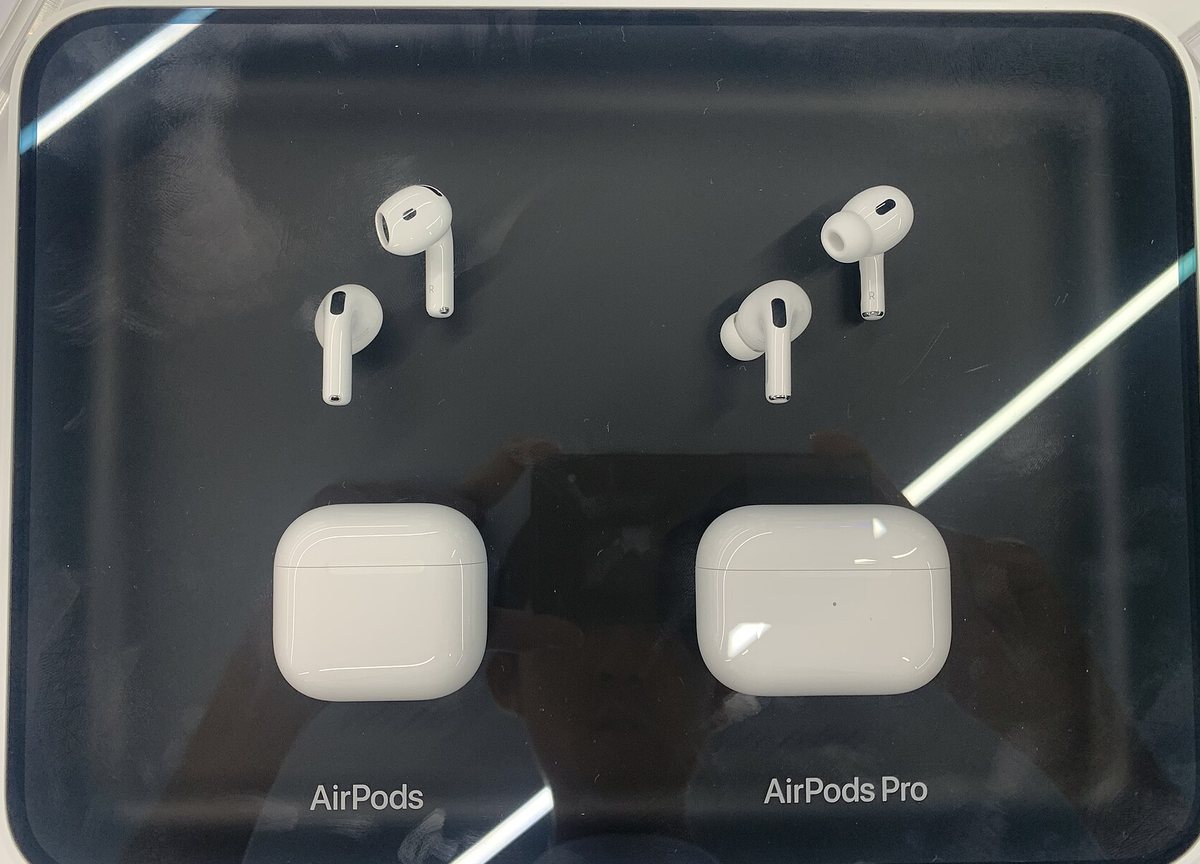
Comfort is the most personal part of this whole decision, and it’s the one thing you can’t judge from any review — including this one. Some people wear sealed in-ear tips for eight hours and forget they’re there. Others feel the pressure within minutes, notice the plugged-up sensation every time they talk, and start counting the seconds until they can take them out. There’s no single “right” answer here — only your own ears.
The AirPods 4’s open fit sidesteps the whole problem. Nothing pushes into your canal, so there’s no pressure and no occlusion — that odd feeling of hearing your own footsteps and chewing amplified inside your head. For anyone who’s bounced off every pair of in-ear buds they’ve tried, this is the entire reason to consider the AirPods 4. And it’s a completely valid one.
The Pro 3 counters with better tips than any earlier AirPods Pro: foam-lined, in five sizes. For most people, the right size disappears comfortably after a short adjustment. But “most” isn’t “all.” If you already know you hate the sealed feeling, no amount of tip-swapping will change your mind — trust that self-knowledge over any spec sheet.
Tip: If you can, try a sealed in-ear pair for a full day before you commit to the Pro 3 — a borrowed pair or a store demo works. A five-minute try-on won’t reveal the fatigue that shows up after a few hours. Your own comfort verdict, not the feature list, is what’s most likely to make you regret a purchase.
What Reddit and Real Owners Actually Say
Dig through owner threads, and the noise settles into a few consistent themes. They line up almost perfectly with the fit fork. It’s worth knowing what people say after the honeymoon, since day-one reviews rarely mention the things that decide whether you keep wearing something.
Pro 3 owners rave about the noise cancellation on flights and commutes. The heart-rate sensor surprises people, too — it tracks close to a dedicated watch on steady runs. The recurring complaint is fatigue: the seal that makes them so good is also what tires some ears out by the end of a long day. Nobody says the Pro 3 sounds bad. The gripe is always about the in-ear feeling, never the performance.
AirPods 4 owners are the mirror image. The praise is almost all about comfort — “finally, AirPods that don’t plug my ears” is practically a copy-paste line — plus the relief of an all-day fit. Honest owners stay clear-eyed about the ANC, too: real, but limited. Useful in an office, outmatched on a train. Almost nobody who bought the AirPods 4 for comfort regrets it. The regret stories come from people who expected Pro-level quiet and didn’t read the fine print.
Battery, the Case, and the Small Stuff That Adds Up
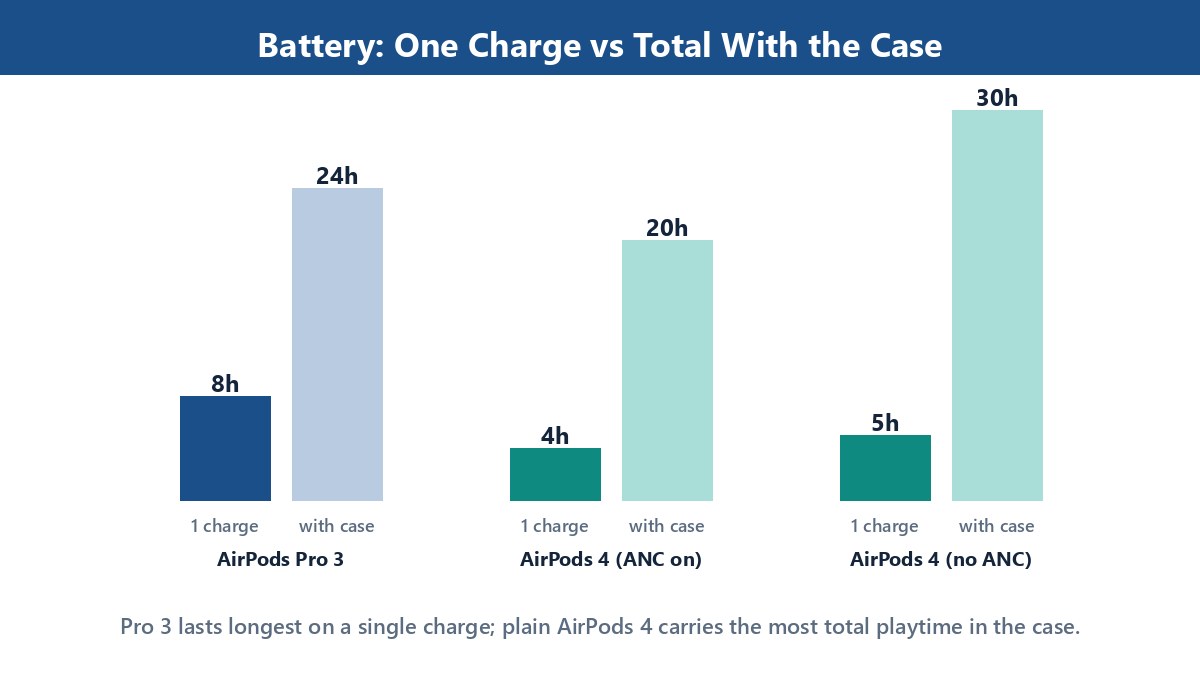
Battery is closer than the price gap suggests, and it doesn’t crown one clear winner. It depends on whether you care about one long session, or a whole day of dipping in and out. The Pro 3 leads on a single charge, at up to 8 hours with ANC on — that’s genuinely a lot, basically a coast-to-coast flight on one charge. The base AirPods 4 manages up to 5 hours per charge, and the ANC version about 4 hours with cancellation running.
Flip to total playtime with the case, though, and the plain AirPods 4 pulls ahead: up to 30 hours, versus 24 for the Pro 3 and 20 for the ANC AirPods 4. So the “best battery” answer really splits in two: Pro 3 for the longest single listen, base AirPods 4 for the most stamina across a busy day.
The cases carry a few small details worth knowing. Every case here charges over USB-C. But only the Pro 3 and the pricier ANC AirPods 4 also charge wirelessly and pack a Find My speaker, which helps when a case slides under the couch. The base AirPods 4 case is USB-C only and stays silent. It’s a small thing, but “I can never find my case” is a real daily annoyance — and it’s part of what your extra dollars buy.
The Honest Bottom Line
Strip away the spec sheets, and this comparison answers itself once you’re honest about two things: how your ears feel about a seal, and where you’ll actually use these. Want maximum quiet, workout tracking, real bass, and a pair that handles anything? The Pro 3 is worth the extra money, and you won’t think about earbuds again. Love the open, unplugged feeling, run near traffic, or just don’t want to spend Pro money? The AirPods 4 is a genuinely great pick, not a consolation prize.
The only real mistake is buying against your own ears — grabbing the AirPods 4 to save money when you were always going to crave the ANC, or spending Pro-level money on a seal you’ll never tolerate. Pick the fit first. The price, the features, and the regret-free purchase all follow from there. And if you’re deep in this decision, it’s often part of a bigger one about your whole setup — our iPhone vs Android breakdown and our picks for the best phone under $500 are the natural next reads.
Image credits: AirPods Pro 3 photos by Burkhard Mücke, CC BY-SA 4.0; AirPods 4 open-fit comparison photo by KKPCW, CC BY-SA 4.0; AirPods 4 photo by AppleFans 1, CC0; Comply Foam Tips photo by Zhuxizoxuan, CC BY-SA 4.0. Comparison chart by TechDaily.
Frequently Asked Questions
Is the AirPods Pro 3 noise cancellation actually better than the AirPods 4?
Yes, and it’s not close on low-frequency noise. The Pro 3 seals your ear canal, so it physically blocks sound before its ANC electronics even start. That’s why it can quiet a plane, a train, or a bus. The AirPods 4 has real ANC now, but with no seal it can only trim office chatter and hiss, not deep rumble. If quiet on a commute is your goal, the Pro 3 is the clear pick.
Which sounds better, the AirPods Pro 3 or the AirPods 4?
For podcasts, vocals, and desk listening, they’re surprisingly close — same H2 chip, same Spatial Audio. The gap opens up on bass and in noisy places. The Pro 3’s sealed fit gives you deep, physical bass, and it sounds the same in a library or a subway. The open-fit AirPods 4 has a lighter low end and lets outside noise compete with your music, so it’s at its best in quiet rooms.
Are the AirPods Pro 3 or AirPods 4 better for running?
It depends on where you run. For road running, the AirPods 4’s open fit is safer, since you can hear traffic and bikes. For treadmill and gym work, the Pro 3’s seal blocks the noise, and its heart-rate sensor and IP57 sweat resistance make it the better training tool. Outdoors near cars, lean AirPods 4. Indoors, or for serious workouts, lean Pro 3.
Which is more comfortable, the AirPods Pro 3 or the AirPods 4?
That’s the most personal question here. The AirPods 4’s open fit puts nothing in your ear canal, so there’s no pressure and no plugged-up feeling — ideal if you’ve disliked every in-ear bud you’ve tried. The Pro 3 seals your ear, which some people forget about within minutes and others find tiring over a long day. If you already know you hate sealed tips, trust that and pick the AirPods 4.
What does Reddit say about AirPods Pro 3 vs AirPods 4?
Owner discussions split along fit, not brand loyalty. Pro 3 owners praise the flight-silencing ANC and the accurate heart-rate tracking, with the main complaint being ear fatigue from the seal on long days. AirPods 4 owners love the comfortable, non-plugged fit and call the ANC real but limited. The regret stories mostly come from people who bought the AirPods 4 expecting Pro-level quiet — a fit mismatch, not a bad product.
Is the AirPods Pro 3 worth the extra money over the AirPods 4?
If you’ll actually use the noise cancellation, the heart-rate sensor, the deeper bass, or the IP57 sweat resistance, yes — the AirPods 4 physically can’t do those things at any price. If you mainly want comfortable earbuds for calls, podcasts, and quiet listening, the AirPods 4 saves you real money, and you won’t miss what you’re not using. One note: the pricier ANC AirPods 4 narrows the gap, so compare against that version, not the base one.
Does the AirPods Pro 3 work as a hearing aid, and can you control volume from the earbud itself?
Yes to both, and the AirPods 4 does neither. The Pro 3’s Hearing Aid feature is FDA-authorized, clinical-grade software for adults with perceived mild-to-moderate hearing loss, running on iPhones with iOS 18 or later — it’s a real over-the-counter hearing aid, not a gimmicky “hear better” mode, and it leans on the same sealed fit that does everything else in this guide. The Pro 3 also lets you swipe up or down on the stem to change volume on the spot, no phone or Siri needed. The AirPods 4 skips both: there’s no hearing aid mode at any price, and for volume you’re stuck saying “Hey Siri” or reaching for the Lock Screen slider. If either one matters to you, it makes the decision for you before anything else in this guide does.