

SpaceX just overtook Amazon to become the fifth most valuable public company in the United States — on $18.7 billion in revenue and a $5 billion annual loss. Here is how the market got there in four trading days.
David and Sophia walk through the aftermath of the largest IPO in history: priced at $135 per share, up almost 20% on day one, and touching a $2.8 trillion valuation. They break down the bull case — Starlink, the reusable-rocket launch monopoly, defense contracts — and the catalyst that changed the math: the xAI merger and the $60 billion Anysphere/Cursor move that turned a rocket company into a space-based AI infrastructure play.
Then the mechanics nobody talks about: a tiny locked-up float squeezed by record retail demand, options chains about to open, and index inclusion that will force every S&P 500 and Nasdaq 100 tracker to buy regardless of price. And underneath the whole rally sits one physical chokepoint — TSMC, its 3-nanometer yields, a $150 billion fab expansion, and the island of Taiwan.
Chapters
00:00 Amazon $742B revenue vs SpaceX $18.7B — and a $5B loss
00:59 IPO mechanics: $135 per share to $2.8 trillion
02:13 Why Wall Street reads a $5B loss as a feature
03:03 The three pillars: Starlink, reusable rockets, defense
04:25 The xAI merger and the $60B Anysphere/Cursor engine
06:24 Float squeeze, options, and forced index buying
08:31 The rotation effect and the Fed under Kevin Walsh
10:41 TSMC: the bottleneck under every trillion-dollar dream
15:49 $150 billion in fabs and $200 million EUV machines
18:16 The Taiwan concentration risk
20:14 What if physics refuses to cooperate?
Key points
– SpaceX became the 5th most valuable US public company within four trading days of its Nasdaq debut
– Valuation touched $2.8 trillion despite a 40x revenue gap with Amazon and a $5 billion annual loss
– Index inclusion will mathematically force passive funds to buy SpaceX shares regardless of price
– Goldman Sachs raised TSMC’s price target 35% and projects 30% revenue growth for 2026
– TSMC’s most advanced 3-nanometer manufacturing stays physically concentrated in Taiwan
More from TechDaily: https://techdaily.ai
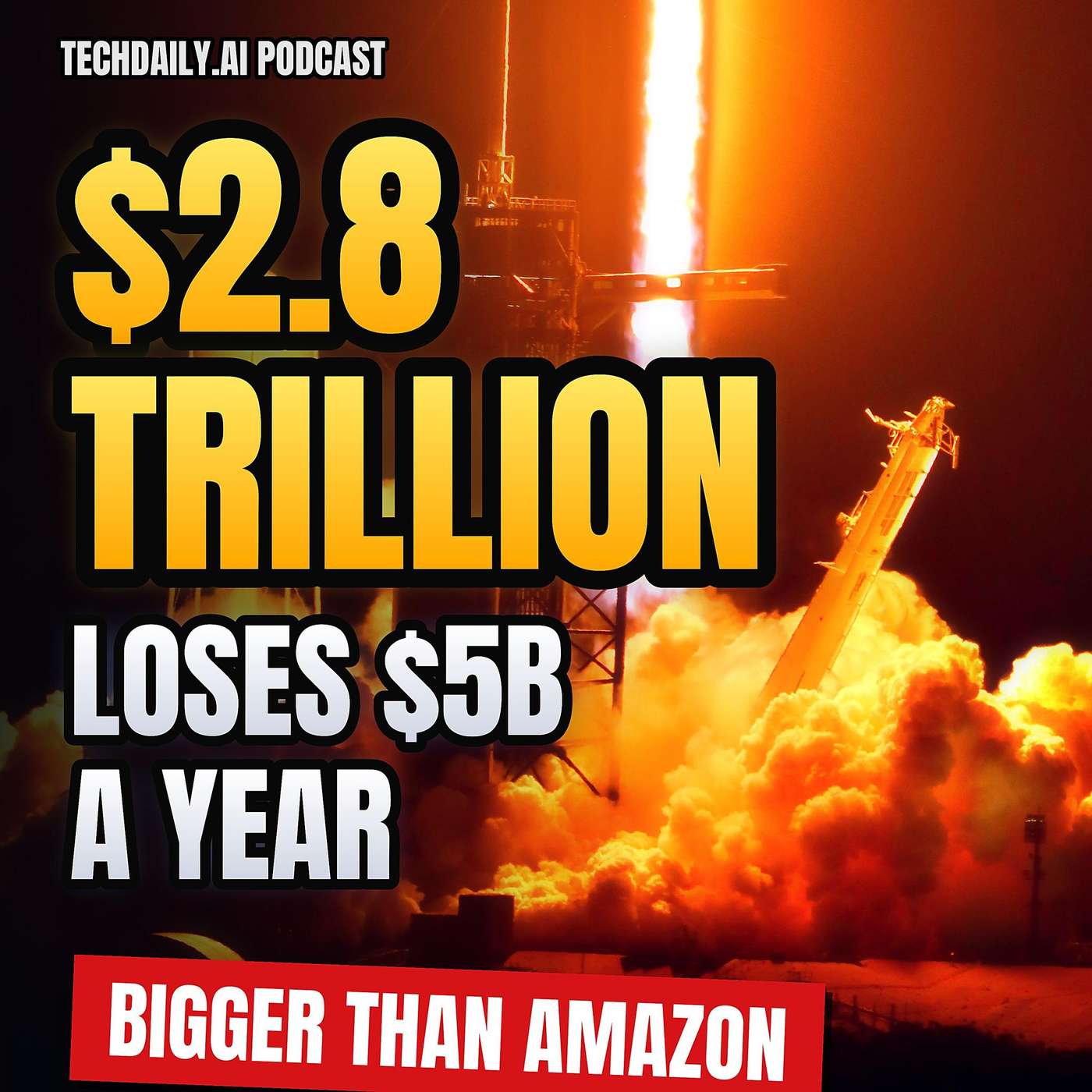
Thumbnail photo: SpaceX Crew-1 liftoff, NASA HQ Photo / Joel Kowsky, CC BY 2.0, via Wikimedia Commons.
#SpaceX #IPO #TechNews