Season opens in weeks, and you want eyes on that trail before the rut. Fine. But the best trail camera for you is not decided by megapixels. It is decided by one thing: whether you are buying a camera or renting one. A card-pull camera is a single purchase. A cellular camera is a phone plan with a lens bolted on, and over three seasons that plan usually costs more than the camera did. My pick for most hunters is the GardePro E5S, because nothing bills you after the first week. If your ground is far enough away that walking in would spoil the spot, the Moultrie Edge 3 earns its monthly fee. Here is how to tell which one you are.
Disclosure: TechDaily is an Amazon affiliate and earns a commission on purchases made through links on this page. It costs you nothing extra, and it does not change which cameras made the list.
- Pick the plan first, then the camera. Hardware is a one-time hit. The plan bills you every month you forget to cancel it.
- The GardePro E5S is the pick if you can walk to your camera. No SIM, no plan, a fast trigger, and no-glow night shots.
- Go cellular only when the walk itself costs you something. Far ground, bumped deer, or a lease you visit twice a year.
- Free tiers are a taste, not a plan. A hundred photos a month sounds fine until a doe stands in front of a feeder for an hour.
- Turn the plan off in February. Running an unlimited plan all year is the single most expensive thing on this page.
- On-camera AI stopped being a luxury this year. The Moultrie sorts photos on the camera before they cost you data; the SPYPOINT tags them for free once they arrive.
How far is your camera from where you park?
★ Your pick: GardePro E5S
You are already standing there, so pulling a card costs you a minute and nothing else.
★ Your pick: Moultrie Edge 3
Built-in memory, all four carriers, and AI that flags the buck so you stop scrolling.
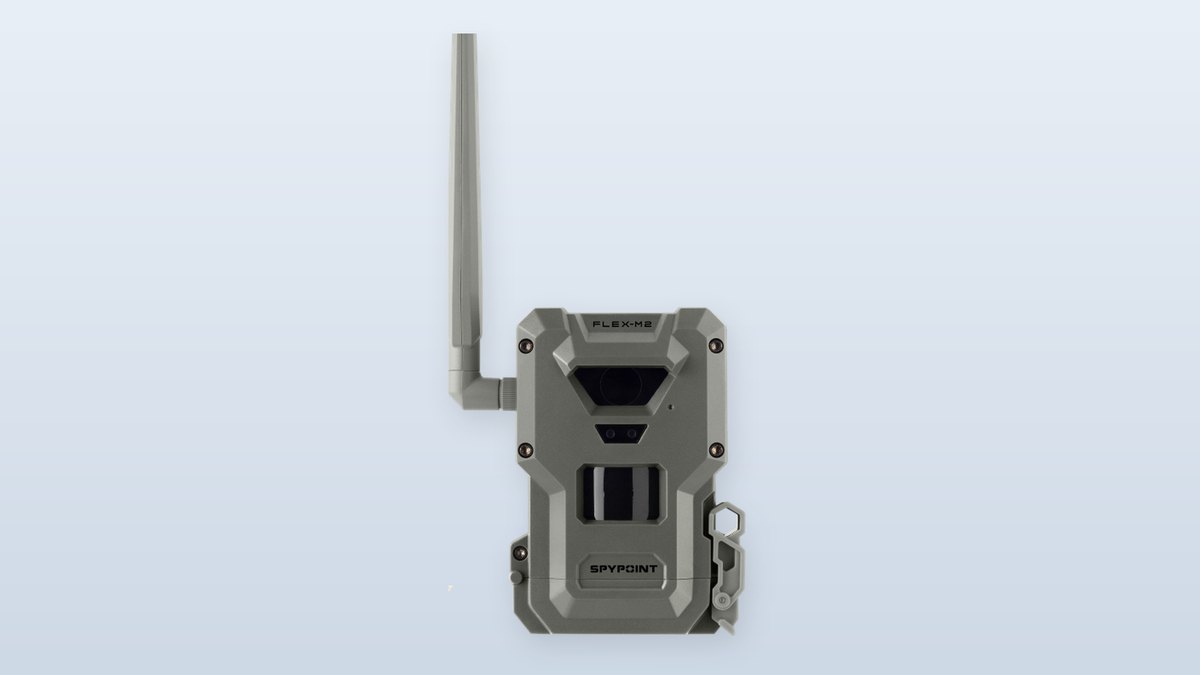
★ Your pick: SPYPOINT FLEX-M2
A hundred photos a month arrive free, so you can try the idea before you pay for it.
★ Your pick: GardePro E5S
Plans are billed per camera, so a small herd of cellular cams adds up fast.
👑 Our Top Pick — Best Overall Value
GardePro E5S
Cheapest camera to actually own, because nothing bills you after the first week.
Opens on our Top Pick. Tap an option to see the best match for you.
Why a Cellular Trail Camera Is Really a Season Subscription
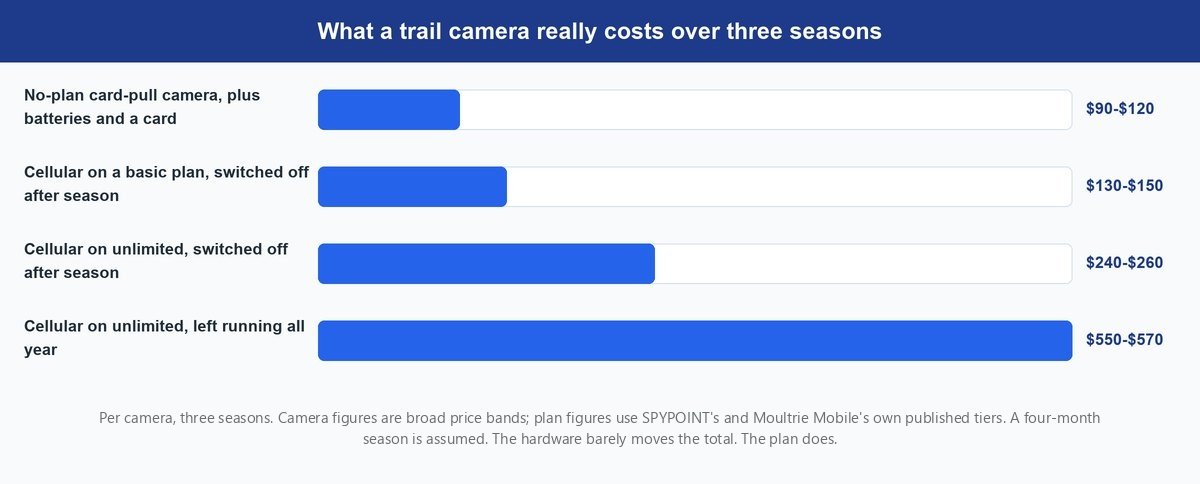
Trail cameras look like a hardware buy. Most of them are not. The moment a camera has an antenna, you are signing up for a bill, and the bill outlives the camera.
Run the numbers on one camera over three seasons. A card-pull camera runs somewhere in the fifty to seventy dollar range, plus batteries and a card. That is the whole cost. A cellular camera starts near the same place, then adds a plan. Moultrie Mobile’s published plan tiers run from a capped tier under ten dollars a month to an unlimited tier in the low teens if you pay for the year, or the high teens month to month. SPYPOINT’s transmission plans cost about the same, and less per month if you pay for the year. None of that is outrageous on its own. It is the multiplying that gets people.
Multiply it by months. Then multiply it by cameras. Four cellular cameras on unlimited plans, left running all year, will cost you more in fees than four cameras cost to buy, every single year. That is the part nobody feels at checkout.
Before you buy: the biggest saving on this page is a calendar reminder. Most brands let you pause a monthly plan in the off-season and restart it in August. Annual billing costs less per month but it does not pause, so it only wins if the camera genuinely runs twelve months.
So here is the rule I use, and it has nothing to do with specs. Ask what a card pull actually costs you. If your camera hangs off a two-track you drive past every week, a card pull costs you a minute. Pay the minute. But if checking that camera means a forty-minute walk through the bedding cover you plan to hunt, the pull is not free at all. You just paid for it in bumped deer. That is the only situation where a monthly fee is genuinely cheaper than your boots.
Distance is the honest test. Convenience is not. Wanting photos on your phone at lunch is a real desire, but it is a want, and it renews every month whether you hunt or not.
The Trail Cameras Worth Hanging This Season
Three cameras, three different answers to the plan question. Each one is the version I would actually hang, not the one with the longest spec sheet, and each is judged on the four things that decide whether you get a usable photo at all: trigger speed, detection range, what the flash does at night, and what it costs you after the first week.
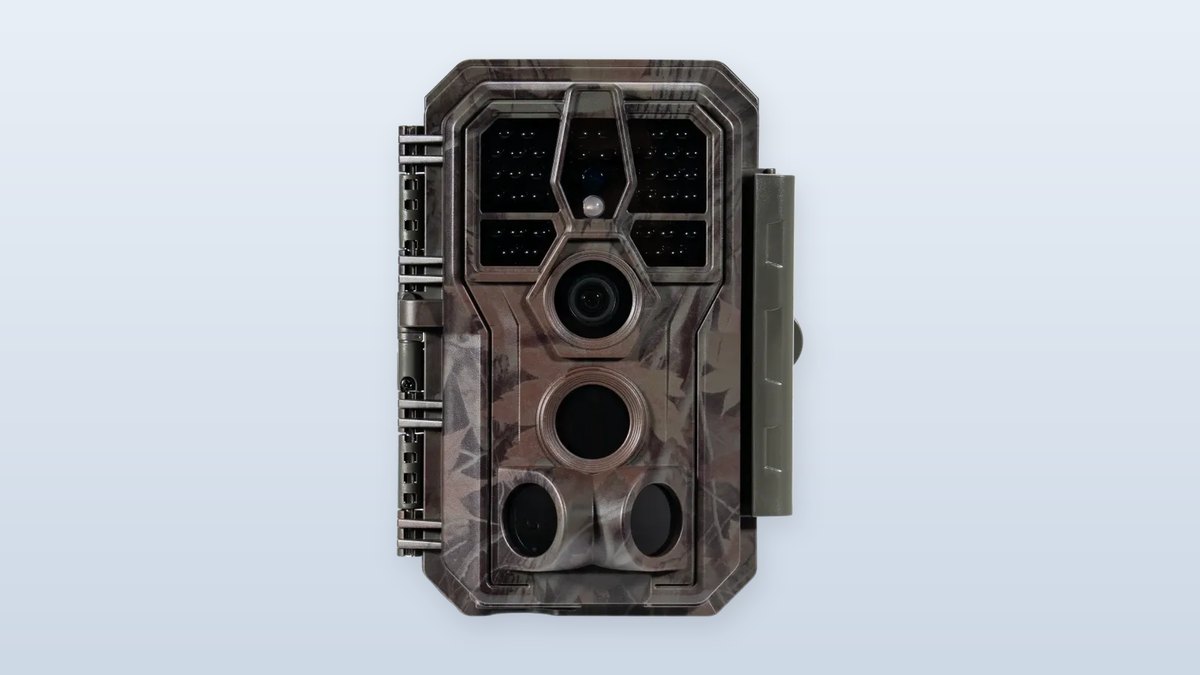
1. GardePro E5S — Best Overall for Anyone Who Can Reach the Camera
≈ $50–$70No subscription0.1s trigger
This is the camera I would hand to most hunters, and the reason is boring. It never asks you for money again. GardePro builds the E5S as a standalone camera with no WiFi or cellular, which sounds like a downgrade until you price three seasons of anything else. Every photo it takes sits on the card in your hand, and nobody bills you to look at it.
It is also the quickest camera on this page, and not by a little. The trigger is rated at a tenth of a second, against half a second on the Moultrie and four tenths on the SPYPOINT. GardePro puts three PIR sensors behind that number instead of one. In practice that is the difference between a whole deer and half a deer at the edge of the frame when something trots through instead of browsing. Detection reaches about ninety feet, which matches the SPYPOINT and gives up ten feet to the Moultrie.
Night is where it splits from the other two. The E5S uses no-glow infrared, so there is no faint red wink when a buck walks up. Both cellular picks use low-glow, which gives a brighter night picture but shows a dull red dot that some deer notice and a few avoid. Photos are 64MP and video is 1296p, the highest numbers of the three, though the trigger matters far more than either.
It runs on AA batteries and takes cards up to 512GB, far more storage than one season needs. GardePro’s own case for leaving the radio out is fewer battery swaps, and that holds up: a cellular camera spends power sending every photo, and this one never sends anything. If you hate changing batteries at all, the SP350 solar panel fits it, and the body is rated IP66 against rain and dust. The catch is the obvious one: you have to walk in to get the pictures. That is a real cost in time and scent, and it is exactly why the next two cameras exist.
Features
- 64MP stills and 1296p video
- 0.1-second trigger speed
- Roughly 90 feet of detection range
- No-glow infrared night vision
- Runs on AA batteries, with an optional solar panel
- Takes memory cards up to 512GB
Pros
- No plan, no SIM, no monthly bill of any kind.
- The fastest trigger of the three picks.
- No-glow flash keeps the camera quiet at night.
- Cheap enough to hang several without wincing.
Cons
- You have to walk in to see anything.
- Every trip in leaves scent where you hunt.
- No app, so nothing warns you when it stops working.
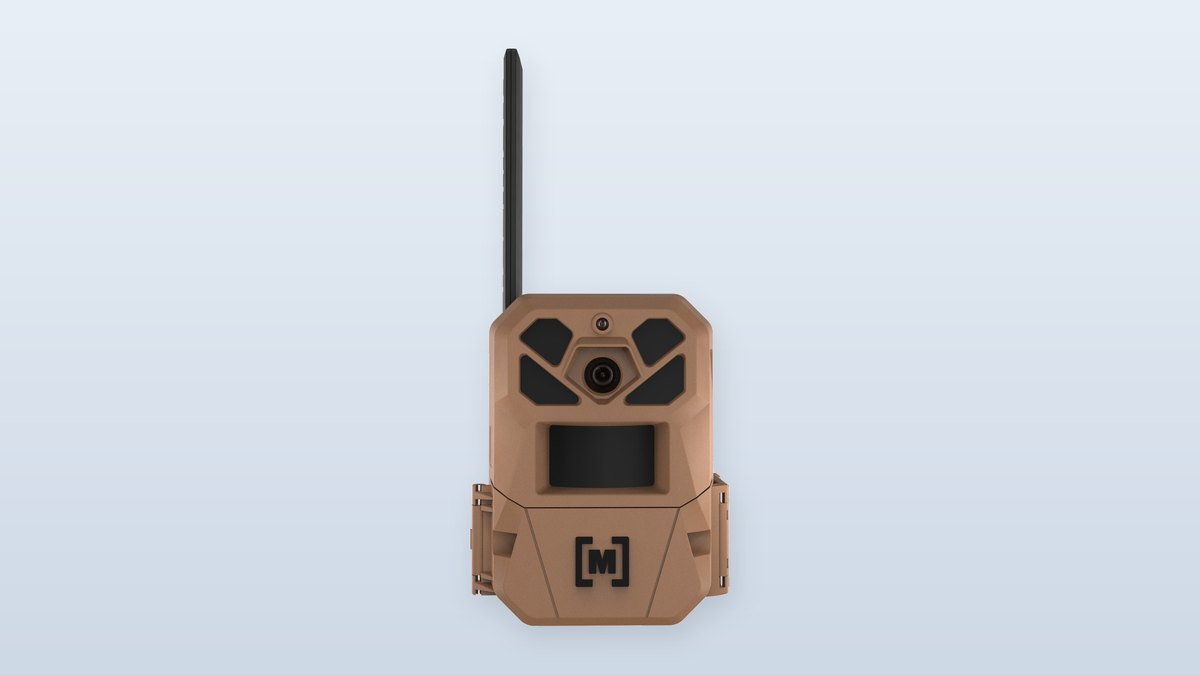
2. Moultrie Edge 3 — Best Cellular Camera for Ground You Cannot Visit
≈ $80–$100Plan requiredBuck-spotting AI
If the walk is the problem, this is the fix. The Edge 3 connects on all four major networks and locks onto the strongest one itself, which matters on ground where one carrier fades behind a ridge and another holds. The SPYPOINT switches carriers too; the GardePro has no radio at all, which is the whole point of it. Memory is built in, so there is no card to forget, corrupt, or drop in the leaves at dusk.
The feature I actually care about is the AI. Moultrie’s system flags when a buck is in front of the camera. That sounds like a gimmick until you have scrolled two hundred photos of one curious raccoon. Sorting happens before the photos reach you, so your attention and your data allowance both survive the week. Live Aim shows you the camera’s view on your phone while you strap it up, so hanging it is a one-person job, and you can request a fresh photo or video whenever you want to check the food plot right now. GPS puts the camera on your in-app map.
On paper it is the middle camera of the three. Photos are 40MP and video is 1080p, between the GardePro’s 64MP and the SPYPOINT’s 32MP, and none of that decides anything. Detection and flash both reach a hundred feet, the longest here, across a fifty-degree field of view, so it covers the edge of a food plot better than either of the others. The trigger is the trade-off: half a second, against four tenths on the SPYPOINT and a tenth on the GardePro. On a feeder or a food plot you will never notice. On a hard-running trail crossing, you sometimes will. Moultrie’s newer Edge 4 closes that gap with a 0.4-second trigger, brighter night lighting and an IP67 body; this card still picks the Edge 3 because it shares the AI, the built-in memory and the carrier switching for noticeably less money.
Power goes in over USB-C, and Moultrie’s POWER MAG+ II rechargeable pack pairs with its solar packs for continuous charging, which is how you stop making battery trips to the one place you bought this camera to avoid. Two honest warnings. Moultrie says connected devices need a paid plan to operate, so the free app alone will not run this camera. And the flash is low-glow, so unlike the GardePro there is a faint red glow at night that a wary buck can catch.
Features
- 40MP stills and 1080p video
- 0.5-second trigger, with 100 feet of detection and flash range
- Connects automatically across all four major carriers
- Built-in memory, so no SD card is needed
- On-camera AI that flags bucks
- USB-C power in, with solar packs available
Pros
- Best cellular coverage of the three, thanks to carrier switching.
- The AI filter genuinely cuts down the junk photos.
- No memory card to fail or fill up.
- Live aim makes hanging it a one-person job.
Cons
- It will not run at all without a paid plan.
- Half-second trigger is the slowest here.
- Low-glow flash throws a faint red glow at night.
3. SPYPOINT FLEX-M2 — Best Way to Try Cellular Without Committing
≈ $70–$90100 free photosFree AI filter
This one exists for the hunter who is curious about cellular but not ready to add another bill. SPYPOINT gives every FLEX-M2 a hundred free photos a month, per camera, with no plan attached. That is enough to learn whether you actually check the app or whether you were just excited at the store.
The camera itself is sensible rather than flashy. Photos are 32MP and video is 1080p with sound. The trigger is rated at four tenths of a second, and detection and flash both reach about ninety feet. Power is flexible in a way that matters in December: the rechargeable lithium pack is rated for around twelve months, and plain AA batteries will run it for roughly six. Its BUCK TRACKER AI tags bucks, does and turkeys in the app for free, so you find the photo that matters without scrolling. It works after the photos arrive, so it does not stretch the hundred-photo allowance.
There is an older FLEX-M with the same name minus the 2, and the M2 is the one to get. It moves video from 720p to 1080p and adds sound, and stills go from 28MP to 32MP. Against the other two picks, the M2 is the middle camera on paper: a 0.4-second trigger sits between the GardePro’s tenth of a second and the Moultrie’s half second, and ninety feet of reach matches the GardePro and gives up ten feet to the Moultrie. Where it stands alone is the plan. It is the only one of the three that sends photos with no plan at all; the Moultrie will not run without one, and the GardePro never sends anything. If the free tier runs dry every month, that is your answer: you use it enough to pay for a real plan, and you now know that for certain instead of guessing.
A camera pointed at a feeder can burn through a hundred-photo allowance in about two days. One doe that settles in for an hour will do it. If you are running the free allowance, aim at a trail or a scrape instead of bait, and use the camera’s delay setting so one doe cannot spend it all in an hour.
Features
- 32MP stills and 1080p video with sound
- 0.4-second trigger speed
- About 90 feet of detection and flash range
- 100 free photos a month, per camera
- Free BUCK TRACKER AI photo filtering
- Rechargeable lithium pack rated near 12 months, or AA batteries near 6
Pros
- The only pick here that sends photos with no plan at all.
- Free AI tagging finds the buck photos among the hundred without scrolling.
- Two power options, so you are not stuck with one.
- Cheapest honest way to test whether you want cellular.
Cons
- A hundred photos is not many on a busy site.
- Low-glow flash, so it is not fully invisible at night.
- Fewer megapixels than the other two, though it barely shows.
What Actually Changed in Trail Cameras Since Last Season
This category turns over every year, and three things moved recently enough that last season’s advice is now out of date.
On-Camera AI Went From Extra to Standard
A year ago, photo sorting was a paid add-on or an app trick. Now it is baked in. Moultrie’s AI flags bucks on the camera itself, and SPYPOINT includes BUCK TRACKER AI tagging at no charge. Only the Moultrie kind changes the plan math: when the camera decides what is worth sending, a smaller allowance goes much further. SPYPOINT’s free tagging happens after the photo arrives, so it saves you scrolling, not data.
Solar Stopped Being a Novelty
Solar used to mean a clumsy panel and a tangle of cable. Now it is either built into the camera, as on Moultrie’s new Edge 4 Solar, or sold as a matched pack, including a panel that fits the GardePro E5S. It matters most in cold weather, when alkaline batteries fade fastest and every battery swap is another walk into your own hunting ground.
Satellite Backup Is Coming, But It Is Not Here Yet
SPYPOINT has announced a FLEX-RANGE model with satellite backup, listed as coming in 2026 rather than shipping now. If it lands as described, it would help hunters on ground with no cell signal at all, which is the one problem cellular cameras have never solved. Treat it as something to watch, not a reason to wait. Buy for this season with what is on the shelf.
How to Hang a Trail Camera So It Catches Deer and Not Grass
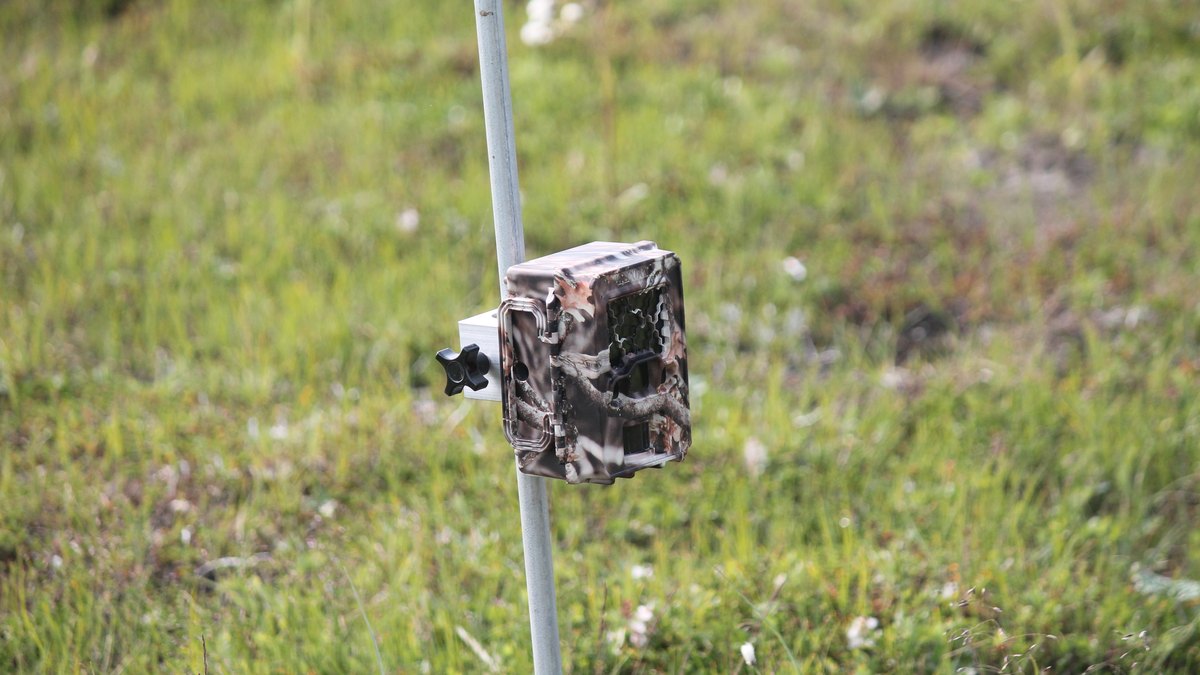
A good camera hung badly is worse than a cheap camera hung well. Most empty cards come from four mistakes, and all four are free to fix.
- Get the height right. Waist to chest high, about three to four feet off the ground, angled slightly down. Hip height fills your card with legs. Head height sails over the back of everything that walks by.
- Face north, or close to it. A camera pointed east or west triggers on sunrise and sunset every day and hands you a thousand photos of glare. A north-facing camera never has the sun crossing its frame.
- Clear the grass in front of the lens. Moving grass reads as a warm body to the sensor and fires all night in a breeze. Pull it. This is the most common reason a card comes back full and useless.
- Aim along the trail, not across it. A deer crossing sideways is often gone before the shutter fires. Aim down the trail at an angle and you get several frames of the same animal instead of one blurry rear end.
Worth knowing: low-glow flash gives off a faint red light that some deer notice and a few will avoid. No-glow is invisible but its night range is shorter and its photos are grainier. On a feeder, take low-glow for the better pictures. On a pinch point you plan to hunt, take no-glow and accept the grain.
One more thing that is not about deer at all. Buy a fast card with plenty of room and format it in the camera before the season, not in a laptop. It is the same card discipline that keeps a dash cam from failing on the day you need the footage.
Check Your State Rules Before You Buy a Cellular Camera
This is the step people skip, and it is the one that can make an expensive camera useless. Several states restrict or ban trail cameras that transmit images during parts of the hunting season, and a few restrict cameras on public land more broadly. The rules differ by state, they differ by public and private ground, and they get revised between seasons.
Six states are worth checking first, because their rules already bite. Arizona bans using a trail camera of any kind to locate or aid in taking wildlife, on public or private ground, any time of year. The camera itself is legal. Using its images to hunt is not. Utah bans every trail camera on public land from July 31 through December 31, but a private-land camera is fine as long as it stores to a card instead of transmitting. Nevada shuts off transmitting cameras starting July 1 and every other trail camera starting August 1, both running through December 31, except on private property you are using with the landowner’s permission, which is exempt outright. Montana only restricts the transmitting kind. It is unlawful to use a camera that relays real-time images or location to you while you are actively hunting, and a standard card-pull camera is not covered. New Mexico bans cellular, WiFi and satellite cameras for hunting or scouting big game statewide, public or private, with no rule against a standard one. Kansas bans every kind of camera, transmitting or not, but only on department-managed public land and Walk-In Hunting Areas. Private ground is not touched.
So check your own state wildlife agency’s current regulations before you spend, not after. It takes five minutes on their site. If your state restricts transmitting cameras during the season you actually hunt, the decision is already made for you: buy the card-pull camera and keep the money.
One warning: cellular cameras need signal where the camera hangs, not where you park. A ridge top and a creek bottom on the same property can be completely different. Stand at the tree, look at the bars on your phone, and decide there.
Frequently Asked Questions
Do I really need a cellular trail camera?
Only if walking to the camera costs you something real. Far ground, a lease you visit twice a year, or a spot where your scent would ruin the hunt. If you drive past the camera every week, a card pull is free and a plan is not.
How much does a trail camera plan cost each month?
The mainstream tiers land in the mid single digits to mid teens per month, per camera, with annual billing cheaper per month than paying monthly. Premium and pro tiers run higher. The number that stings is not the monthly figure. It is that figure times the number of cameras, times twelve months if you forget to pause it.
How long do trail camera batteries last?
It depends far more on how busy the site is than on the brand. A quiet trail can go a whole season on one set of AAs. A camera over bait, firing all night with the flash on, can drain them in weeks. Cold weather makes alkalines fade faster, which is why lithium packs and solar panels have taken over.
What is the best height to hang a trail camera?
About chest high, roughly three feet up, tilted slightly down toward the trail. Higher than that and you shoot over deer. Lower and you collect legs and grass. If you are worried about someone finding the camera, go higher and angle it down more sharply, but expect to lose some detail.
Do trail cameras work without a SIM card or WiFi?
Yes, and most of them still do. A standard camera writes to a memory card and you carry the card out. That is exactly how the GardePro E5S works. Cellular is an option you buy on purpose, not a requirement.
Are more megapixels actually better on a trail camera?
Barely. Trigger speed, detection range and flash quality decide whether you get a usable photo at all. Megapixels only decide how large the photo is once you already have it. A 64MP camera that fires late gives you a very detailed picture of an empty trail.
The Bottom Line Before You Buy
Buy the camera that matches your walk, not the one with the best spec sheet. If you can reach the tree without ruining the hunt, get the GardePro E5S, pocket the plan money, and hang a second camera with it. If your ground is far or fragile, the Moultrie Edge 3 is worth its monthly fee because it saves you trips, not just scrolling. If you are honestly unsure, start with the SPYPOINT FLEX-M2 and let its free allowance answer the question for you.
Then set one reminder for February to pause the plan. That single note will save you more than any camera choice on this page.