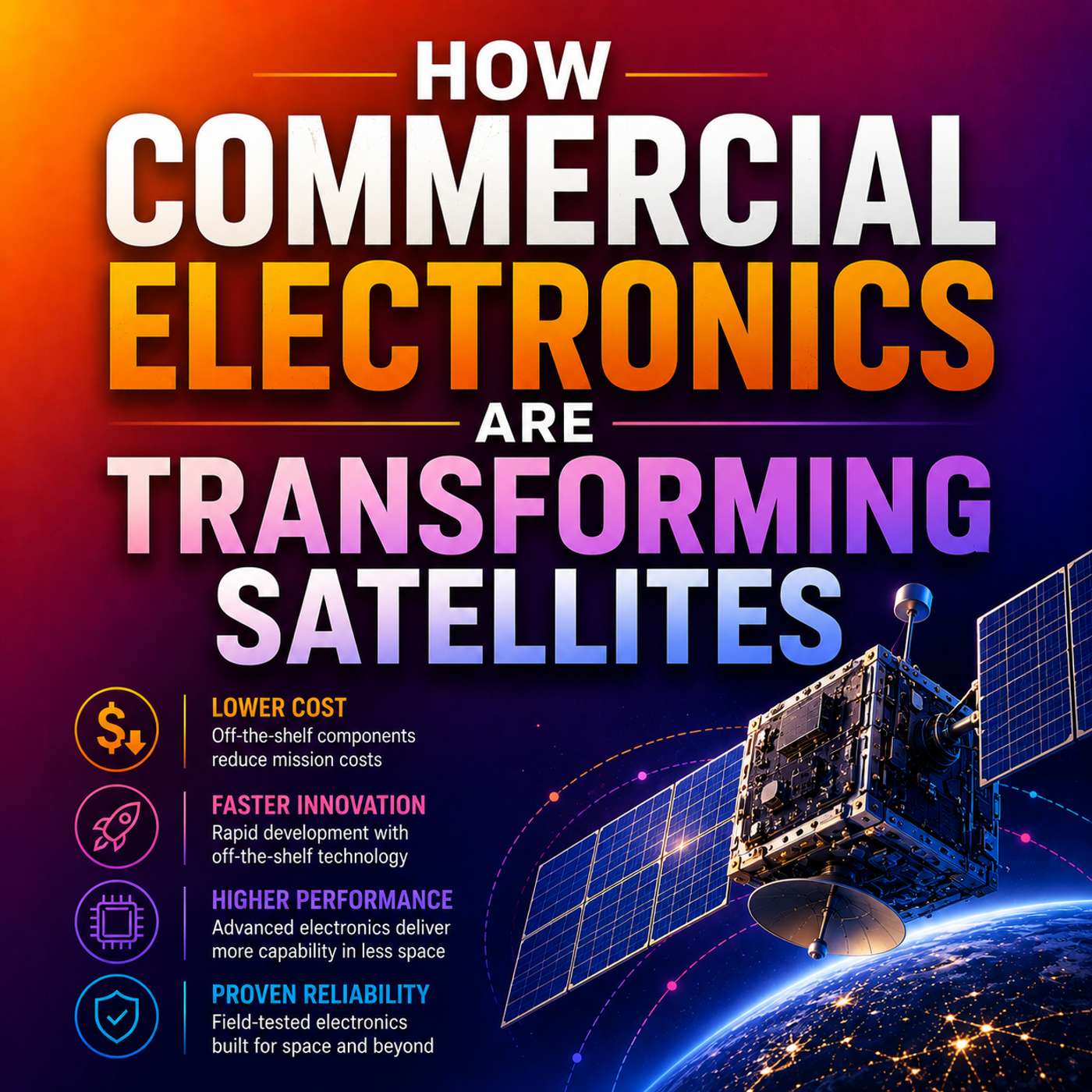


What happens when you take technology similar to what powers everyday electronics and send it into a radiation-filled orbit at roughly 17,000 mph?
The answer reveals one of the biggest shifts happening in modern satellite engineering.
In this episode of techaily.ai, David and Sophia explore how low Earth orbit (LEO) constellations are replacing the traditional aerospace obsession with zero failure with a radically different strategy: build scalable networks that can keep operating even when individual components—or entire satellites—fail.
For decades, satellites were engineered like handcrafted Rolls-Royces. Radiation-hardened components, extensive qualification testing, massive budgets, and 15-to-20-year operating lives were necessary because replacing hardware thousands of miles above Earth was practically impossible.
LEO constellations are changing that equation.
With reusable launch systems reducing the cost of reaching orbit and satellite lifecycles shrinking to around five years, engineers can prioritize rapid deployment, technology refreshes, and system-level resilience. That opens the door to commercial off-the-shelf components with dramatically greater computing performance.
In this episode, you’ll hear about:
- Why LEO constellations can tolerate failures that traditional satellites could not
- How size, weight, power, and cost—or SWaP-C—shape spacecraft design
- The differences between radiation-hardened, radiation-tolerant, and commercial components
- How single-event upsets and latchups threaten electronics in space
- Why watchdog timers, error correction, fault isolation, and workload redistribution matter
- How neighboring satellites can route traffic around a failed spacecraft
- Why phased-array beamforming is transforming satellite communications
- How gallium nitride (GaN) supports higher-power, more efficient electronics
- Why optical inter-satellite links are bringing lasers into satellite networks
- How onboard AI and edge analytics increase computing and thermal demands
- Why cooling high-performance electronics in a vacuum is so difficult
- How semiconductor obsolescence and supply continuity affect satellite manufacturing
- The role of FPGAs and reconfigurable hardware in adaptable spacecraft
The result is a completely different philosophy of space engineering. Instead of demanding perfection from every component, modern constellations can distribute resilience across processors, spacecraft, and the network itself.
And that raises an even bigger question: if LEO satellites are continuously replaced with newer technology, what happens to all that aging orbital hardware?
Could recycling processors, amplifiers, and other electronics in orbit eventually become an industry of its own?
Tune in to techaily.ai for the full conversation, and subscribe or share the episode with someone interested in satellite technology, aerospace engineering, semiconductors, and the future of the space industry.