

What happens when artificial intelligence stops living inside an app and starts living on your keychain, your face, and in the background of everyday life?
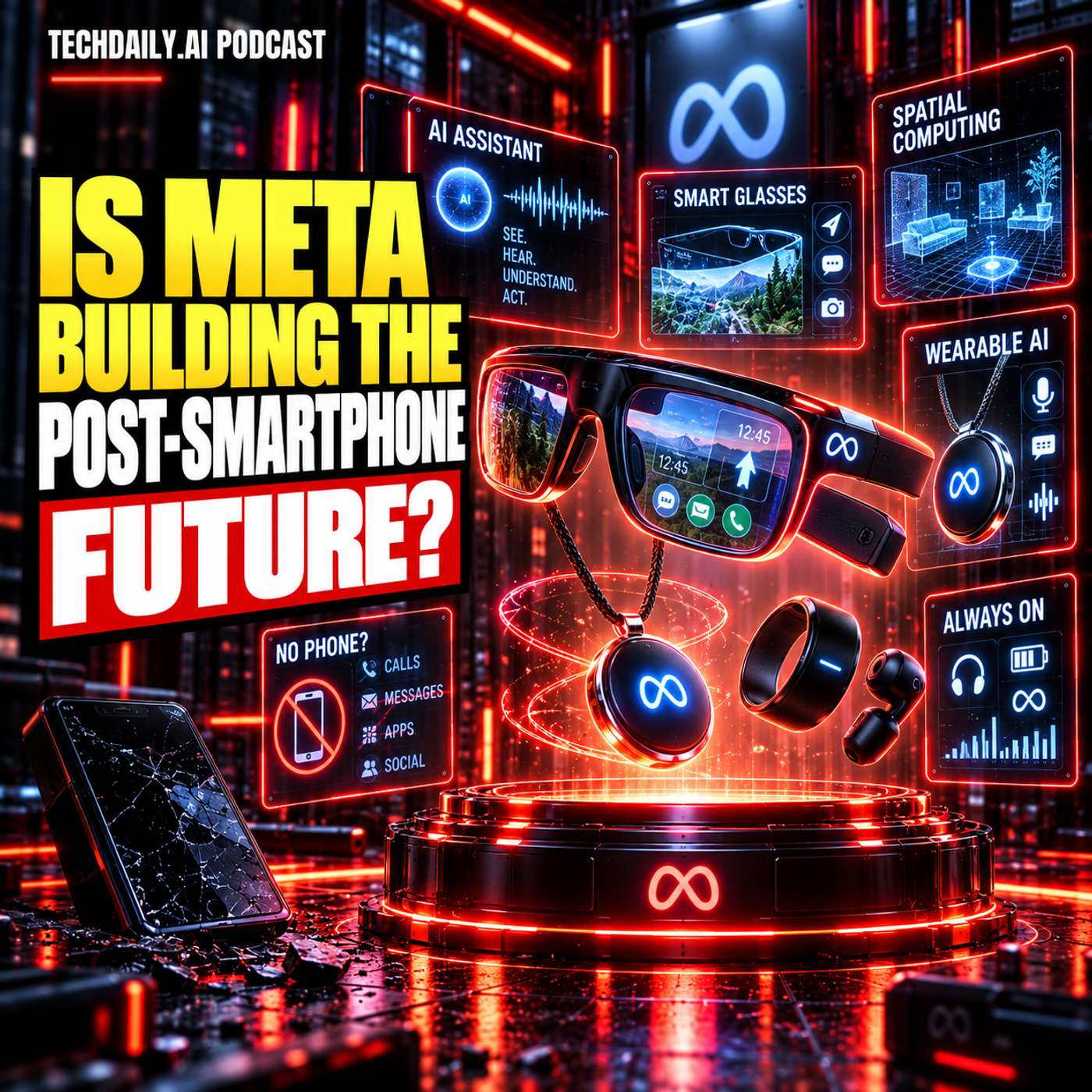
In this episode of techdaily.ai, David and Sophia explore Meta’s ambitious push toward a post-smartphone future built around AI companions, smart glasses, lightweight VR hardware, and ambient computing.
At the center of the discussion is the Muse Charm, a compact AI device designed around a tiny touchscreen, independent connectivity, and a small language model running locally on the hardware. The episode examines why local AI processing could make interactions feel faster and more conversational, while also questioning whether a dedicated AI gadget can offer enough value to compete with the smartphone already in your pocket.
The conversation also digs into the larger strategy behind Meta’s hardware push. Rather than depending entirely on Apple and Google to reach consumers, Meta appears focused on owning more of the computing experience itself — from the AI assistant to the devices people carry and wear.
You’ll hear about:
- Why Meta is investing in post-smartphone AI hardware
- How the Muse Charm uses a small language model for faster responses
- Why AI agents could bypass traditional apps and websites
- The business impact of AI completing tasks such as shopping and travel booking
- What the Rabbit R1 can teach the industry about AI hardware failures
- Why Meta may be targeting Gen Z with AI companions and wearables
- How smart glasses could become technology people wear like fashion
- The trade-offs behind lightweight VR glasses and external processing hardware
- Why audio-first smart glasses could compete with wireless earbuds
- How always-listening AI creates difficult questions around privacy and consent
- Why ambient computing could fundamentally change the relationship between humans and technology
The biggest shift may not be a new device at all. It may be the transition from technology we deliberately open and use to technology that continuously observes, listens, interprets, and responds to the world around us.
If AI becomes woven into glasses, accessories, and everyday interactions, does it remain a tool — or become the filter through which we experience reality?
Tune in for a deep exploration of AI wearables, ambient computing, privacy, smart glasses, personal AI agents, and the possible end of the smartphone era.
Subscribe to techdaily.ai, share the episode with someone following the future of AI hardware, and join us again as we keep questioning the technology reshaping everyday life.