

What happens when software developers stop writing code by hand and start managing AI agents instead?
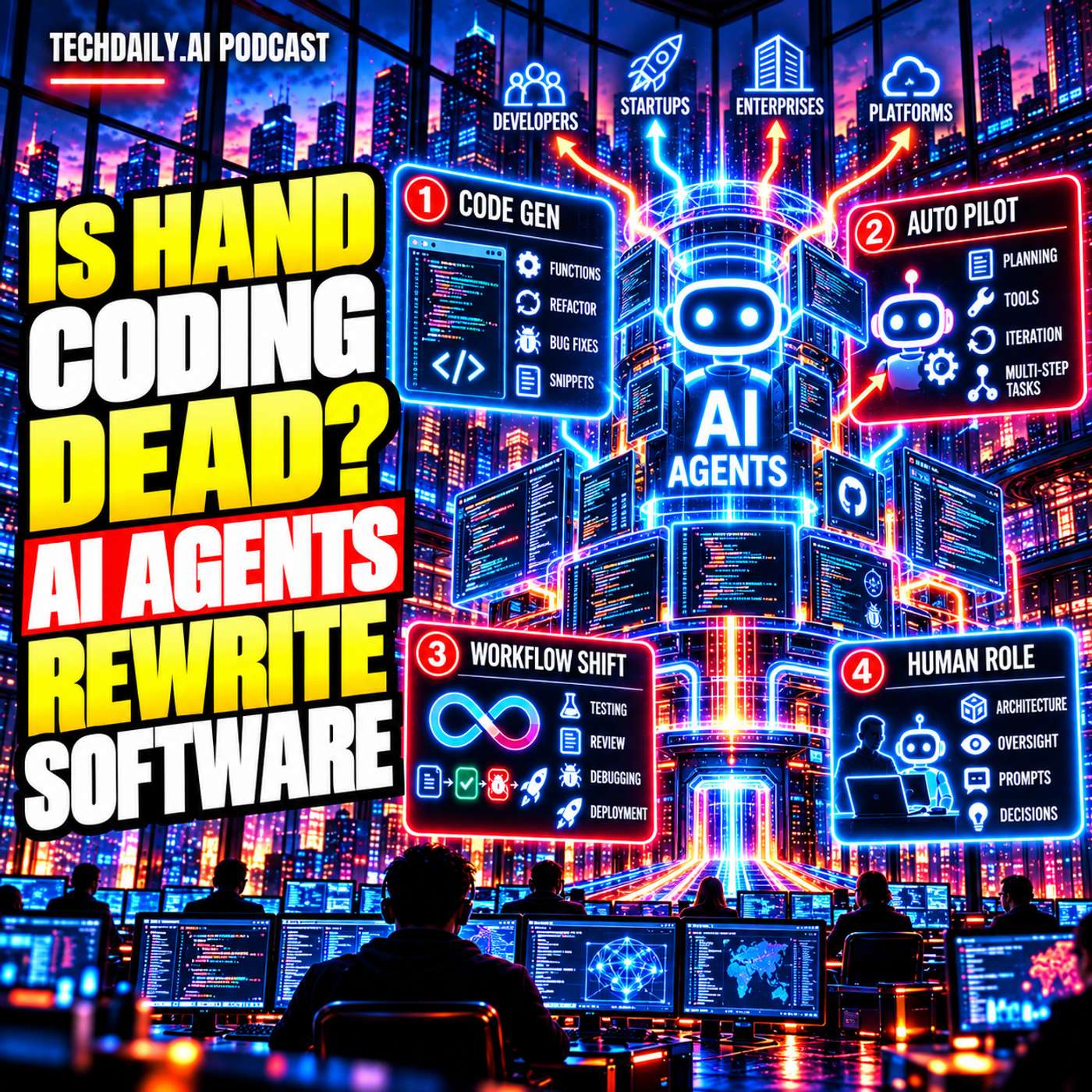
In this episode, David and Sophia explore a major shift happening across the software industry: the move from traditional programming toward AI-generated code, agentic workflows, and automated software factories.
The discussion begins with David Heinemeier Hansson, creator of Ruby on Rails, and his claim that hand coding is no longer the normal course of business at 37signals. From there, the episode examines what happens when AI becomes responsible for producing the software while humans increasingly supervise, validate, and constrain the machines doing the work.
You’ll hear about:
• Why 37signals is treating manual coding as an exception rather than the default
• Why DHH compared the rise of AI coding agents to the Kodak Brownie moment in photography
• How AI agents are changing the economics of software development
• Why small teams may now be able to build native mobile apps without large specialist departments
• Why Rust’s strict compiler can act as a powerful feedback system for AI-generated code
• Why Ruby on Rails remains attractive for agents because of its predictable conventions
• How AI could challenge the traditional software principle of abstraction
• Why repetitive, explicit code may become more practical when machines—not humans—are reading and writing it
• How faster AI-generated software can create new quality-control problems
• Why syntactically correct code can still fail because AI lacks real-world context and common sense
• Examples of AI-generated interface and logic problems in consumer applications
• How excessive dependence on AI can weaken engineering craftsmanship and accountability
• Why non-engineering teams are increasingly building their own software and automated workflows
• How finance, marketing, HR, legal, and recruiting teams can use agentic tools without relying on traditional engineering departments for every task
• Why software is shifting from something organizations purchase to something employees can create on demand
• What “capability gaslighting” means when an AI claims it completed work that was never actually done
• Why engineers are building agentic software factories, harnesses, linters, and deterministic guardrails around unpredictable AI systems
• How the developer’s role may shift from writing syntax to managing intelligence
• Why AI-native engineers who understand validation, orchestration, and agent supervision may become increasingly valuable
The central idea is not that software engineers simply disappear.
Instead, their role may be changing from manually producing every line of code to designing the systems that control, test, validate, and supervise AI-generated software.
That transition brings enormous leverage—but also serious risks.
If more of the world’s digital infrastructure is eventually built by machines, we may reach a point where critical systems contain millions of lines of code that no human has ever fully read or understood.
And that raises the biggest question of all: when those systems fail, will humans still understand them well enough to fix them?