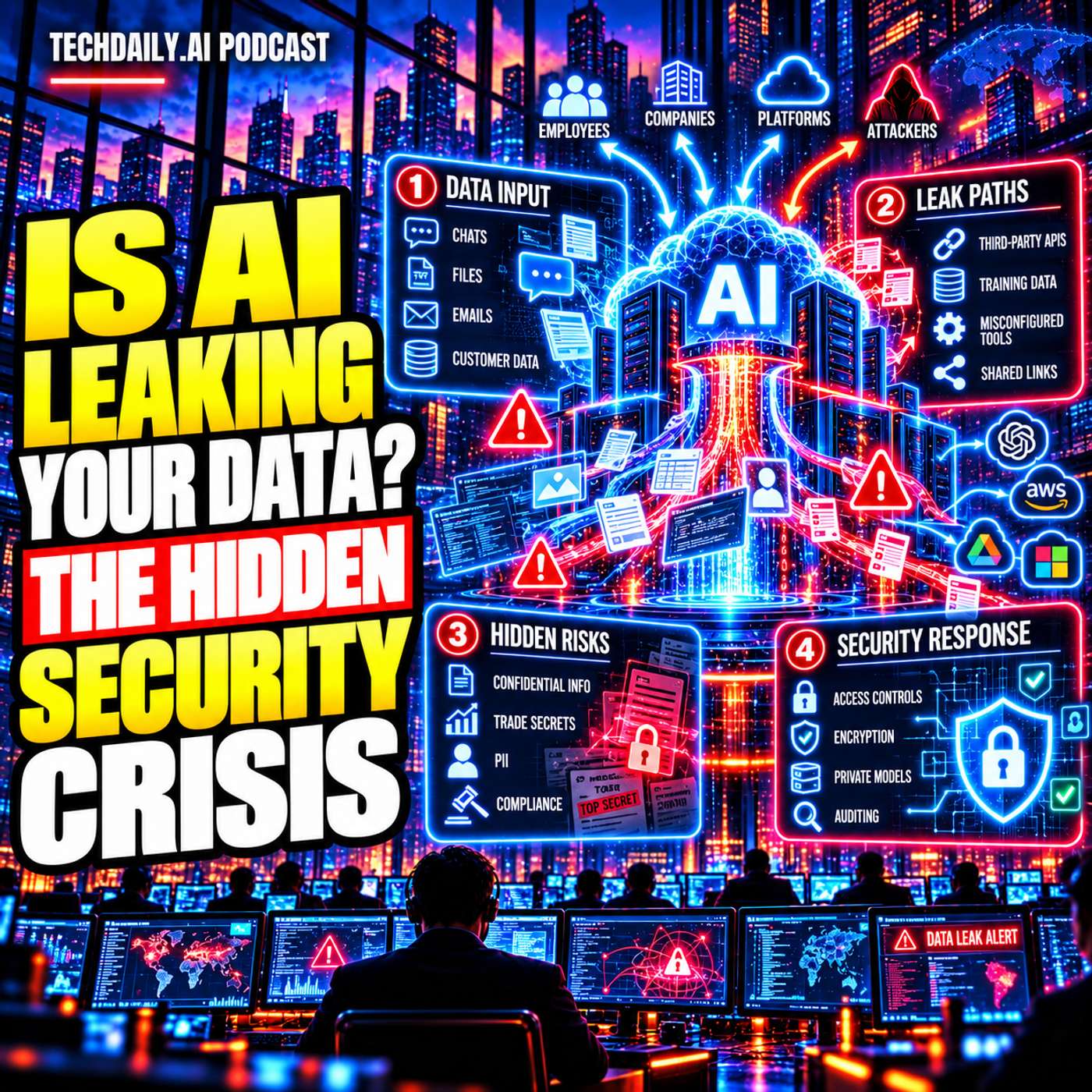


AI can summarize documents, analyze spreadsheets, search internal systems, and automate entire workflows—but what happens to your sensitive data once it enters those systems?
In this episode, David and Sophia explore the growing security risks created by rapid AI adoption and explain why traditional data protection tools may be unable to see where confidential information is actually going.
From shadow AI and public chatbots to retrieval augmented generation, vector databases, AI agents, and temporary sub-agents, modern AI workflows are creating entirely new paths for sensitive information to move through an organization.
You’ll hear about:
• Why AI adoption can outpace traditional security controls
• What “shadow AI” means and why employees may use unauthorized tools to get work done faster
• How sensitive spreadsheets, emails, customer information, and internal documents can be exposed through public AI tools
• Why traditional Data Loss Prevention systems may fail to detect AI-driven data movement
• How Retrieval Augmented Generation, or RAG, allows AI systems to pull information from internal repositories
• Why hidden context, policy overrides, and prompt injection can create serious security risks
• How autonomous AI agents can access tools, databases, code repositories, and other systems
• Why sub-agents make data lineage increasingly difficult to track
• How sensitive information can be transformed into summaries, vectors, and new files while still retaining its underlying meaning
• Why vector databases create new challenges for traditional keyword-based security tools
• What “child files” are and why AI-generated presentations, documents, or reports may still contain the sensitivity of their source material
• The difference between monitoring AI workloads and monitoring employee behavior
• Why cloud-only, endpoint-only, and storage-only security approaches can each leave major blind spots
• Why organizations may need unified, end-to-end visibility across users, data, AI models, agents, and destinations
• How continuous data classification can help identify PII, protected health information, financial records, and intellectual property
• Why lineage-driven risk visibility matters when data changes form as it moves
• How AI-powered security tools could help investigate incidents faster without overwhelming networks
• Why compliance frameworks require organizations to prove where sensitive data moved and how it was handled
The central challenge is simple: AI needs access to data in order to be useful, but that same access can create invisible pathways for information to leave its original security boundaries.
The goal is not to stop data from moving. It is to understand exactly where it came from, how it changed, where it went, and who or what accessed it along the way.
As AI systems become more autonomous, organizations may need to shift from simply building stronger walls around information to continuously tracking the data itself.
Because when AI can transform a confidential document into vectors, summaries, child files, and new insights, digital security is no longer just about protecting files—it is about protecting the entire lineage of the information.