

What if your AI coding assistant could deliver $35 in value for every dollar spent, but a simple five-minute bug fix could unexpectedly cost your company $1,000?
In this episode of TechDaily.ai, host David and expert guest Sophia explore the growing financial and operational challenges of AI-powered software development. Drawing from a panel discussion featuring engineering leaders from Datadog, Harness, and Incident.io, they examine how AI coding agents are transforming developer productivity, software engineering workflows, and the economics of building software.
Developers are generating code faster than ever, but engineering leaders face a difficult question: Are AI coding tools actually delivering measurable business value, or are companies simply trading traditional development bottlenecks for rising AI compute costs, technical debt, and increasingly complex workflows?
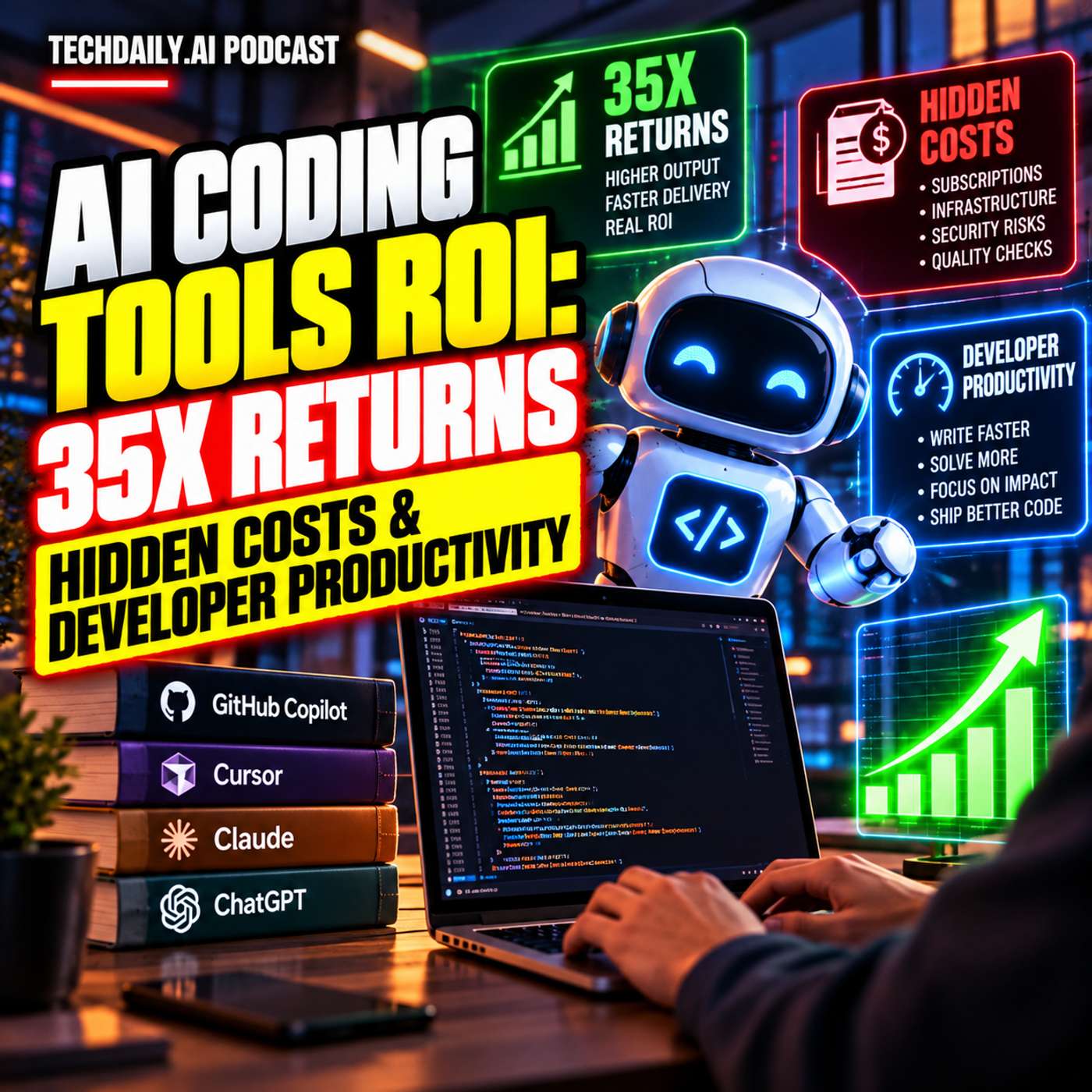
The conversation examines a reported 35:1 return on investment from AI engineering tools, the risks of uncontrolled token consumption, and why traditional developer productivity metrics may no longer tell the full story.
David and Sophia also explore how engineering organizations can balance faster code generation with software quality, security, financial accountability, and long-term business outcomes.
In This Episode, You’ll Discover:
- How AI coding tools are changing developer productivity and challenging traditional DORA metrics.
- Why measuring pull request throughput and deployment frequency alone can create a misleading picture of engineering efficiency.
- How one engineering team calculated approximately $35 in avoided hiring and onboarding costs for every $1 spent on AI coding tools.
- Why AI-generated code must be evaluated alongside defect rates, customer request resolution times, and measurable business outcomes.
- How autonomous AI coding agents can become trapped in expensive loops that repeatedly generate, test, and rewrite code.
- Why a seemingly simple software bug fix reportedly consumed $1,000 in AI compute costs.
- How token usage tracking and granular cost attribution can help companies connect AI spending to specific development tasks.
- Why developers using AI agents may consume $1,000 or more in daily compute resources without realizing it.
- How AI-assisted development can shift bottlenecks from code generation to security reviews, testing, and deployment.
- Why AI critic models and deterministic security checks could reshape software development pipelines.
- How automated model routing, compute budgets, and cost controls can improve AI coding efficiency.
- Why engineering leaders must connect AI investment to customer satisfaction, software quality, and actual business results.
The Real Cost of AI-Powered Development
AI coding assistants promise extraordinary productivity gains, but faster code generation doesn’t automatically mean better software or stronger business performance.
An engineering team might produce significantly more code while spending additional time reviewing defects, resolving incidents, and managing complex deployment pipelines.
Meanwhile, autonomous coding agents can generate substantial compute expenses when they repeatedly process large context windows, use expensive frontier models for simple tasks, or continue operating without proper spending limits.
The episode examines why organizations need a clearer view of the total cost of ownership of AI development tools.
From tracking token usage per Jira ticket to selecting appropriate AI models for different programming tasks, David and Sophia discuss how engineering teams can reduce waste without sacrificing innovation.
Rethinking Software Engineering for the AI Era
As artificial intelligence accelerates code generation, traditional software development processes face increasing pressure.
Can AI-powered code reviews replace some manual approval steps? How can companies maintain security and compliance while moving toward autonomous development pipelines? And who should be responsible for controlling the growing costs of AI-powered engineering?
The discussion explores the role of AI critic models, automated testing, deterministic workflows, and smarter model selection in creating software development processes that are faster, more reliable, and financially sustainable.
Whether you’re a software developer, engineering manager, CTO, DevOps professional, startup founder, or technology executive, this episode offers practical perspectives on AI coding ROI, developer productivity, engineering costs, and the future of software development.
Join the Conversation
Are AI coding assistants genuinely making engineering teams more productive, or are they creating new costs and bottlenecks that traditional productivity metrics fail to capture?
Join David and Sophia as they explore the economics of AI-assisted programming, the challenges of measuring real productivity, and the evolving relationship between human engineers and autonomous coding agents.
Subscribe to TechDaily.ai for more conversations about artificial intelligence, software engineering, cybersecurity, emerging technologies, and the business challenges shaping the future of technology.
Enjoyed this episode? Share it with your development team, engineering leadership, or anyone exploring AI-powered software development.