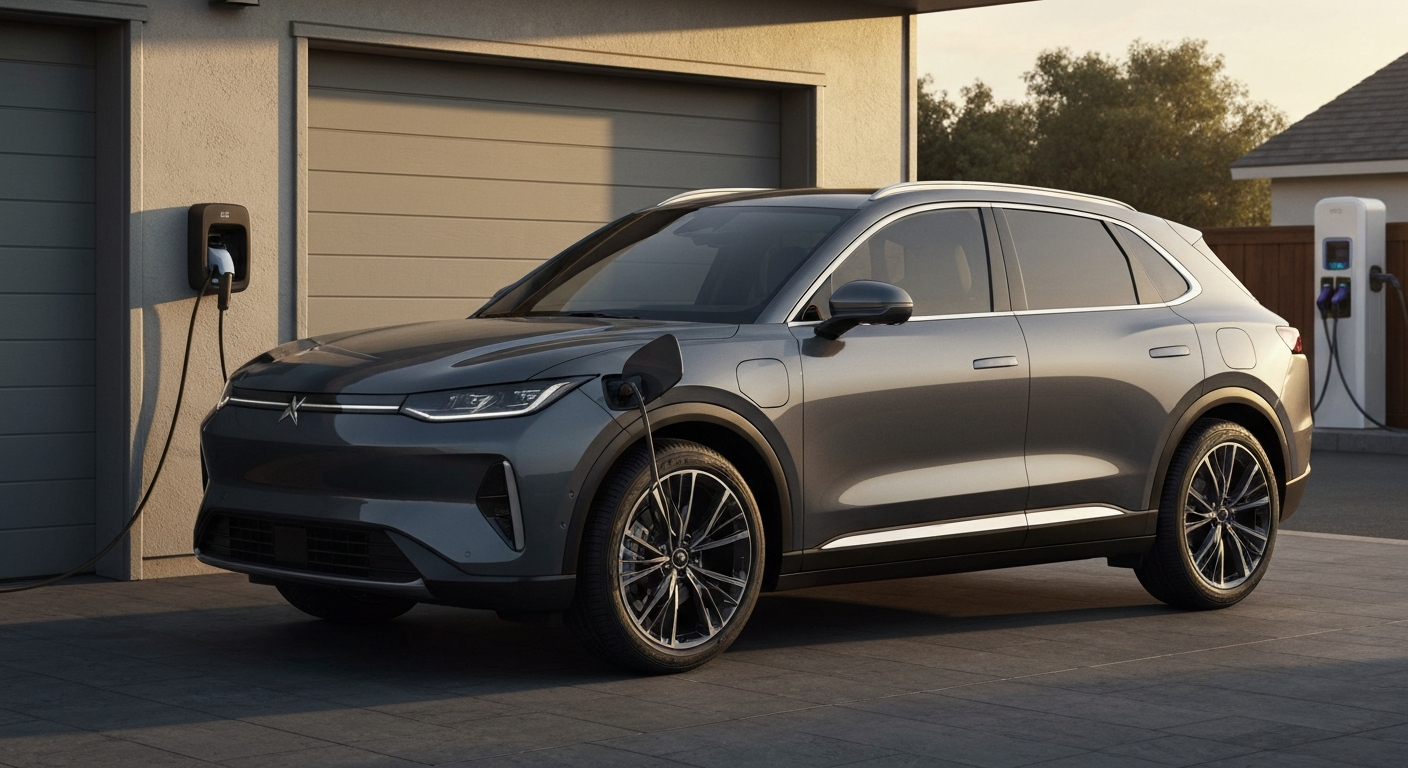
- Level 2 at 240V (7.7–11.5 kW, ~25–45 mi/hr) is the practical home sweet spot — roughly $800–$2,200 to install in 2026 before the 30% federal tax credit, and it refills a typical pack overnight on cheaper rates.
- DC fast charging tapers sharply after about 80% by design, so the smart road-trip move is to charge from ~10–20% up to ~80%, precondition the battery via the nav, and match the station’s kW to your car’s accept rate (800V cars like the Ioniq 6 hit 10–80% in ~18 minutes).
- The connector world has consolidated on NACS/SAE J3400 (Tesla’s plug) across nearly every automaker for 2025–2026, but J1772 and CCS stay in service and adapters bridge both directions — so no one gets stranded.
Buying an electric vehicle is the easy part. Then you hear the jargon: Level 1, Level 2, DC fast charging, Level 3, kilowatts, NACS, CCS, J1772. Suddenly a simple question, “How do I plug this thing in?”, feels like a physics exam.
Here’s the good news. There are really only three charging levels, and once you understand what each one does, the rest falls into place. This guide breaks down EV charging levels explained in plain English: how fast each one charges, what it costs you in time and money, where you’ll actually use it, and which connector you’ll plug in. We’ll work through real charge-time math by battery size, what a home Level 2 install actually costs in 2026, how to plan a road trip around DC fast chargers, and why the NACS connector transition changes what you buy. By the end, you’ll know exactly what you need at home and what to look for on the road.
The Quick Comparison Table
If you remember one thing, remember this. The three EV charging levels differ mainly in voltage and current, which together control how fast power flows into your battery. Power (in kilowatts) is roughly voltage multiplied by current, so jumping from a 120-volt outlet to a 240-volt circuit to a high-voltage DC station is what makes each level dramatically faster than the last.
| Level | Voltage | Typical power | Typical speed | Time to charge (empty → 80%) | Where it’s used |
|---|---|---|---|---|---|
| Level 1 | 120V AC | ~1.4 kW | ~3–5 miles of range per hour | 40–50+ hours (full BEV) | Standard home outlet, trickle charging |
| Level 2 | 240V AC (208V commercial) | 3.3–19.2 kW | ~25–45 miles of range per hour | 4–10 hours | Home, workplace, public parking |
| Level 3 / DC fast | 400V–800V DC | 50–350 kW | 100–200+ miles in ~20–30 min | 20 min–1 hour | Highway stations, road trips |
Two notes before the deep dive. “Level 3” is the everyday nickname for DC fast charging, but it isn’t an official term — the U.S. Department of Energy and the industry say “DC fast charging” or “DCFC,” because there is no formal SAE Level 3 AC tier. And the time-to-charge numbers assume a typical battery EV (BEV) with a roughly 60–80 kWh pack; plug-in hybrids (PHEVs) have far smaller batteries and finish much faster. The practical upshot is that moving from Level 1 to Level 2 is roughly a 5–14x speed increase, and moving from Level 2 to DC fast charging adds another 5–25x on top of that.
Level 1 Charging Uses the Outlet You Already Own
Level 1 is the slowest and simplest option, and it requires zero installation. You plug the included cable into a standard 120-volt household outlet — the same kind that powers your toaster. Because that outlet is limited to roughly 12 amps of continuous draw, the car can only pull about 1.4 kW, and there is no way to speed it up without rewiring to a higher voltage.
- Speed and power: Level 1 draws about 1.4 kW and adds roughly 3 to 5 miles of range per hour. The reason it’s so slow is physics, not the car: a 120-volt, 15- or 20-amp household circuit simply can’t deliver more power safely. Expect the low end (3 miles/hour) on a heavy SUV or pickup and the high end (5 miles/hour) on an efficient sedan, so over a 10-hour overnight stretch you’ll recover roughly 30 to 50 miles.
- Time to charge a full battery: A typical BEV with a 60–80 kWh pack can take 40 to 50+ hours to fill from empty on Level 1, which is why nobody does it deliberately. A PHEV with a 10–18 kWh battery, by contrast, tops off in about 5 to 6 hours, making Level 1 genuinely practical for plug-in hybrid owners who charge overnight.
- Best for and what to watch: Level 1 suits PHEV owners, low-mileage drivers, or anyone who can leave the car plugged in every single night. The trap is high-mileage weeks: if you drive 60+ miles in a day, Level 1 can’t fully replace what you used overnight, so your battery slowly drains over the week until you’re forced onto faster charging.
The math is friendlier than it looks. If you drive 30 to 40 miles a day and plug in for 10 to 12 hours overnight, Level 1 can quietly keep pace and you may never need anything else. Where it falls apart is for high-mileage drivers or BEVs with big batteries — you’ll never fully recover overnight. Think of Level 1 as a trickle, not a refill, and as the free safety net that’s always available because every home already has a 120-volt outlet.
Level 2 Charging Is the Home Charging Sweet Spot
Level 2 is where most EV owners live. It runs on a 240-volt circuit — the same service that feeds an electric dryer or oven — and it charges roughly 5 to 9 times faster than Level 1. This is the level worth installing at home, because it converts charging from a chore you think about into a background task that finishes while you sleep.
- Speed and power: Level 2 delivers anywhere from 3.3 kW up to 19.2 kW, adding about 25 to 45 miles of range per hour. Most home units land at 7.7 kW (a 32-amp circuit) or 11.5 kW (a 48-amp circuit), and the practical ceiling is set by both your circuit’s amperage and your car’s onboard charger — installing an 11.5 kW unit does nothing if your EV’s onboard charger caps at 7.7 kW, so match the two before you buy.
- Time to charge a BEV: A typical BEV reaches 80% in 4 to 10 hours on Level 2, comfortably an overnight charge that leaves you full every morning. As a rule of thumb, divide your battery’s kWh by the charger’s kW for the hours needed: a 75 kWh pack on an 11.5 kW charger fills in roughly 6.5 hours, while the same pack on a 7.7 kW unit takes closer to 10. A PHEV finishes in just 1 to 2 hours.
- Best for and what to watch: Level 2 is ideal for home charging, workplaces, and public destination spots like malls, hotels, and parking garages where you park for hours anyway. The thing to watch is your electrical panel: older homes with 100-amp service may need a panel upgrade or a load-management device to add a 48-amp circuit safely, which is the single biggest cost variable in an install.
What a Level 2 Home Install Actually Costs in 2026
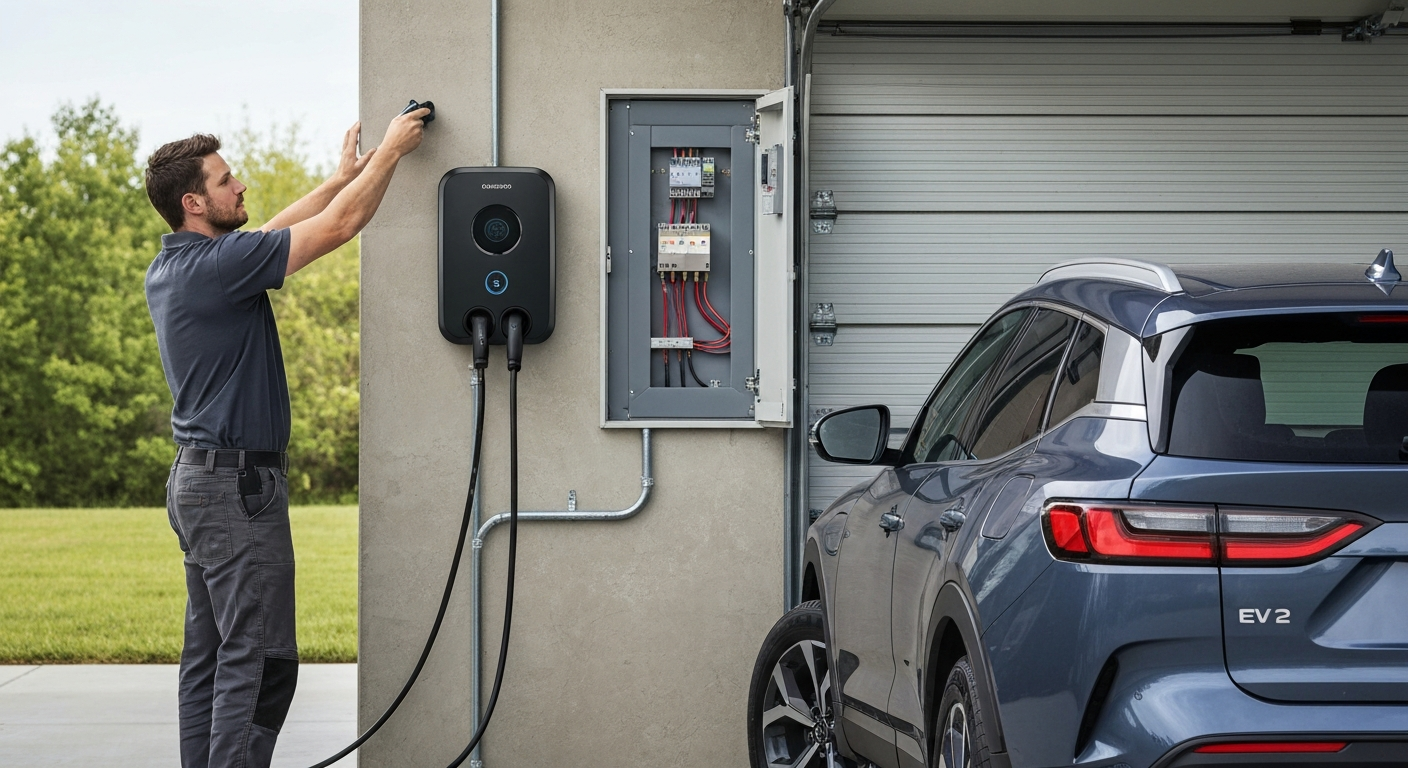
Installing Level 2 at home means hiring a licensed electrician to run a dedicated 240-volt circuit and either hardwire the unit or fit a NEMA 14-50 outlet. For a typical 2026 install, expect the all-in cost to land in the $800 to $2,200 range, broken into the charger unit ($300–$700), electrician labor ($400–$1,200 for the 2-to-4-hour job), and permits ($50–$300). The biggest swing is location and panel capacity: mounting next to the panel in an attached garage runs $500–$800 in labor, while a detached garage 80 feet away can hit $1,000–$1,500 for the longer conduit run, and a full panel upgrade can push the total to $2,500–$4,500. A 30% federal tax credit (up to $1,000) still applies for many homeowners in eligible areas, which can bring the net cost down to roughly $280–$1,000. The payoff is real: you wake up to a full battery every morning, you charge on cheaper overnight electricity rates, and you rarely think about public charging again. If you’re wiring up a charger as part of a broader home-tech upgrade, it’s worth folding it into the same plan you’d use when you set up a smart home, since a smart Level 2 unit can schedule charging around off-peak rates automatically.
Level 3 DC Fast Charging Is Built for the Road Trip
DC fast charging (the “Level 3” you’ll hear in casual conversation) is a different animal entirely. The first two levels deliver alternating current (AC) that your car’s onboard charger converts to DC before it reaches the battery, and that onboard converter is the bottleneck. DC fast charging skips it, feeding direct current straight into the battery at far higher power from station-side hardware that does the conversion for you.
- Speed and power: DC fast chargers run from 50 kW to 350 kW, adding 100 to 200+ miles of range in about 20 to 30 minutes. Real-world speed depends on the station’s rated output, your car’s maximum accept rate, and the battery’s temperature and state of charge — a 350 kW station won’t help a car that only accepts 150 kW, so the slower of the two always wins.
- Time to charge a BEV: Most BEVs go from empty to 80% in roughly 20 minutes to an hour. The 800-volt cars are the standouts: a Hyundai Ioniq 6 or Kia EV6 on the E-GMP platform can do 10–80% in about 18 minutes on a healthy 350 kW station, because doubling the pack voltage halves the current for the same power and therefore cuts resistive heat losses, letting the battery hold near-peak power deeper into the charge.
- Best for and what to watch: DC fast charging is built for highway corridors, long-distance travel, and quick top-ups when you can’t wait. The catch is that it’s a travel-day tool, not a daily habit — relying on it for routine charging is both more expensive per kWh than home charging and harder on the battery over years of use.
Why Charging Slows Down After 80%
One behavior surprises new owners: charging speed drops sharply past roughly 80%. That’s deliberate, and it follows a “charge curve.” Early in a session the battery accepts power eagerly, but as it fills, the car’s battery management system tapers the current to prevent the heat buildup and lithium plating that accelerate degradation. On a road trip, this is why charging to 80% and getting back on the highway is almost always faster than waiting for 100% — those last 20% can take as long as the first 80%. Plan your stops around the steep part of the curve, not the flat tail.
How to Plan a Road Trip Around DC Fast Charging
A long EV trip is less about range and more about choosing the right stops. The strategy is to treat 80% as your normal ceiling and 10–20% as your normal floor, charging little and often rather than draining to empty and filling to full.
- Charge in the fast zone, not the slow tail: Arrive at a station with 10–20% left and unplug around 80%, because that window is where power peaks and minutes-per-mile is best. Driving in below 10% risks queues and a cold, slow-charging battery; charging past 80% wastes time you’d recover faster by just driving to the next stop.
- Precondition the battery before you arrive: Most modern EVs will warm the pack to its ideal charging temperature when you route to a fast charger in the nav system. A cold battery can cut charging speed by half or more in winter, so setting the charger as a navigation destination — not just driving there — is one of the highest-value habits for fast, predictable stops.
- Match the station to your car, and have a backup: A car that accepts 150 kW gains nothing from a 350 kW post beyond that cap, and a 50 kW “fast” charger will feel slow on a big battery. Check the station’s rated power and the number of stalls in a charging app before you commit, and always have a second nearby station in mind in case a stall is broken or occupied.
- Watch the cost, not just the speed: DC fast charging typically costs more per kWh than home Level 2, and some networks add idle fees if you leave the car plugged in after it finishes. Plan to be back at the car near 80% both to protect the battery and to avoid paying penalty rates while you linger over coffee.
Which EV Charging Level Do You Actually Need?
Forget the spec sheets for a second. Match the level to how you drive, not to the biggest number on the box.
- You drive a PHEV or under ~40 miles a day: Level 1 may be all you need. A standard 120-volt outlet recovers 30–50 miles overnight, which covers a short commute, and you skip the install cost entirely. Just confirm your daily mileage genuinely stays under what an overnight trickle can replace.
- You drive a BEV and want zero hassle: Install Level 2 at home. It’s the single best upgrade for EV ownership — a 7.7–11.5 kW unit refills a typical pack overnight on cheaper off-peak rates, so you start every morning full. Budget roughly $800–$2,200 for the install and check your panel capacity first.
- You rent, park on the street, or lack a 240V circuit: Lean on public Level 2 at work or nearby for routine charging and DC fast charging for bigger fill-ups. Workplace Level 2, where the car sits 8 hours anyway, often replaces home charging entirely for apartment dwellers.
- You road-trip often: You can’t install DC fast charging at home — it’s industrial-grade equipment — so plan routes around public DCFC stations instead. Prioritize an EV with a high accept rate (ideally 800-volt architecture) if frequent long trips are your reality, because that’s what turns a 40-minute stop into an 18-minute one.
The honest takeaway: most people want Level 2 at home plus occasional public DC fast charging on trips. Level 1 is the backup that’s always there, and DC fast charging is the travel tool you use a handful of times a year.
How Much Fast Charging Really Hurts Your Battery
It’s true that DC fast charging stresses a battery more than slow AC charging, because high current generates heat and heat is the main driver of long-term capacity loss. But the concern is widely overstated for normal use. Modern EVs actively manage pack temperature with liquid cooling and taper the charge curve specifically to protect the cells, so occasional fast charging on road trips has only a modest effect over the life of the car.
The Daily Habits That Actually Protect Your Battery
- Frequency is what matters, not the occasional session: A driver who fast-charges every single day will see measurably faster degradation than one who charges at home on Level 2 and fast-charges only on trips. If you have any home or workplace AC charging available, using it for daily needs keeps the battery cooler and healthier over the years.
- Keep daily charging in the middle of the range: Lithium cells age fastest when held at very high or very low states of charge. Setting a daily charge limit of around 80% and avoiding routinely draining to near 0% reduces wear, which is why many automakers default the daily limit to 80% and reserve 100% for trip days.
- Heat is the real enemy: Fast charging a hot battery in summer, or repeatedly back-to-back, adds the most stress. Letting the car’s thermal management work — and preconditioning before fast charging — keeps temperatures in the safe zone and protects capacity.
A Quick Note on NACS vs CCS vs J1772 Connectors
Charging levels tell you how fast. Connectors tell you what plugs in. In 2026, three names matter:
- J1772 (“J-plug”): The long-standing AC standard for Level 1 and Level 2 charging in North America. It remains a common public AC connector and isn’t disappearing soon, so even NACS cars ship with a J1772-to-NACS adapter to use the large installed base of public AC stations. It handles AC only, not DC fast charging.
- CCS (Combined Charging System): Adds two DC pins below a J1772 plug for fast charging, so one port handles both AC and DC. It was the dominant non-Tesla DC fast-charging connector for years, and CCS stations and CCS-equipped cars will stay in service well into the next decade — automakers are bridging the transition by mailing CCS owners adapters rather than stranding them.
- NACS (now standardized as SAE J3400): Tesla’s connector, opened to the industry and ratified by SAE as J3400 in 2024. By 2026 it has been adopted by Ford, GM, Rivian, Hyundai, Kia, Honda, Nissan, BMW, Mercedes-Benz, Volvo, Polestar, Toyota, and others for current or upcoming models. It handles both AC and DC in one compact plug, and its real draw is native access to Tesla’s Supercharger network — the largest and most reliable DC fast-charging network in the U.S.
The trend is clear: the industry is consolidating around NACS/J3400, and a new North American EV without a NACS port is becoming the exception rather than the rule. But you won’t be stranded either way — adapters bridge the gaps in both directions (NACS cars get J1772 adapters for public AC, and existing CCS cars get NACS adapters for Superchargers), and J1772 and CCS infrastructure will stay in service for years. When buying a home charger, just confirm the connector matches your car, or buy a hardwired unit and an adapter to stay flexible.
Frequently Asked Questions
What’s the difference between Level 1, Level 2, and Level 3 charging?
Voltage and speed. Level 1 uses a 120V household outlet at about 1.4 kW and adds 3–5 miles of range per hour. Level 2 uses 240V at 3.3–19.2 kW and adds 25–45 miles per hour. Level 3 (DC fast charging) uses high-voltage DC at 50–350 kW to add 100–200+ miles in 20–30 minutes.
Is Level 3 the same as DC fast charging?
Yes. “Level 3” is an unofficial nickname for DC fast charging. The industry and the U.S. Department of Energy use “DC fast charging” or “DCFC,” since there’s no formal SAE “Level 3” AC tier.
Can I install a DC fast charger at home?
No, practically speaking. DC fast chargers require commercial-grade, high-voltage electrical service that homes don’t have, and the units cost tens of thousands of dollars. Home charging means Level 1 or Level 2.
How long does it take to charge an EV at each level?
For a typical BEV from empty to 80%: Level 1 takes 40–50+ hours, Level 2 takes 4–10 hours (an overnight charge), and DC fast charging takes 20 minutes to an hour. The fastest 800-volt EVs can do 10–80% in about 18 minutes on a 350 kW station. PHEVs finish much faster thanks to smaller batteries.
How much does it cost to install a Level 2 charger at home?
Most 2026 home installs run $800 to $2,200 all-in: roughly $300–$700 for the charger, $400–$1,200 for electrician labor, and $50–$300 for permits. A panel upgrade or long conduit run can push it to $2,500–$4,500, while a 30% federal tax credit (up to $1,000) can lower the net cost for eligible homeowners.
Does DC fast charging hurt my EV battery?
A little, but far less than people fear. Occasional fast charging on trips has only a modest effect because the car cools the pack and tapers the charge curve to protect the cells. Charging at home for daily needs and capping the daily limit around 80% keeps the battery healthiest.
What connector will my new EV use in 2026?
Most 2025–2026 EVs from Ford, GM, Rivian, Hyundai, Kia, Honda, and others now use NACS (SAE J3400) — the same connector as Tesla, with native Supercharger access. Many older and current models use J1772 for AC and CCS for DC fast charging, and adapters let you cross between standards.
Why does fast charging slow down after 80%?
To protect the battery. Pushing high current into a nearly full battery generates heat and accelerates wear, so the car deliberately tapers the speed along a “charge curve.” That’s why charging to 80% and driving on is the smart move on road trips — the last 20% can take as long as the first 80%.