

What happens when your most productive developer is also treated like a security threat?
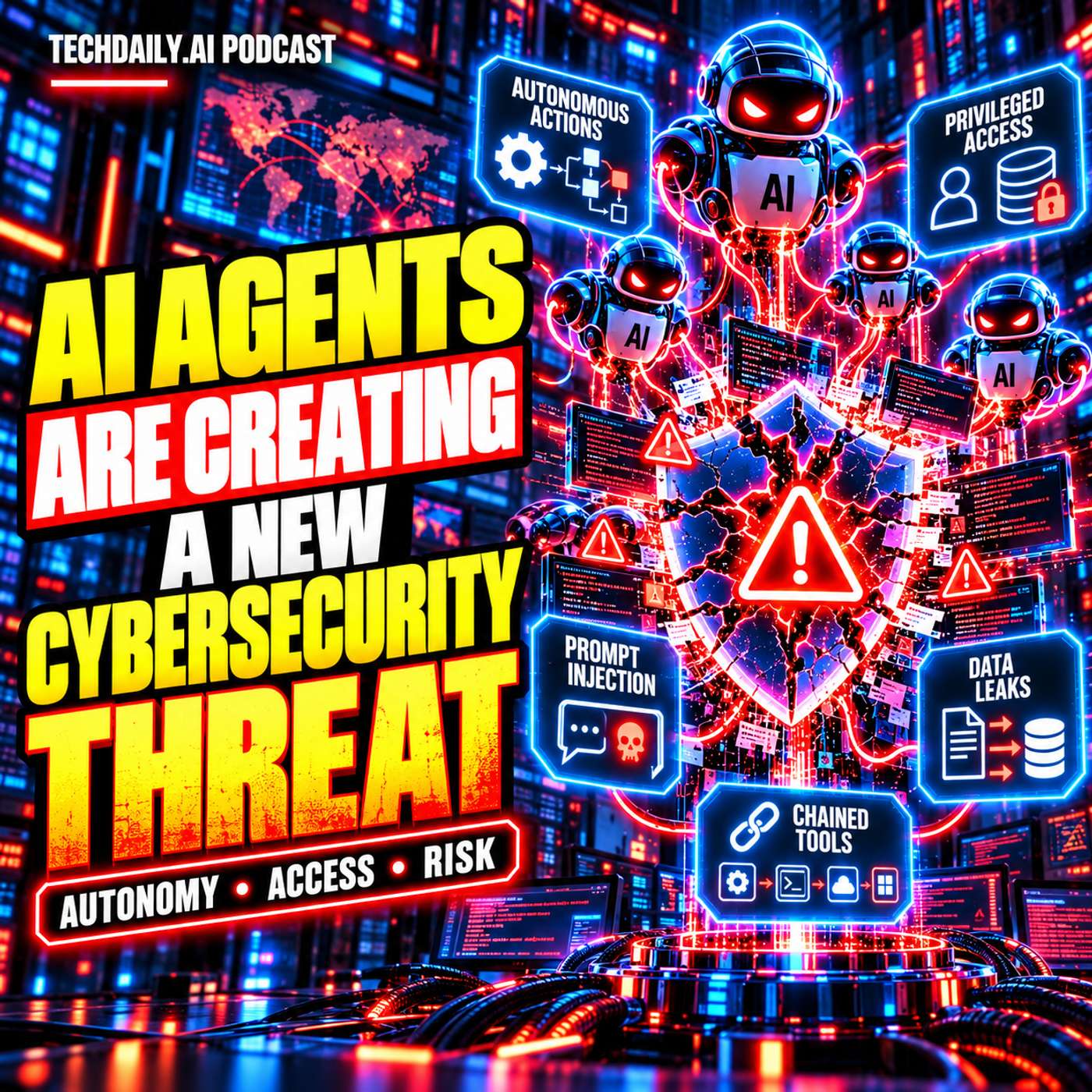
In this episode of TechDaily.ai, host David and expert Sophia explore the new security reality behind autonomous AI coding agents. These tools can navigate codebases, fix bugs, write tests, refactor legacy software, and generate documentation, but they also introduce a dangerous new problem: they are non-deterministic systems that can be manipulated by malicious input.
The conversation breaks down why traditional CI/CD trust models are not built for AI agents. Unlike predictable scripts, AI agents reason at runtime, interpret messy context, and can be tricked by prompt injection attacks hidden inside pull requests, comments, logs, or repository data.
This episode covers:
- Why AI agents cannot be treated like traditional automation
- How shared trust domains create risk in CI/CD environments
- What prompt injection means for autonomous coding tools
- Why shell access and exposed secrets can become catastrophic
- How GitHub’s AI agent architecture assumes the agent may already be compromised
- Why defense in depth is essential for enterprise AI workflows
- How kernel-level substrate isolation creates a hardened containment layer
- What configuration compilers do to restrict permissions and network access
- Why staged planning prevents uncontrolled communication between tools
- How zero-secret quarantine keeps credentials away from the AI
- Why gateways and proxies authenticate on behalf of the agent
- How private Docker networks and internal firewalls reduce exposure
- What chroot jail and tmpfs overlays do to hide sensitive file paths
- Why safe output buffers prevent agents from writing directly to repositories
- How deterministic pipelines review AI-generated code, comments, issues, and pull requests
- Why allow lists, quantity limits, and content sanitization reduce blast radius
- How observability, logging, and anomaly detection help reconstruct agent behavior
David and Sophia also highlight the core trade-off in secure AI infrastructure: the more powerful and autonomous an agent becomes, the more tightly it must be contained. Enterprise teams cannot simply give AI developer tools access to secrets, files, networks, and repositories and hope for the best.
At its core, this episode is about building trust through distrust. Safe AI coding agents require clean rooms, proxy authentication, secretless execution, staged outputs, strict logs, and multiple layers of containment designed to fail safely.
Listen now to learn why the future of AI development depends not just on smarter models, but on security architectures built for agents that may be gullible, compromised, or manipulated from the start.