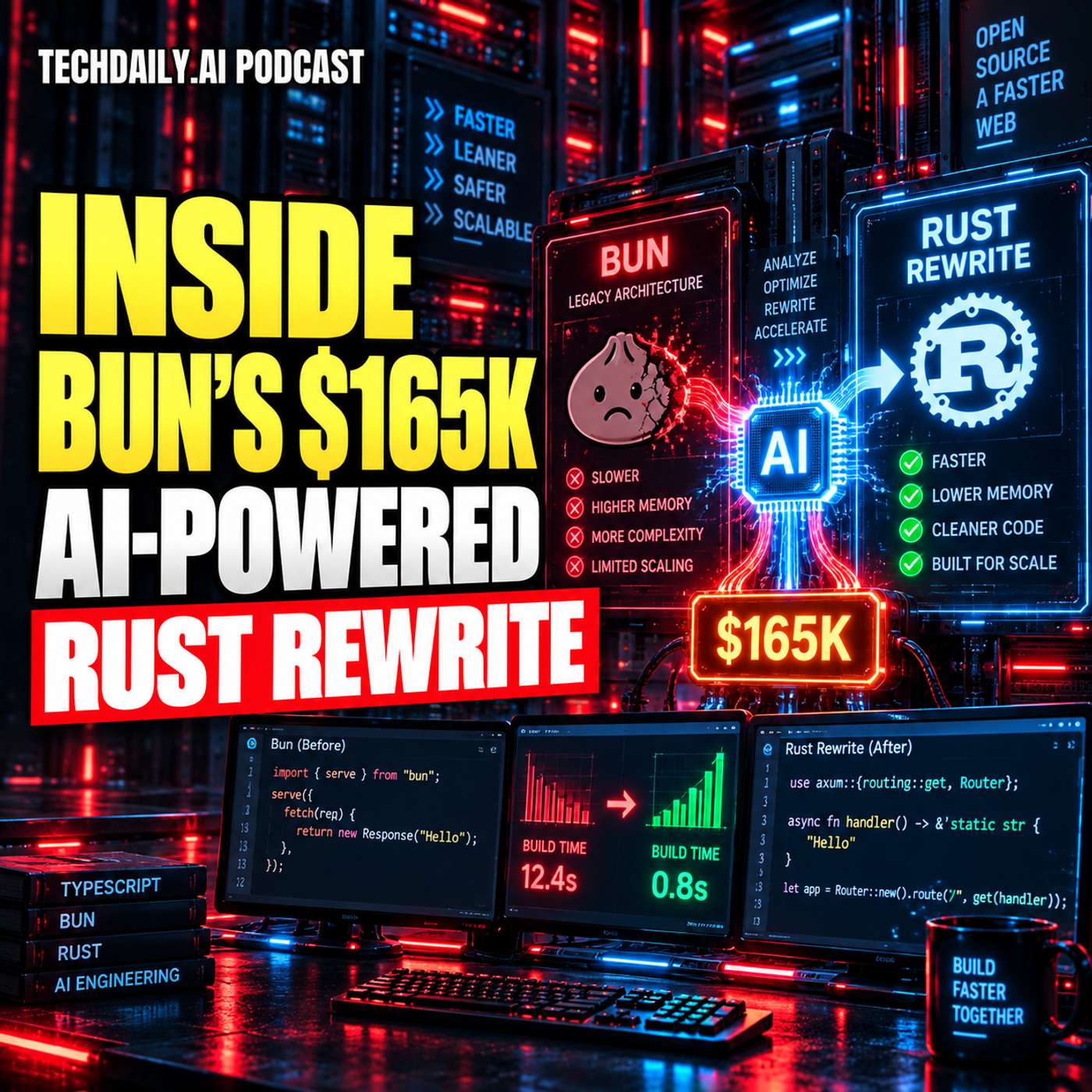


What normally takes a team of senior software engineers a year was completed in just 11 days.
In this episode of TechDaily.ai, David and Sophia explore the extraordinary story of Bun’s massive migration from Zig to Rust—an effort involving more than 535,000 lines of code, 64 parallel AI agents, roughly 16,000 compiler errors, 6,500 AI-generated commits, and a reported compute bill of $165,000.
But this wasn’t a matter of dropping a codebase into an AI chatbot and asking for a rewrite.
The migration required careful human planning, a highly detailed 600-line porting rulebook, isolated development environments, automated compiler feedback, adversarial AI code reviews, and a comprehensive continuous integration testing system.
In this episode, you’ll hear:
• Why Bun’s memory-management problems motivated the move from Zig to Rust
• How Rust’s memory safety, RAII, and borrow checker reduce dangerous runtime errors
• Why rewriting a 500,000-line codebase would traditionally take a dedicated engineering team a year or longer
• How 64 AI agents initially caused chaos by sharing the same Git environment
• Why isolating agents across separate worktrees dramatically improved the workflow
• How AI agents translated more than 535,000 lines of Zig into Rust in approximately two days
• How the system worked through roughly 16,000 Rust compiler errors while the human team slept
• Why separate AI reviewers were used to challenge proposed fixes before they were committed
• How automated testing and CI provided the safety net needed to merge thousands of AI-generated changes
• Why a $165,000 AI compute bill may actually be inexpensive compared with a conventional rewrite
• What Brooks’s law reveals about the difference between coordinating dozens of humans and dozens of AI agents
• Why domain expertise, strong architectural rules, and a rigorous test suite remain essential for AI-driven software development
The bigger question goes far beyond Bun.
If AI can safely migrate hundreds of thousands of lines of complex infrastructure code from one programming language to another in days rather than years, the economics of technical debt could change dramatically.
Could aging financial systems, government platforms, and enterprise applications eventually be modernized by AI swarms? And if entire codebases can be translated this quickly, will the programming language a startup chooses today even matter several years from now?
Tune in for a detailed look at one of the most ambitious examples of AI-assisted software engineering discussed on TechDaily.ai.
Subscribe, share the episode, and stay curious as we continue exploring how AI is reshaping software development and the future of technology.