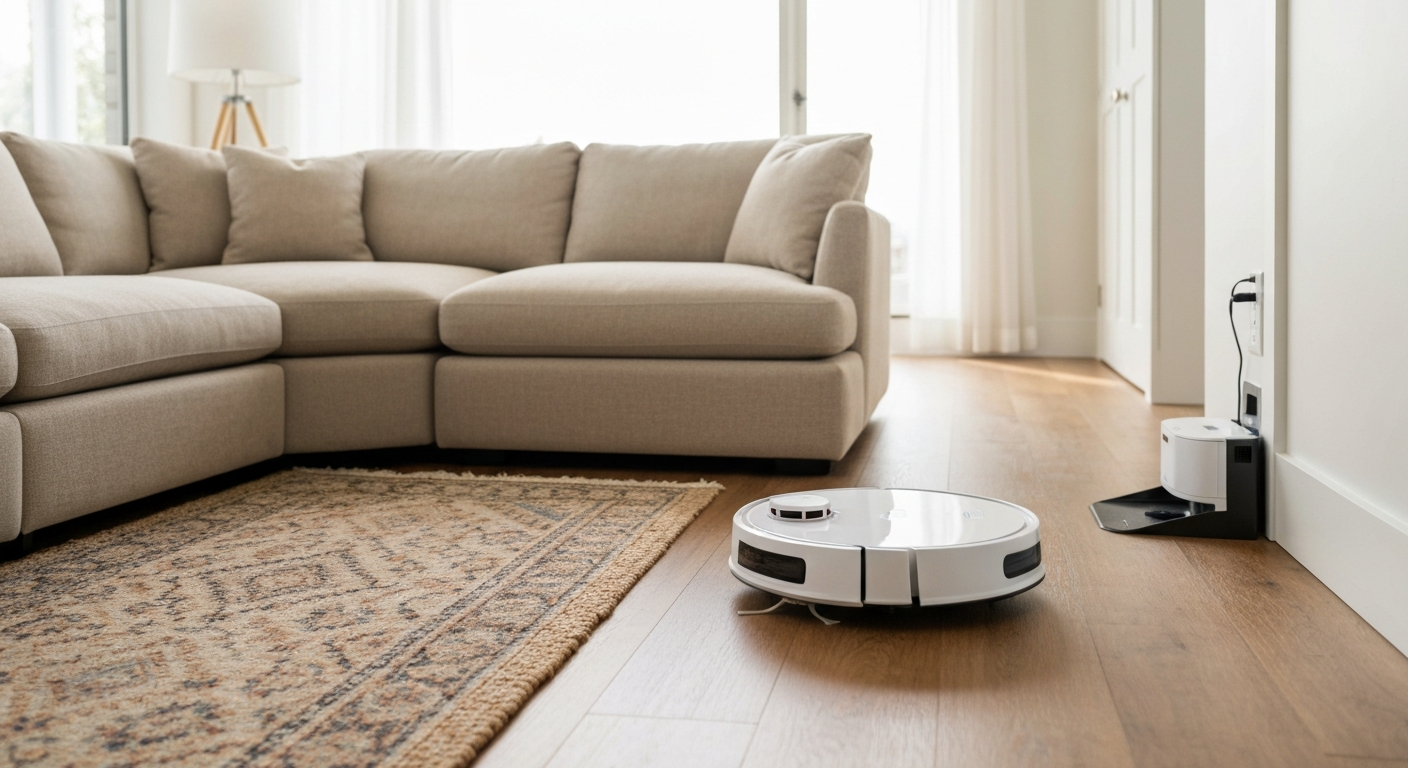
A few years ago, the honest answer to “should I buy one of these” was a shrug. Early robot vacuums wandered into table legs, got strangled by phone chargers, choked on a single sock, and still needed you to empty a thimble-sized bin every other day. So when people ask are robot vacuums worth it today, they are usually remembering that older, frustrating machine.
The 2026 reality is different. The category quietly grew up. Self-emptying docks went from luxury to baseline, suction numbers exploded, brushrolls stopped eating long hair, and most mid-range models now mop as well as vacuum. None of that makes them magic, and there are real reasons to skip one. But the question deserves a fresh answer based on what the hardware actually does now, not what it did in 2021. This guide walks through what changed, where robots still fall short, how they stack up against a cordless stick, and exactly who should buy versus who should save their money.
- Are robot vacuums worth it for most homes in 2026? Yes for daily maintenance on hard floors and low-pile carpet, no if you expect it to replace a deep-clean vacuum entirely.
- The big 2026 upgrades that closed old gaps: self-emptying docks (roughly 2 to 4 liter bags, often 45 to 100 days between touches), suction commonly in the 15,000 to 20,000+ Pa range with carpet boost, anti-tangle brushrolls, and 2-in-1 vacuum-and-mop docks.
- They still cannot climb stairs, struggle with thick high-pile carpet and tight corners, and need periodic hands-on maintenance.
- A self-emptying robot and a cordless stick vacuum solve different problems; many homes are happiest owning both.
- Sweet-spot pricing in 2026 is the mid-range tier, where dock automation and strong suction have trickled down from the flagships.
How 2026 Robot Vacuum Hardware Closed the Old Gaps
The whole “worth it” math hinges on hardware. The complaints people still repeat are mostly aimed at a generation of robots that no longer represents what is on sale. Here is what genuinely changed, feature by feature, and why each one matters to your daily life.
Self-Emptying Docks Became the Default, Not a Splurge
The single biggest quality-of-life change is the dock. The robot returns home, and the base station vacuums the debris out of the robot’s small onboard bin into a large sealed bag so you are not handling dust every cleaning cycle. Bag capacity on current models typically runs around 2 to 4 liters; several popular units use a roughly 3.2 liter bag that the maker rates for up to 100 days between swaps, while budget self-empty docks lean on 45-day disposable bags. Even allowing for marketing optimism, going from emptying a tiny bin daily to changing a bag every month or two is the difference between a gadget you babysit and an appliance you forget about. Self-emptying capability now starts in the budget tier, so it is no longer a feature reserved for flagships.
Suction Climbed Into Carpet-Capable Territory
Old robots simply did not pull hard enough to lift embedded grit from a rug. In 2026, mid-range models routinely advertise suction in the 15,000 to 20,000+ Pa range, with one widely sold model rated around 19,500 Pa and flagships pushing far higher numbers on the spec sheet. Just as important as the headline figure is carpet-boost or adaptive suction, where the robot detects a rug and automatically ramps power, then eases off on hard floors to save battery and noise. Treat the Pa numbers as a rough comparison tool rather than gospel, because nozzle design, airflow sealing, and brush agitation matter just as much as the raw figure. Independent labs such as RTINGS and Consumer Reports test actual debris pickup rather than trusting spec sheets, which is the data you want before buying.
Anti-Tangle Brushrolls Solved the Hair Nightmare
If you have ever spent ten minutes with scissors freeing a brushroll wrapped in hair, this one matters. Newer designs use rubber or dual brush systems and reshaped channels that funnel hair toward the suction path instead of letting it wind around the bar. Reviewers note that several current Roomba models use non-tangle rubber brushrolls, and at least one premium Dreame model logged zero hair tangles in a dedicated tangle test according to roundups citing RTINGS and Consumer Reports data. For households with long-haired people or shedding pets, this is arguably the upgrade that makes a robot genuinely usable rather than a chore generator.
2-in-1 Vacuum and Mop Docks Handle Both Jobs
Most mid-range and up robots now vacuum and mop in one pass, and the better docks automate the gross part: they wash the mop pads in hot water, dry them with warm air so they do not go sour, and refill the clean-water tank. That does not turn a robot into a steam mop for caked-on messes, but for keeping kitchen and bathroom tile lightly clean between real moppings, it removes a task most people skip anyway. The caveat is maintenance creep, which we cover honestly below, because more automation means more parts that eventually need rinsing or replacing.
Are Robot Vacuums Worth It for the Average Home in 2026
Here is the framing that actually answers the money question. A robot vacuum is not competing with your existing vacuum on raw cleaning power. It is competing with the cleaning you never get around to doing. The value is in frequency. A robot that runs the main floor every day at a mediocre-but-decent level keeps dust, crumbs, and pet hair from ever building up, so your home stays at a steady baseline of clean with zero effort from you.
That is the ROI lens. If your floors currently get vacuumed once a week (or once a month, no judgment), a robot that runs daily will make your home visibly cleaner even if its single-pass deep-cleaning is weaker than your upright. You are trading peak performance for consistency, and consistency wins for most households. The robot handles the boring maintenance layer; you bring out the heavy vacuum occasionally for the deep clean.
Where the value collapses is when buyers expect a robot to be the only vacuum they ever need. It is not, and we will be blunt about that in the comparison and replacement sections. If you are new to smart-home gear generally, it is worth understanding how these devices fit alongside other connected products before you buy; our smart home guide for beginners is a good primer on setup expectations and app ecosystems.
The Honest Pros and Cons of Owning a Robot Vacuum
No marketing gloss here. These are the trade-offs that decide whether you will love the thing or list it secondhand in three months.
What Robot Vacuums Genuinely Do Well
- Hands-off daily maintenance. Scheduled runs plus a self-emptying dock mean weeks can pass without you touching it. This is the core reason to buy.
- Under-furniture access. A short robot glides under beds, sofas, and toe kicks where you rarely push an upright, catching dust you would otherwise ignore.
- Hard-floor and low-pile carpet performance. On tile, laminate, hardwood, and thin rugs, modern suction plus carpet boost handles everyday crumbs, grit, and pet hair well.
- Pet-hair handling. Anti-tangle brushrolls plus daily frequency keep shedding under control far better than a weekly manual pass.
- App control and mapping. LiDAR mapping lets you set no-go zones, clean a single room by voice, and schedule around your day, features that used to be flagship-only.
Where Robot Vacuums Still Fall Short
- Upfront cost. A capable self-emptying model is a real purchase, typically a few hundred dollars, and premium omni-station units cost several times that.
- Ongoing maintenance. You still replace dock bags, filters, brushes, and mop pads, and you periodically clean sensors, wheels, and the brushroll. More automation means more parts.
- Edges and corners. Round and D-shaped robots cannot fully reach into 90-degree corners or tight gaps; side brushes help but do not match a crevice tool.
- Stairs are a hard stop. A robot cannot climb stairs. In a multi-story home you either carry it between floors or buy one per level.
- Thick high-pile carpet. Deep shag and plush high-pile rugs can stall a robot or simply out-resist its suction; this is a genuine limitation, not a settings problem.
- Obstacle errors. AI obstacle avoidance is much better, but cords, socks, and the occasional pet accident can still trip it up, and a robot driving through a mess is a memorable bad day.
Robot Vacuum vs Cordless Vacuum and Which One You Actually Need
This is the comparison most buyers really want, because the robot vacuum vs cordless vacuum decision is usually framed as either-or when it should be either-or-both. They are built for opposite jobs. A robot automates routine maintenance with no effort. A cordless stick gives you strong, directed suction on demand for spot messes, stairs, upholstery, and the deep clean a robot cannot match.
Reviewers consistently land in the same place: a high-powered cordless stick deep-cleans carpet and rugs better thanks to focused suction and an agitating brushroll under your manual control, while robots win on effortless, repeatable daily upkeep. TechRadar’s robot vs cordless breakdown and Consumer Reports’ lab testing both reflect that split rather than crowning a universal winner. Use this table to match the tool to your home.
| Factor | Robot Vacuum (2026) | Cordless Stick Vacuum (2026) |
|---|---|---|
| Effort | Fully automated; scheduled, self-emptying | Manual; you push it every time |
| Deep-clean power on carpet | Good for surface debris; limited on high-pile | Stronger focused suction; better deep clean |
| Edges, corners, stairs | Weak in corners; cannot do stairs | Excellent with crevice/stair tools |
| Upholstery and car | Not designed for it | Versatile with attachments |
| Best use case | Daily whole-floor maintenance | On-demand spot and deep cleaning |
| Runtime model | Runs daily; recharges and resumes | ~40 to 60 min normal; ~10 to 15 min on max |
| Upfront cost | Budget to premium, topping out well above a stick vac | Budget to premium, cheaper at both ends |
| Storage/charging | Docked and out of the way | Wall mount; needs recharging between uses |
The practical verdict: if you can only buy one and your home is mostly hard floors and low-pile rugs on a single level, a robot delivers the most life improvement for the least effort. If your home is heavily carpeted, multi-story, or you clean cars and stairs often, a cordless stick is the more flexible single purchase. Many households end up with both because they are complementary, not redundant.
Do Robot Vacuums Work on Carpet or Only Hard Floors
Short answer: yes, modern robots work on carpet, with an asterisk that depends entirely on pile height. So when people ask do robot vacuums work on carpet, the honest framing is “which carpet.”
On low-pile carpet and area rugs, today’s suction levels plus automatic carpet boost handle everyday debris, crumbs, and pet hair perfectly well for maintenance cleaning. The robot detects the rug, ramps suction, and pulls surface dirt effectively. For daily upkeep on these surfaces, a good robot is genuinely capable, not a compromise.
On medium-pile carpet, performance is solid for surface dirt but weaker for deeply embedded grit, which is the territory where a manual vacuum’s stronger, focused suction and aggressive brushroll still win. On thick high-pile or shag carpet, robots struggle: they can get stuck, fail to make good floor contact, or simply lack the agitation to dig deep. If your home is wall-to-wall plush carpet, temper your expectations and plan to keep a real vacuum for deep cleans. Independent testing from labs like RTINGS measures carpet pickup directly, so check a model’s specific carpet score rather than trusting the headline Pa figure, since nozzle and brush design change real-world results more than the spec implies.
Robot Vacuum for Pet Hair Performance and What to Look For
Pet households are where a robot earns its keep, because shedding is a daily problem and daily cleaning is exactly what a robot does. A capable robot vacuum for pet hair keeps fur from accumulating into tumbleweeds, and the 2026 anti-tangle brushrolls mean you are not constantly cutting wound-up hair off the bar. Reviewers rate models with non-tangle rubber brushrolls, strong suction, and good obstacle avoidance highest for pets, and roundups citing RTINGS, Consumer Reports, and Forbes Vetted point to anti-tangle designs as the make-or-break feature for fur.
When shopping for pet hair specifically, prioritize these:
- Anti-tangle brushroll. Rubber or dual-brush designs that resist hair wrap are non-negotiable for long-haired pets.
- Self-emptying dock with a large sealed bag. Pet hair fills a small onboard bin fast; a 2 to 4 liter dock bag means far fewer interventions, and sealed bags help contain allergens.
- Strong, adaptive suction. Pet hair clings to carpet fibers, so carpet boost and higher suction meaningfully improve pickup.
- Reliable obstacle avoidance. This is the feature that helps the robot route around pet toys, food bowls, and the dreaded accident rather than spreading it across your floor.
- HEPA-style filtration. Useful for allergy-prone households to trap fine dander rather than recirculate it.
The realistic expectation: a robot for pet hair is outstanding for daily maintenance and keeping fur under control, but a heavy weekly deep clean of pet-heavy carpet and furniture is still a job for a stronger vacuum with upholstery tools.
Do Robot Vacuums Replace Regular Vacuums or Just Supplement Them
This is the expectation that makes or breaks buyer satisfaction. The honest answer to do robot vacuums replace regular vacuums is: for some homes yes, for most homes no, and you should buy assuming no. A robot replaces the routine of regular vacuuming, not necessarily the deep-cleaning capability of a good upright or cordless.
A robot can be your only vacuum if your home is predominantly hard floors with low-pile rugs, single level, and you do not have heavy deep-clean needs like thick carpet, stairs, upholstery, or vehicles. In that scenario, daily robot runs plus an occasional handheld for spot jobs can genuinely cover everything. Plenty of small-apartment and condo dwellers live happily robot-only.
For everyone else, the robot is a supplement that handles the 80 percent maintenance layer so your full-size vacuum comes out far less often, for the jobs it is actually better at: deep-cleaning carpet, stairs, sofas, car interiors, and corners. That is not a knock on the robot; it is the correct division of labor. Think of the robot as the appliance that keeps your floors at a consistent baseline, and the regular vacuum as the tool you deploy when you want a true deep clean. If you are wiring up a broader connected home, it is also worth knowing how your devices talk to each other; our explainer on Matter vs Zigbee covers the smart-home standards that affect voice control and cross-device automation, including vacuums.
Who Should Buy a Robot Vacuum and Who Should Skip It
Cutting straight to it, here is the decision in plain terms.
Buy a Robot Vacuum If You Fit These
- You have mostly hard floors and low-pile carpet. This is the robot’s home turf, where daily automated cleaning shines.
- You own pets or shed a lot of hair. Daily frequency plus anti-tangle brushrolls solve a daily problem.
- You are busy or value convenience over peak power. The whole point is reclaiming the time you spend vacuuming.
- Your living space is single-level or you will buy one per floor. No stair-climbing means flat or per-level layouts suit robots best.
- You will keep a secondary vacuum for deep cleans. Buyers who treat it as a maintenance tool, not a total replacement, are the happiest.
Skip a Robot Vacuum If This Sounds Like You
- Your home is wall-to-wall thick, high-pile carpet. Robots struggle here and you will be disappointed.
- You expect zero maintenance. You still empty dock bags, clean brushes and sensors, and replace filters and pads.
- You have a complex multi-story layout and a tight budget. One robot cannot cover stairs, and one per floor gets expensive fast.
- You want a single vacuum that deep-cleans everything. A cordless or upright stick is the smarter single purchase for that.
- Clutter is constant. Robots run best on reasonably clear floors; a perpetually toy-strewn or cord-heavy floor leads to frequent errors.
If you do buy, favor a lidar-mapping model over cheap bump-and-gyro navigation. Lidar maps and cleans accurately even in the dark, while gyro-only units bounce around blindly and miss spots once the lights are off.
Frequently Asked Questions About Robot Vacuums
Do robot vacuums actually work or are they a gimmick?
In 2026 they genuinely work for daily maintenance, especially on hard floors and low-pile carpet. Higher suction, carpet boost, anti-tangle brushrolls, and self-emptying docks have closed most of the gaps that made early models frustrating. They are not a gimmick, but they are a maintenance tool rather than a deep-cleaning powerhouse.
Can a robot vacuum replace my regular vacuum entirely?
For small, mostly hard-floored, single-level homes, often yes, paired with a handheld for spot jobs. For homes with thick carpet, stairs, upholstery, or heavy deep-clean needs, no; the robot handles routine upkeep while a stronger vacuum does the periodic deep clean. Buy assuming it supplements rather than fully replaces.
Are robot vacuums good on carpet?
They are good on low-pile carpet and area rugs for surface debris and pet hair, thanks to adaptive carpet-boost suction. Medium-pile is acceptable for maintenance but weaker on embedded grit, and thick high-pile or shag carpet is where robots genuinely struggle. Check a model’s specific carpet test score from a lab like RTINGS rather than the headline Pa number.
Are robot vacuums worth it for pet hair?
Yes, pet households are one of the strongest use cases. Daily automated runs keep shedding under control, and 2026 anti-tangle brushrolls plus large self-emptying dock bags mean far less hands-on hassle. Prioritize anti-tangle brushes, strong suction, good obstacle avoidance, and HEPA-style filtration for dander.
How much maintenance does a robot vacuum really need?
Less than older models but not zero. You change the dock bag every roughly 45 to 100 days, replace filters, brushes, and mop pads on a schedule, and periodically clean the brushroll, sensors, and wheels. Mopping models also need their water tanks and pads rinsed. Budget a few minutes of upkeep every week or two.
Are robot vacuums worth it for a multi-story house with stairs?
Robots cannot climb stairs, so a multi-story home means either carrying the unit between floors or buying one per level. That changes the value math significantly. If you have stairs and a tight budget, a cordless stick that you can carry and use on steps is often the more sensible single purchase.
How much should I spend on a robot vacuum in 2026?
The value sweet spot is the mid-range tier, where LiDAR mapping, strong suction, self-emptying, and mop automation that used to be flagship-only have all trickled down. Basic self-emptying models start in the budget tier, while premium omni-station flagships cost roughly four times that. Spend at the level that matches your floor type and how much automation you actually want.