Published July 8, 2026 · Last updated August 27, 2026
- Matter and Zigbee aren’t rivals. Zigbee is a low-power radio and mesh. Matter is a shared language that rides over Wi-Fi, Ethernet, or Thread.
- Starting fresh? Buy Matter over Thread. It works with every big platform, and you can switch ecosystems later without re-buying a thing.
- Zigbee still wins on price and selection in 2026. Its catalog is enormous, and its sensors run for years on a single coin cell.
- Already own Zigbee gear? Keep it. A Matter bridge like the Aqara Hub M3 shows it to every Matter app at once.
Walk down any smart-home aisle in 2026 and two badges fight for your eye: “Works with Matter” and “Zigbee.” Salespeople talk about them like rival brands of the same thing. They aren’t. That mix-up is exactly why people buy a smart bulb that won’t talk to their hub. Or a motion sensor that vanishes from their app after an update.
Here’s the short version of Matter vs Zigbee: they solve different problems. Zigbee is a radio. It physically moves data between devices. Matter is a shared language. It lets different brands and apps understand each other. Once you see that split, the choice stops being a coin flip. It becomes a simple call based on what you own and where you’re headed.
This guide keeps it concrete. What each one is. How the machinery works. Where Thread fits, because you can’t honestly cover this topic without it. What changed in Matter 1.5. And what to buy for the home you actually have — with real setups, migration paths, and the gotchas nobody warns you about.
What Is Zigbee?
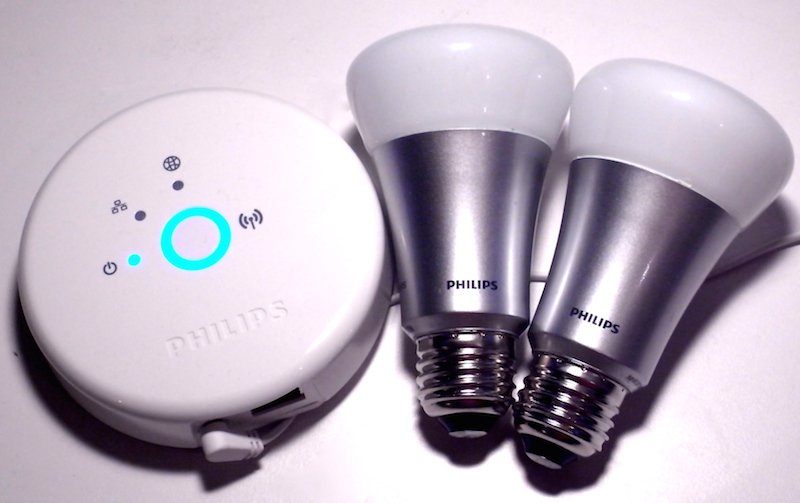
Zigbee is a complete low-power wireless protocol. It has quietly run smart homes for almost twenty years. It defines the whole stack in one package: the radio, the network, and the commands. It’s built on a radio standard called IEEE 802.15.4 and talks in the 2.4 GHz band. When a Zigbee bulb tells a Zigbee switch “turn on,” every part of that exchange is Zigbee’s own.
Three design choices explain why it earned its place in real homes:
- It’s a self-healing mesh. Every plugged-in Zigbee device also works as a repeater. A bulb, an in-wall switch, a smart plug — each one passes signals along for its neighbors. Traffic hops device to device until it arrives. So adding more powered devices makes the network stronger, not weaker. A 40-device mesh can blanket a 2,500 sq ft house, garage and far bedroom included.
- Batteries last for years. The radio wakes briefly, sends a tiny packet, and goes back to sleep. That’s why a Zigbee door sensor can run 1–3 years on one coin cell. A Wi-Fi radio doing the same job would drain that cell in days. It’s also why almost no serious battery sensor uses Wi-Fi.
- The catalog is huge and cheap. Two decades of adoption means well over 4,000 device types and billions of units shipped. Philips Hue, IKEA, Aqara, Sonoff, Tuya, Third Reality, and thousands of smaller brands. Need a leak sensor for under the sink, a mailbox sensor, or a $9 button? Zigbee almost certainly has it today, often for a fraction of the price.
The catch is translation. Zigbee devices speak only Zigbee. They need a hub — a Hue Bridge, a SmartThings hub, an Aqara hub, or a USB stick running Home Assistant — to reach your phone and the internet. Worse, brands layered their own tweaks on top of the standard. A sensor could show extra features on one brand’s hub and lose them on another’s. That mess is exactly the pain Matter was created to fix.
What Is Matter?
Matter is not a radio. That’s the single most important fact in the whole Matter vs Zigbee debate. Get it wrong, and you end up comparing two things that were never the same kind of thing.
Matter is a shared rulebook for how devices talk. It comes from the Connectivity Standards Alliance (CSA) — the same group that stewards Zigbee, which is why the two get confused. Matter defines how a device announces what it is, how your app finds it, how it joins your home securely, and exactly what commands it accepts. It has no network layer of its own. Instead, it rides on networks you already have: Wi-Fi, Ethernet, or a low-power mesh called Thread.
The payoff is compatibility that finally just works. One Matter device can be controlled by Apple Home, Google Home, Amazon Alexa, Samsung SmartThings, and Home Assistant at the same time. There’s no forced cloud account. Setup is usually scanning one QR code or tapping an NFC tag. And control stays local, so a Matter light keeps obeying a wall-switch automation even when your internet is down.
The trade-off in 2026 is maturity. Here’s where the standard honestly stands:
- The spec has reached Matter 1.5, released November 20, 2025. It added the categories early adopters missed most: cameras and video doorbells streamed locally, “closures” like garage doors, blinds and awnings, smart-garden soil sensors and irrigation, and deeper energy features such as two-way EV charging. The CSA has settled into roughly one major release a year — 1.4 in November 2024, 1.5 a year later. That’s a standard stabilizing, not thrashing.
- Product counts are growing fast but still trail Zigbee. Tracking sites list on the order of 750+ shipping or imminent Matter products in 2026. The true number is higher once you count color and region variants. It’s a big jump from a year earlier — and still a fraction of Zigbee’s deep catalog. For the live spec version and product count, check the CSA directly. Both move quickly.
- Platforms lag the spec. A feature published in the spec is not a feature in your app. No single platform implements all of Matter in 2026. Samsung SmartThings tends to be fastest — it announced Matter 1.5 support within weeks. Apple, Google, and Amazon roll out new device types on their own timelines. So confirm your platform handles a category before you buy into it.
How Matter and Zigbee Compare Head to Head
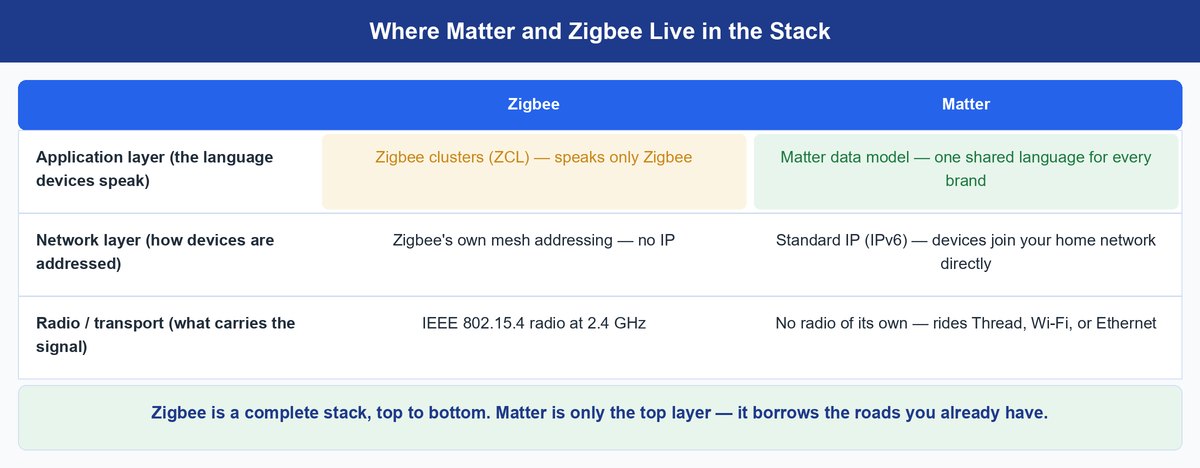
Here’s the side-by-side that settles the difference between Matter and Zigbee. Notice the two aren’t measured on identical axes. One is a radio chip you can point at. The other is software that chip can speak.
| Feature | Zigbee | Matter |
|---|---|---|
| Protocol type | Full wireless protocol (radio + network + app layers) | Application/interoperability standard only |
| Layer it lives on | Physical → application (complete stack) | Application layer; rides on existing networks |
| Underlying radio | IEEE 802.15.4 @ 2.4 GHz | None of its own — uses Wi-Fi, Ethernet, or Thread |
| Mesh networking | Yes (native, self-healing) | Only when running over Thread; not over Wi-Fi |
| Range | ~10–30 m per hop indoors; effectively unlimited via mesh | Depends on transport (Wi-Fi reach, or Thread mesh) |
| Power use | Very low — great for coin-cell battery sensors | Depends on transport (Thread = very low; Wi-Fi = high) |
| Interoperability | Often hub/brand-locked historically | Cross-platform by design (Apple/Google/Alexa/SmartThings) |
| Setup | Pair within a brand’s app/hub | QR-code or NFC commissioning, multi-admin sharing |
| Local control if internet is down | Yes (via local hub) | Yes (local-first by design) |
| Hub/controller required? | Yes — a Zigbee hub/bridge | A Matter “controller”; Thread devices also need a border router |
| Latest version (mid-2026) | Zigbee PRO / Zigbee Direct era | Matter 1.5 (Nov 2025): cameras, closures, garden, energy |
| Ecosystem (mid-2026) | Largest — 4,000+ device types, billions deployed | Growing — ~750+ certified products and climbing |
| Best at | Mature, cheap, deep device selection, battery life | Future-proofing, brand-agnostic freedom, no lock-in |
The honest takeaway: Zigbee wins on selection, price, and proven battery life today. Matter wins on freedom. Buy once, use it on any platform, switch ecosystems later without re-buying hardware.
Security and certification deserve their own quick look. Both systems are solid for home use. They just got there in different ways, and the differences show at setup time.
| Security angle | Zigbee | Matter |
|---|---|---|
| Encryption | AES-128, typically with one shared network key | AES-secured sessions with separate keys per device pair |
| Proving a device is genuine | Optional install codes; rigor varies with the device’s age | Every device carries an identity certificate checked at setup |
| Certification | CSA “Zigbee Certified” program | CSA Matter certification plus a public device ledger (the DCL) |
| Software updates | Left to each maker | Over-the-air updates are defined in the spec itself |
In plain terms: a well-built Zigbee network is safe for home use. Matter simply bakes today’s checks in from day one, for every certified device.
How Matter, Zigbee, and Thread Actually Relate
This is where most explainers go sideways, so let’s be precise. Matter vs zigbee vs thread isn’t a three-way race between equals. It’s a layer cake. See which layer each one occupies, and the whole thing clicks.
- Thread is a radio and mesh, like Zigbee. It’s a low-power, self-healing mesh on the same IEEE 802.15.4 radio at 2.4 GHz. At the chip level, Thread and Zigbee are close cousins. The decisive difference: every Thread device gets its own IPv6 address. It’s a first-class citizen of your home network, not a foreigner needing a translator. Thread reaches the rest of your network through a border router. That’s built into a HomePod mini, an Apple TV 4K, a Nest Hub, newer Echo speakers, and the Aqara Hub M3. You can run several at once with no single point of failure. Unplug one, and the mesh re-routes on its own.
- Matter is the language on top. It runs over a network rather than being one. Run Matter over Thread and you get the best of both worlds: the efficient mesh reliability that made Zigbee great, plus cross-brand compatibility Zigbee never delivered. Run Matter over Wi-Fi instead — common for cameras, plugs, and anything with constant power — and you skip Thread entirely.
So the cleanest pairing in 2026 is Matter over Thread. A useful mental model: Thread is the road. Matter is the shared language every driver speaks. Wi-Fi is a wider, power-hungry road that Matter can also travel when a device needs the bandwidth.
Where does Zigbee land? Zigbee is a parallel road that never touches Matter directly. A Zigbee device can’t speak Matter on its own — it has no IP layer and no Matter vocabulary. But a bridge solves that cleanly, and your years of Zigbee investment aren’t stranded. More on the bridge below. For the official technical reference, the Connectivity Standards Alliance maintains the Matter documentation and the live certified-product directory.
A Real Setup, Layer by Layer
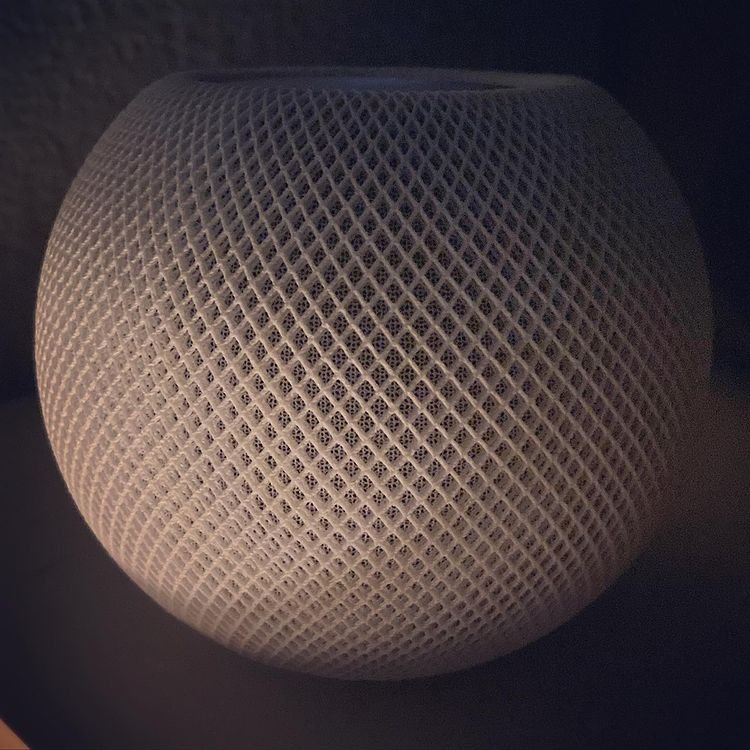
Abstract layers are easy to nod at and hard to act on. So picture a real living room. You buy a Matter-over-Thread temperature sensor for the back bedroom. You scan its QR code in Apple Home, and your iPhone commissions it. The sensor joins the Thread mesh through the nearest border router — say, a HomePod mini in the hallway. The HomePod relays its readings to Apple Home over Wi-Fi. And because Matter supports multiple controllers, you then share the same sensor into Google Home for your partner’s Android phone. No re-pairing. One physical device, two ecosystems, zero compatibility charts.
Now run the Zigbee version of that sensor. You pair it into SmartThings through a SmartThings hub. It joins the Zigbee mesh, repeating through any powered Zigbee device along the way. It works beautifully inside SmartThings. But you can’t simply share it into Apple Home the way Matter allows. The hub itself would have to expose its Zigbee devices to Matter — which newer hubs increasingly do. The device is just as reliable either way. What differs is how easily it moves between platforms.
Migrating Without Throwing Money Away

The fear that stops people from upgrading is wasted hardware. It’s mostly unfounded. You almost never need to rip out a working Zigbee setup to adopt Matter.
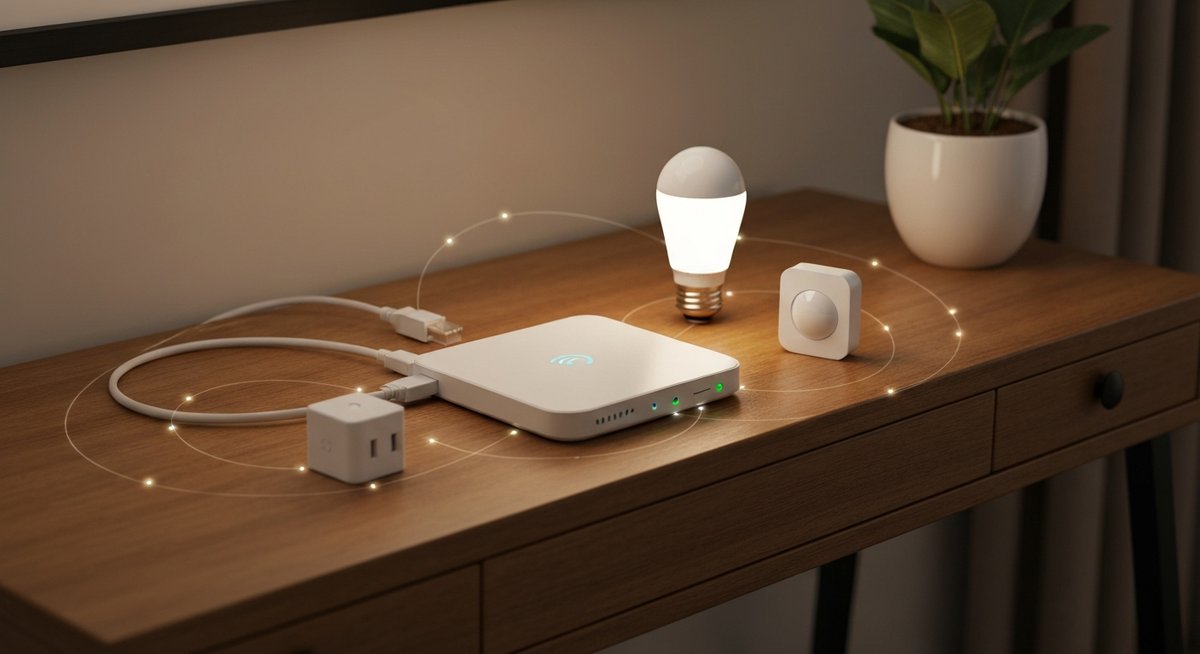
- Add a bridge, keep your gear. A Matter bridge such as the Aqara Hub M3 connects your existing Zigbee devices — it manages on the order of 100+ — and republishes them to Apple Home, Google Home, Alexa, and SmartThings as Matter devices. A drawer full of cheap Zigbee sensors suddenly works in ecosystems that never officially supported them. You re-buy nothing.
- Lean on hubs that do double duty. Many 2026 hubs are three things in one box: a Zigbee coordinator, a Thread border router, and a Matter controller. One box runs legacy Zigbee and new Matter-over-Thread devices side by side. No stack of three bridges and three apps.
- Migrate by attrition, not demolition. Leave working Zigbee devices alone. Buy Matter — ideally over Thread — for every new device going forward. Over a couple of years your network naturally tilts toward the open standard. And you never spend an afternoon re-pairing 50 devices by hand.
One honest caveat before you buy the bridge: not every feature survives the trip across. A bridged device keeps its core function, but some extras stay behind in the maker’s own app. Here’s what typically carries over, device type by device type.
| Device type | Carries over cleanly | What can get lost in translation |
|---|---|---|
| Smart plugs | On/off and automations | Energy-use readings often stay in the maker’s app |
| Bulbs | On/off, dimming, color | Dynamic scenes and effects usually stay in the maker’s app |
| Door/window and temperature sensors | Open/close state and readings | Little to lose — these are simple devices |
| Locks | Lock/unlock and status | Managing user codes and fingerprints usually needs the maker’s app |
| Presence sensors | Basic “someone is here” detection | Room zones and multi-person tracking often don’t carry over |
None of this is a reason to skip the bridge. The core functions carry over, and those are what your automations actually use. Just keep the maker’s app installed for the power-user extras, and check calibration or firmware updates there too.
Troubleshooting and the Gotchas Nobody Mentions
Both ecosystems have rough edges that only show up after you’ve bought in. Know them before you do.
Thread Border-Router Fragmentation Splits Multi-Platform Homes
Run Apple, Google, and Amazon gear together and you can end up with several slightly different Thread networks. A device commissioned through one may be invisible to another’s automations. The fix is sharing Thread credentials across platforms, but that’s still uneven in 2026. If you’re heavily multi-platform, pick one ecosystem as your primary controller so devices don’t get orphaned.
One Cheap Zigbee Bulb Can Quietly Break Your Mesh
Some bargain bulbs are poor repeaters that drop their neighbors’ traffic. Add the wrong $6 bulb, and a previously rock-solid sensor across the room starts going silent. If a battery device turns flaky right after you added powered gear, suspect the new repeater before you blame the battery.
Matter Setup Fails at the Network More Often Than the Device
Matter commissioning relies on your IP network behaving. The usual culprits: devices split across separate Wi-Fi bands, an access point with client isolation turned on, or IPv6 disabled on the router — Thread needs IPv6. If a Matter device refuses to commission, check your router settings before you blame the gadget.
What Each Ecosystem Actually Runs You
Money matters as much as protocol theory, and the two price out differently. Zigbee remains the budget champion. Thousands of makers compete fiercely, so individual Zigbee sensors and bulbs routinely cost less than half of comparable Thread or Wi-Fi devices. A basic Zigbee hub is inexpensive too. Want to outfit a whole house with dozens of contacts, motion sensors, and bulbs on a tight budget? Zigbee is still hard to beat in 2026.
Matter’s cost story is about the money you don’t spend later. A Matter device may cost a few dollars more up front. What you’re really buying is insurance against lock-in. Switch from Alexa to Apple Home in two years, and your Matter gear comes with you. Brand-locked gear might be e-waste. And the honest reality: a mature 2026 smart home is rarely pure either way. Most run a hybrid — Matter over Thread for new and portable devices, a Zigbee mesh for the cheap, deep long tail, and a single hub bridging both.
Which Should You Choose in 2026?
Forget the spec sheet for a second. Match the protocol to your actual situation.
Starting fresh? Choose Matter over Thread. New build, new apartment, or a clean slate — go Matter-first. You get QR-code setup, local control, and the freedom to switch between Apple, Google, and Alexa later without re-buying anything. The hubs you already own often double as Thread border routers, so the entry cost can be near zero. (New to all of this? Our guide on how to set up a smart home for beginners walks through the first steps.)
Want the widest selection or the lowest price? Choose Zigbee. Need a specific niche sensor, dozens of cheap bulbs, or a Home Assistant setup with a USB coordinator? Zigbee’s mature catalog and coin-cell battery life are still unbeaten in 2026. Buy a good hub up front. And favor reputable brands as your powered repeaters, so the mesh stays solid.
Already own Zigbee gear? Don’t rip it out. Add a Matter bridge such as the Aqara M3, and your existing devices become visible to every Matter platform at once. Everything works together, and you re-buy nothing.
Deep in one ecosystem, like all Apple Home? Go Matter over Thread. The major hubs now include Thread border routers. Just confirm the exact category you need — locks, cameras, niche sensors — is supported in your app today, not just in the spec.
The decision rarely needs to be either/or. A practical 2026 home often runs both: Matter over Thread for new and portable devices, Zigbee for the cheap long tail, with a single hub bridging them together.
FAQ
Is Matter replacing Zigbee?
No. Matter is a language, not a radio, so it can’t replace Zigbee’s network technology. They live on different layers. In practice they coexist: Matter unifies how devices are controlled across brands, while Zigbee and Thread move the actual data. Many 2026 hubs run both at once.
Can Zigbee devices work with Matter?
Not on their own. A Zigbee device can’t speak Matter directly, because it lacks Matter’s IP layer and data model. But a Matter bridge like the Aqara Hub M3 translates for it. The bridge shows your Zigbee gear to Apple Home, Google Home, Alexa, and SmartThings as if it were native Matter hardware, so nothing you own is stranded.
What’s the real difference between Matter and Zigbee?
Zigbee is a full wireless protocol: radio, networking, and application layer, all defined together. Matter is only an application-layer language with no radio of its own. It runs over Wi-Fi, Ethernet, or Thread. In one line: Zigbee moves the data, Matter makes brands understand each other.
Is Thread better than Zigbee?
They’re technically close cousins — both are low-power 802.15.4 meshes. Thread’s advantage is native IPv6 addressing, which lets it plug straight into IP networks and pair seamlessly with Matter. Zigbee’s advantage is a far larger, cheaper device catalog in 2026. Neither is universally better. It depends on whether you value portability or selection.
Do I need a hub for Matter?
You need a Matter controller — a smart speaker, a hub, or a compatible phone. Matter-over-Thread devices also need a Thread border router, which is built into many modern hubs from Apple, Google, and Amazon. Matter-over-Wi-Fi devices, like many plugs and cameras, skip the Thread requirement and connect straight to your router.
What’s new in Matter 1.5, and does it matter for buying?
Matter 1.5 (November 2025) added cameras and video doorbells over WebRTC, closures like garage doors and blinds, smart-garden soil sensors and irrigation, and deeper energy features like EV bidirectional charging. Those were the biggest gaps in earlier Matter. But the spec leads platform support, so confirm your specific app has rolled out the category you want before buying.
Are Zigbee devices cheaper than Matter devices?
Usually, yes. Thousands of makers compete in Zigbee, so sensors and bulbs often sell for less than half the price of comparable Thread or Wi-Fi devices. Matter gear tends to cost a few dollars more today. What that premium buys is portability — you won’t re-buy your devices if you ever switch platforms.
Will Zigbee disappear?
Not any time soon. Billions of Zigbee devices are already installed, the CSA still develops the standard, and new Zigbee products keep shipping in 2026. Expect a long coexistence: Matter takes the spotlight for new gear, while Zigbee keeps serving the cheap, deep catalog — often behind a Matter bridge.
Should I buy Matter or Zigbee in 2026?
If you’re starting fresh, buy Matter — ideally over Thread — for future-proof, cross-platform freedom. If you need the widest device selection or the lowest cost, Zigbee still leads. If you already own Zigbee, keep it and add a Matter bridge. You don’t have to choose just one, and most mature homes end up running both.