Go looking for a gaming chair and the first thing Google hands you is not a review. It is a Reddit thread, and it comes from r/BuyItForLife, where the whole point of the place is stuff that does not break. The title is not asking which chair feels nicest. It is asking which ones actually last, and more than 240 comments piled up under it. That tells you what people are really worried about here. So let us take it seriously: the best gaming chair is not the one that wins a comfort test on day one, it is the one still holding you up in year three. This guide covers what your money buys at each step up the ladder, where it stops buying anything your back can feel, and the three chairs worth buying now.
Disclosure: TechDaily is an Amazon affiliate and earns a commission on purchases made through links on this page. It costs you nothing extra, and it does not change which chairs made this list.
- The used office chair advice is right for one specific person and wrong for almost everyone else. It depends on whether you can actually get to one.
- Anything under about eighty dollars is worse than a second-hand office chair, and you find that out in month four rather than week one.
- The step that matters is the one where the lower back support stops being a pillow on an elastic strap and becomes part of the frame.
- Past roughly three hundred dollars your money goes on warranty length and finer adjustment, not on comfort your body can tell apart.
- The GTPLAYER GT800A is the pick when this is your first real chair and the budget is genuinely tight.
- The Corsair TC100 Relaxed is the one most people should buy, because it is the cheapest chair here that gets the boring parts right.
- The Razer Iskur V2 X is for a back that wants support built into the frame instead of a cushion that slides down every hour.
What is actually pushing you to buy one?
★ Your pick: GTPLAYER GT800A
Cheap enough to be a first chair, with a metal base instead of the plastic one that ruins this price tier.
★ Your pick: Razer Iskur V2 X
The lumbar support is built into the frame, so it cannot slide out of position while you play.
★ Your pick: GTPLAYER GT800A
The lowest price here that still buys you a metal frame and a footrest that works.
★ Your pick: Corsair TC100 Relaxed
Built for full days at a desk but priced like a gaming chair, which is the combination you want.
★ Your pick: Razer Iskur V2 X
Razer rates it to 299 pounds, well above the Corsair’s 264, and covers it for three years.
👑 Our Top Pick — Best Overall Value
Corsair TC100 Relaxed
The safe answer. It gets the base, the gas lift and the foam right, and it reclines the furthest of the three at 160 degrees.
Opens on our Top Pick. Tap an option to see the best match for you.
Why the Used Office Chair Advice Is Only Half Right
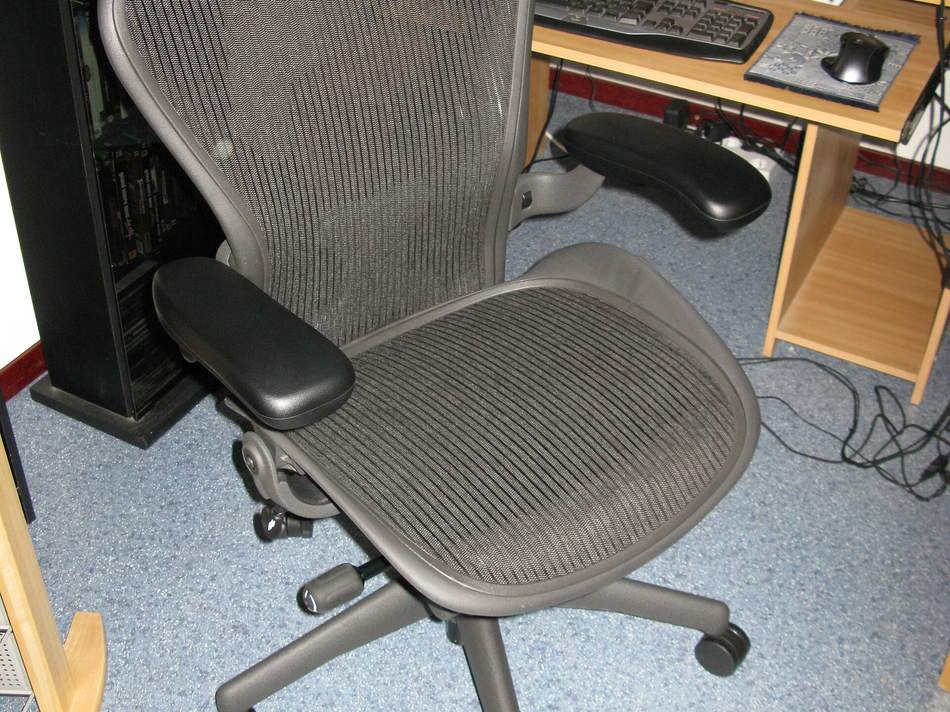
Ask this question anywhere gamers gather and someone will tell you to skip the whole category. Buy a second-hand Herman Miller Aeron or a Steelcase off the local classifieds, they say. Pay the same money. Get a chair built for people who sit in it forty hours a week.
They are not wrong about the chairs. An Aeron was designed to be repaired rather than replaced, and the used ones you see are often fifteen years old and still fine. Nothing sold as a gaming chair at the same money is built to that standard. Herman Miller still sells the gaming versions today, and the cheapest one is just under a thousand dollars while the Embody runs past two thousand. A used one at a third of that is a genuine bargain.
Here is what that advice quietly assumes about you. That there is a used office furniture market near you, because these chairs are heavy and nobody ships them cheaply. That you have a car, or a friend with one. That you do not mind somebody else’s decade already sitting in the foam. And that your body suits a chair built for desk work, with an upright back and no recline worth using.
If all four are true, go and buy the used office chair. Genuinely. You will get more chair for your money than anything below.
For a lot of people at least one of those is false. If you are sixteen and shopping from your bedroom, there is no van and no classifieds run. If you live somewhere with no office churn, there is no supply. If you want to lean back and watch something between matches, an Aeron will not do that and a gaming chair will.
That is why the category exists, and it is why the argument never ends. Both sides are right about different people. The trap is not gaming chairs. The trap is the bottom of the gaming chair market, where the price gets low enough that the parts stop being real.
Worth knowing: Wired’s current gaming chair guide argues that the best gaming chair is also the best office chair, which is a useful way to think about the whole thing. Judge these chairs as furniture you sit in all day. Judge them by the base, the lift and the foam. The racing shape on the back is styling, and styling has never held anybody up.
What Each Step Up in Price Actually Buys You
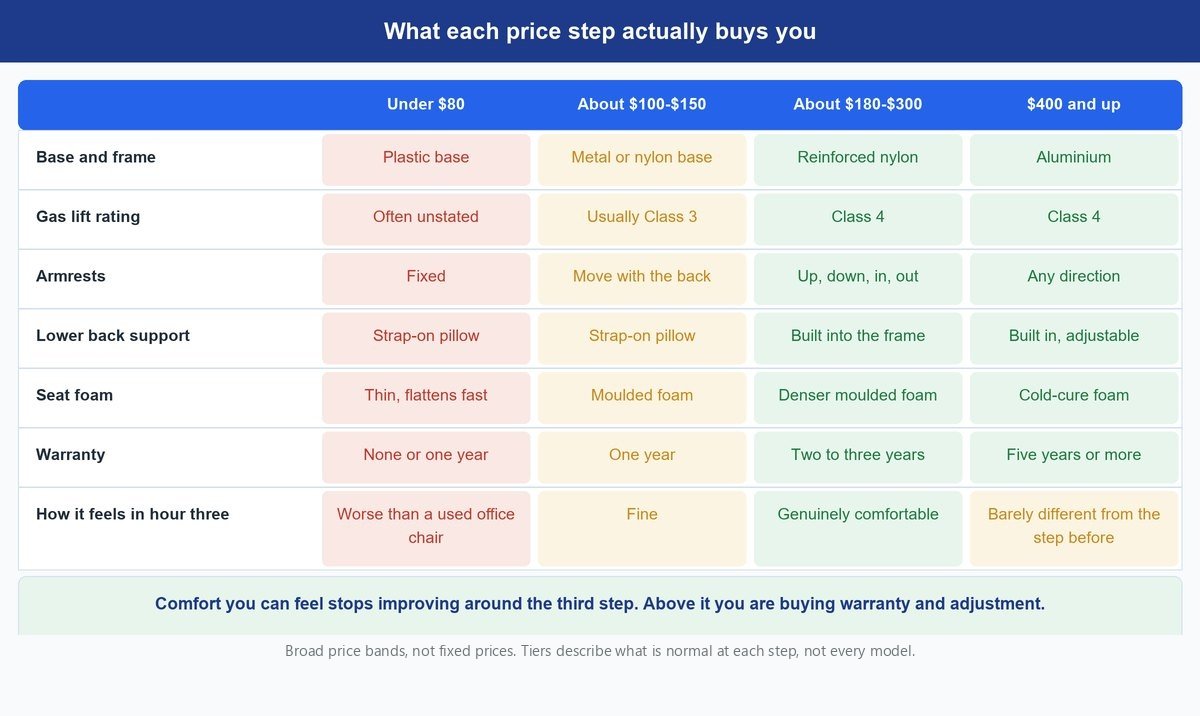
Google shows the two ends of this market on the same search and nothing in between. Herman Miller’s gaming chairs sit on page one from just under a thousand dollars. RESPAWN’s range sits there too, starting around a hundred and ninety. That is a five times gap with no explanation attached, so here is the explanation.
Under About Eighty Dollars Is a Trap
This is where the money runs out before the parts do. The base is usually plastic, the gas lift often has no rating printed anywhere, and the foam is thin enough that you feel the frame through it within a few months. The chair looks identical to the one two steps up in a photo. It is not identical in month six. This is the tier where the used office chair advice is completely correct, and it is the only tier where it is.
About a Hundred to a Hundred and Fifty Buys Real Parts
Here the base becomes metal or proper nylon, the foam is moulded rather than cut from a sheet, and the frame is steel. You often get a retractable footrest at this step too. The armrests are usually linked to the backrest, which means they move when you recline rather than adjusting on their own. That is the compromise you accept for the price, and for most people it is a fair one.
About a Hundred and Eighty to Three Hundred Buys the Most for the Money
This is where the lower back support stops being a cushion held on with elastic and starts being part of the chair. It is also where you reliably get a Class 4 gas lift, armrests that move up, down and inward on their own, and a warranty measured in years rather than months. Both of the more expensive picks below live here. If you only read one line of this article, read this one: this is the step where a chair stops being a compromise.
Four Hundred and Up Buys Longevity, Not Comfort
Aluminium base instead of nylon. Cold-cure foam that holds its shape for longer. Armrests that move four ways instead of two. A warranty of five years or more. All of that is real, and none of it changes how your back feels in hour three compared with the step below. You are buying the chair’s tenth year, not your Tuesday evening. This is the tier where Secretlab’s Titan Evo and Herman Miller’s Vantum live, and it is the tier most other guides lead with. That is a fine reason to spend the money, but it is not the reason the marketing gives you.
Do the math: a chair from that middle step, kept for four years, works out to a few dollars a month. The same four years out of a chair from the bottom tier means buying two or three of them. Cheap chairs are not cheap. They are just cheap first.
The Gaming Chairs Worth Buying Right Now
Three picks, three different reasons, and I have said plainly who should walk past each one. I have not sat in these in a lab, so every number below comes from the maker’s own published specification.
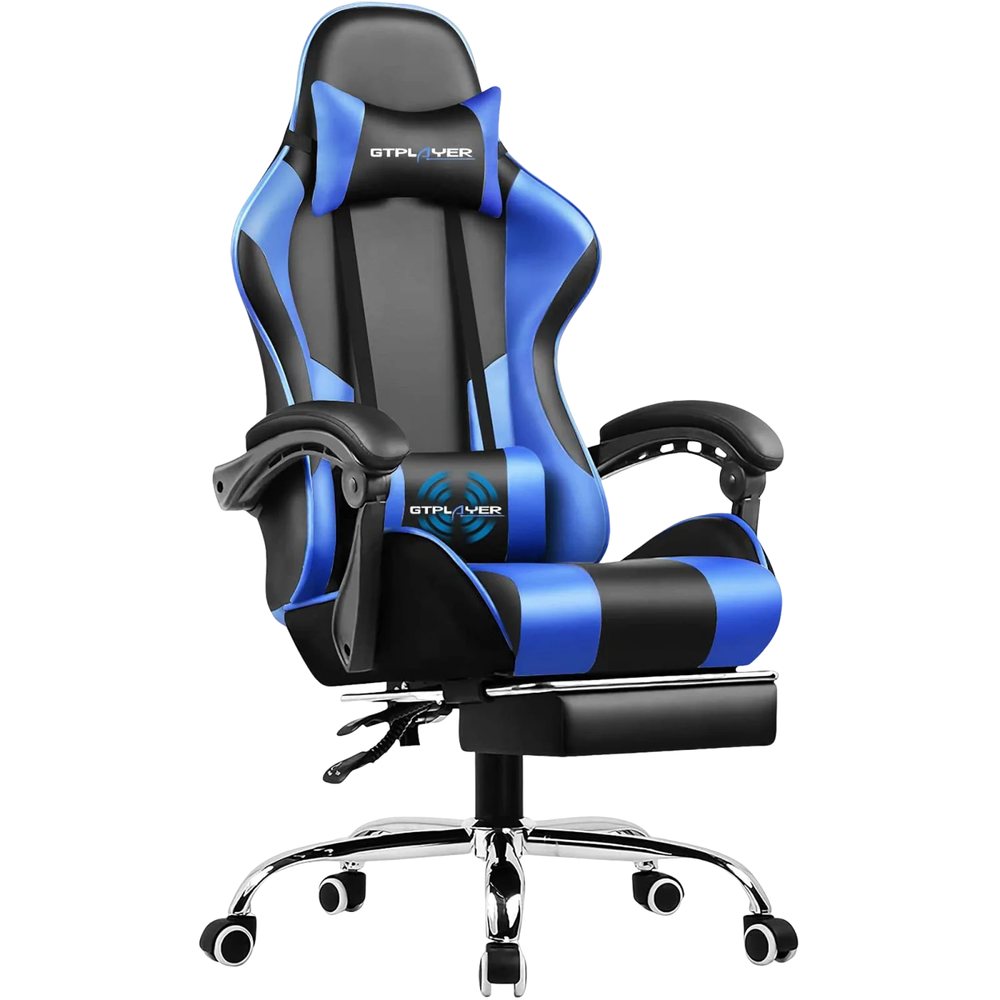
Before you buy: check the model number, not just the picture. GTPLAYER and GTRACING are sister brands from the same maker, and several of their footrest chairs look identical to this one in a thumbnail. Match the model number, GT800A, on the product page to the pick here before you pay.
1. GTPLAYER GT800A — Best First Chair on a Tight Budget
≈ $90–$140Retractable footrestMetal base
This is the chair for someone moving from a dining chair or a hand-me-down to their first real one. It comes from GTPLAYER’s Footrest Series, which tells you the whole idea in two words: a lean-back chair for a room where you watch as much as you play. Pull the footrest out from under the seat, tip the back to its stop, and you have something neither of the other two picks here offers at any price.
What makes it worth having at this money is the base. GTPLAYER uses a metal five-star base and a metal frame rather than the plastic that is normal one step down, and that single choice is the difference between a chair that wobbles by summer and one that does not.
The honest limits are worth knowing before you order. The armrests are linkage type: GTPLAYER pads them and fixes them to the backrest, so they tip with you when you lean back, but you cannot set their height on their own the way the Corsair and Razer arms let you. The recline stops at 135 degrees, against 160 on the Corsair and 152 on the Razer, so this is a chair for leaning back, not lying flat. And the version most people buy is faux leather, which looks good on day one and is the material most likely to crack along the seams eventually. GTPLAYER also sells a Fabric Edition of the same chair, and if your room runs warm that is the one to pick.
Walk past this one if you want armrests you can set and forget, if your lower back needs support built into the frame rather than a cushion, or if you already own something with a metal base. The Corsair buys you a foam density figure printed by the maker, a Class 4 gas lift and 25 more degrees of recline. The Razer buys you the built-in lumbar arch and a three-year warranty. What the GT800A gives back is the footrest and the lowest price of the three. It is a first chair, and it is a good one. It is not an upgrade from a decent chair.
Features
- Metal five-star base and internal metal frame
- Retractable footrest that slides under the seat
- Headrest cushion and lumbar cushion included
- Faux leather or fabric over a thick high-density foam pad
- Linkage armrests that move with the backrest
- Eight colour options
Pros
- A metal base at a price where plastic is the norm.
- Eight colour options, so it does not have to be a black chair.
- The footrest is genuinely useful for anything watched rather than played.
- Cheap enough that it is not a painful mistake if you outgrow it.
Cons
- The armrests cannot be adjusted on their own.
- Recline stops at 135 degrees, the shortest lean of the three.
- The faux leather version ages worse than fabric in a warm room, so pick the Fabric Edition if you can.
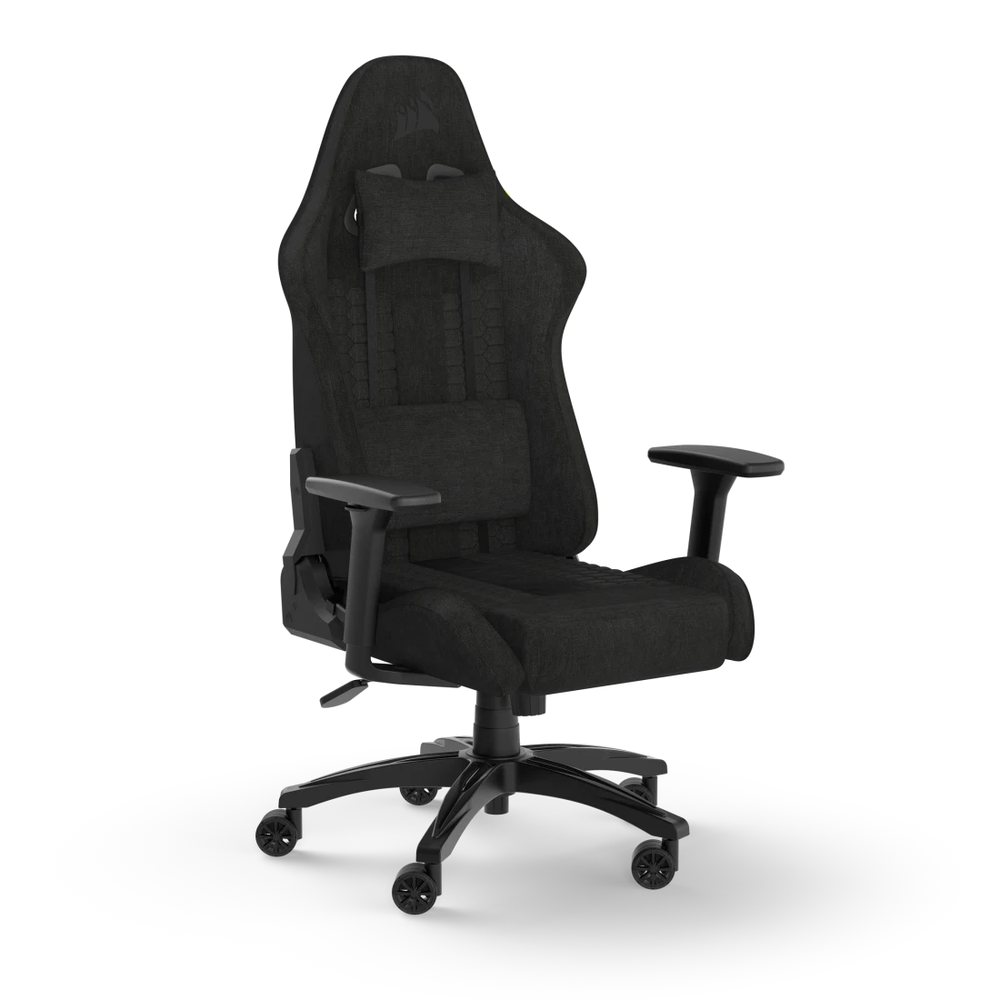
2. Corsair TC100 Relaxed — Best for Long Sessions at a Desk
≈ $180–$270Class 4 gas liftRated 264 lb
This is the one I would buy without asking any follow-up questions. Corsair aimed the Relaxed version at people who found normal racing-style chairs too narrow, and the result is a chair with a wider, flatter seat and softer side bolsters. If you have ever felt like a gaming chair was gripping your hips, this is the fix.
The parts list is where it earns the money. Corsair’s own page quotes a steel frame, a Class 4 gas lift with 100 mm of travel, and foam at 30 kilograms per cubic metre. That foam number is the one nobody advertises and everybody feels. Denser foam is what stops a seat going flat under you, and printing the figure at all is a sign a maker expects you to check.
Go for the fabric version rather than the leatherette one. Fabric breathes, and a chair you sit in for six hours in July is one where breathing beats shine. Corsair quotes a recline range of 90 to 160 degrees, which leans back far enough to nap in without becoming a recliner you cannot work in.
The published limits are the reason to walk past it. Corsair rates the chair to 264 pounds and a maximum user height of six foot two. Those are its numbers, not mine, and if you are outside either one this is not your chair. The lower back support is also a strap-on pillow rather than a built-in shape, so if pillows annoy you, look at the next pick. And the armrests move two ways, not four.
Features
- Steel frame with a nylon five-star base
- Class 4 gas lift with 100 mm of height travel
- Foam quoted by Corsair at 30 kg per cubic metre
- Recline from 90 to 160 degrees, plus seat tilt
- Two-way adjustable armrests
- Neck and lumbar pillows included, two-year warranty
Pros
- A 54 cm wide, flat seat with soft bolsters, which suits most bodies better than a racing bucket.
- Corsair publishes the specs that actually predict lifespan, including foam density.
- The fabric version stays cool through long sessions.
- The longest recline here at 160 degrees, with a 10-degree seat tilt on top.
Cons
- The published weight limit is the lowest here at 264 pounds.
- Lower back support is a pillow you have to keep repositioning.
- Black on black with almost no colour choice, if that matters to you.
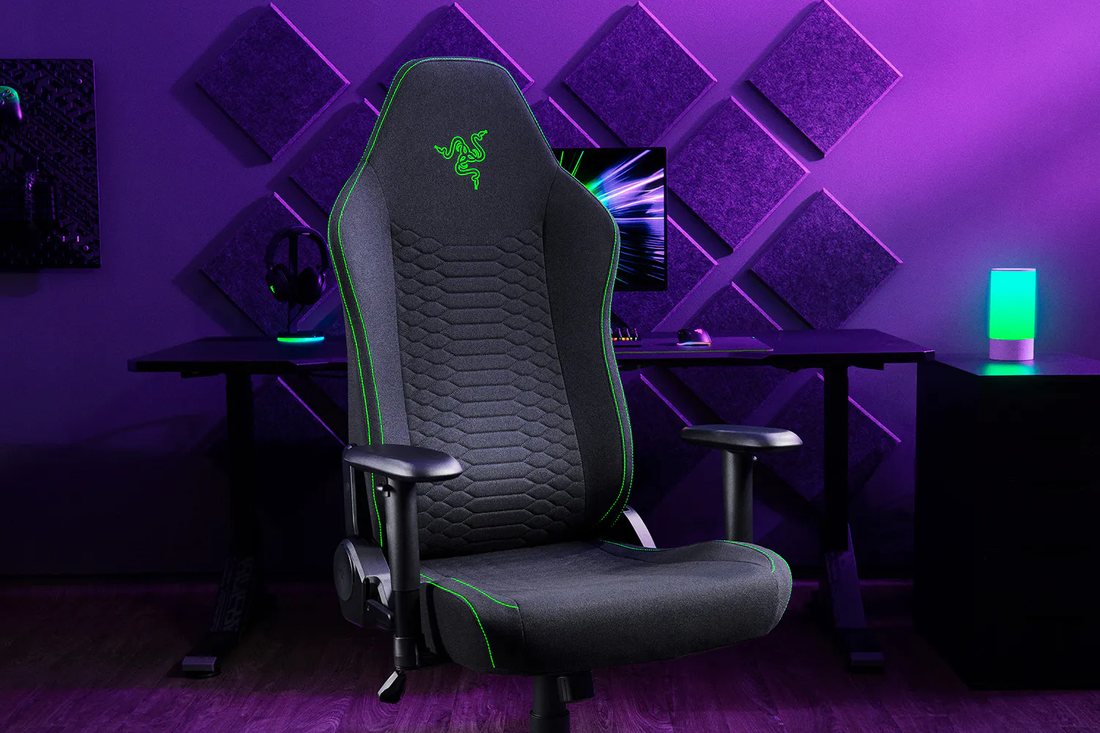
3. Razer Iskur V2 X — Best Back Support Without a Pillow
≈ $250–$300Built-in lumbar archRated 299 lb
Every other chair here hands you a cushion and a strap and wishes you luck. This one builds the curve into the backrest itself. Razer’s page describes a lumbar arch shaped into the frame, and the practical difference is that it is still in the right place at midnight. A strapped-on pillow slides. A shaped back cannot.
It is also a wide chair by Razer’s own numbers, with a seat base widened to 545 millimetres and the edges reduced, a touch wider than the Corsair’s 540. Razer rates it to 299 pounds and covers it for three years, the longest warranty in this group. For a chair you plan to keep, that is worth more than another inch of padding.
Razer also makes an Iskur V2 X NewGen, and the difference is the surface, not the shape. The NewGen swaps the fabric for Razer’s Gen-2 EPU leather with a cooling finish, and it stretches the fit range up to six foot six. The plain V2 X is the fabric one, and it is the one this card recommends: fabric breathes on its own, and it is the safer material in a warm room, as the wear section below explains. Both versions share the same built-in lumbar arch, the same 299-pound rating, the same 152-degree recline and the same three-year warranty. So unless you are over six foot two or you want the leather look, the fabric chair is the one to buy.
Walk past this if the built-in arch does not match your spine. That is the trade you make for support that cannot move: when the shape suits you it is the best back here by a distance, and when it does not you cannot adjust your way out of it. Razer publishes a fit range of five foot three to six foot two, so check yourself against it first. There is also no footrest, so if leaning back with your feet up is the plan, the GT800A does that and this does not.
Features
- Lumbar arch shaped into the backrest, not a separate pillow
- Seat base widened to 545 mm with a softened front edge
- Weight rating of 299 pounds, above the Corsair’s 264
- Recline to 152 degrees
- Two-way adjustable armrests
- Breathable fabric upholstery, three-year warranty
Pros
- Back support that stays exactly where it should, session after session.
- A wider seat and a higher weight rating than the Corsair.
- Three years of cover, longer than either other pick.
- Fabric rather than a shiny surface, so it stays cool.
Cons
- A fixed arch is wrong for you or right for you, and you cannot change it.
- No footrest at all.
- Recline stops at 152 degrees, eight short of the Corsair.
What Actually Breaks First on a Cheap Chair
Chairs rarely die all at once. They fail in a fixed order, and knowing the order tells you exactly which specs to read. Here are the four parts, in the sequence they usually give up.
The Gas Lift Is Usually the First Part to Fail
The gas lift is the metal cylinder under the seat that sets your height. When it goes, the chair sinks slowly while you sit in it, and there is no fix except a new cylinder. These cylinders are sold in classes, and Class 4 is the strong one. Corsair prints the class on the product page. Chairs at the bottom of the market usually do not print it at all, which tells you something on its own. A cylinder is cheap to replace if you are willing to do it, and most people simply buy a new chair instead.
The Base Decides Whether the Chair Wobbles
The five-star base takes your whole weight and every shove sideways. Plastic bases flex a little more each month until one arm cracks, usually near a caster. Metal and reinforced nylon do not. This is the single spec that separates a chair worth buying at the low end from one that is not, and it is easy to check because makers who use metal always say so.
Foam Density Is the Comfort Spec Nobody Prints
Seat foam is why a chair that felt great in month one feels like a plank in month ten. Density is measured in kilograms per cubic metre, and it is the number almost nobody publishes. Corsair’s 30 figure is a rare exception. When a maker stays quiet about foam, assume it is thin, and expect to be sitting on the frame sooner than you would like.
Faux Leather Peels and Fabric Does Not
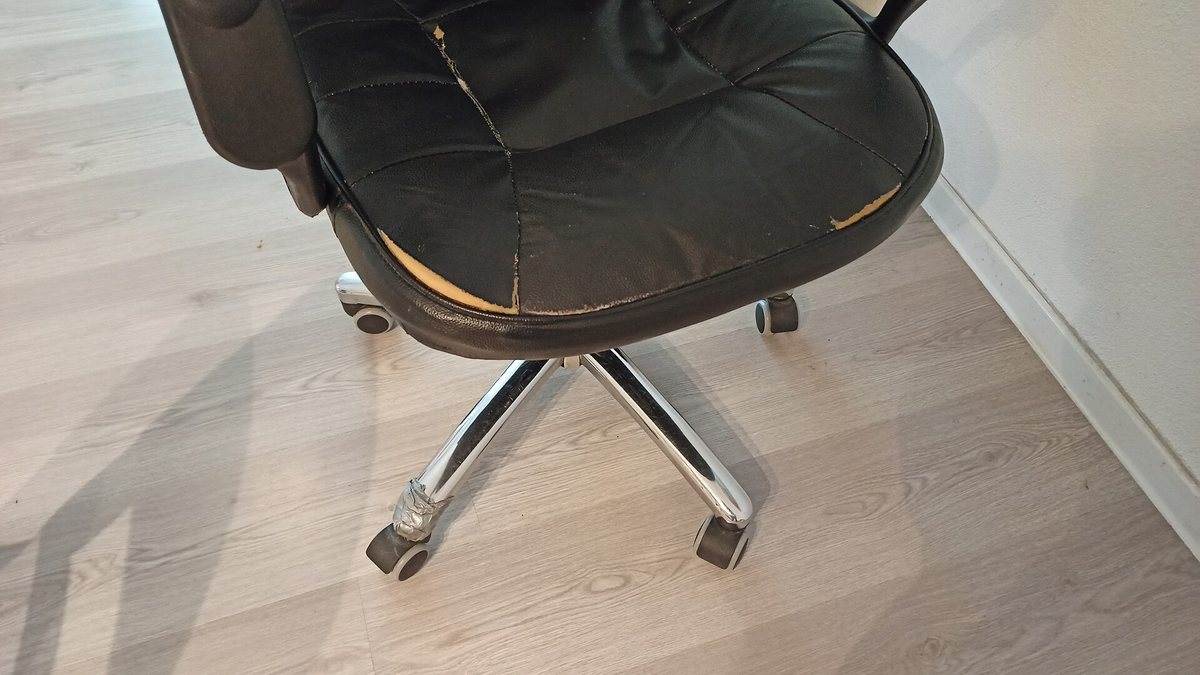
Faux leather is a plastic coating on a backing cloth. Sweat, heat and friction break that coating down, and once it starts it flakes off in patches around the seat edge and the front of the armrests. Fabric wears differently. It goes shiny and it collects crumbs, but it does not shed. If your room gets warm, fabric is the safer buy every time.
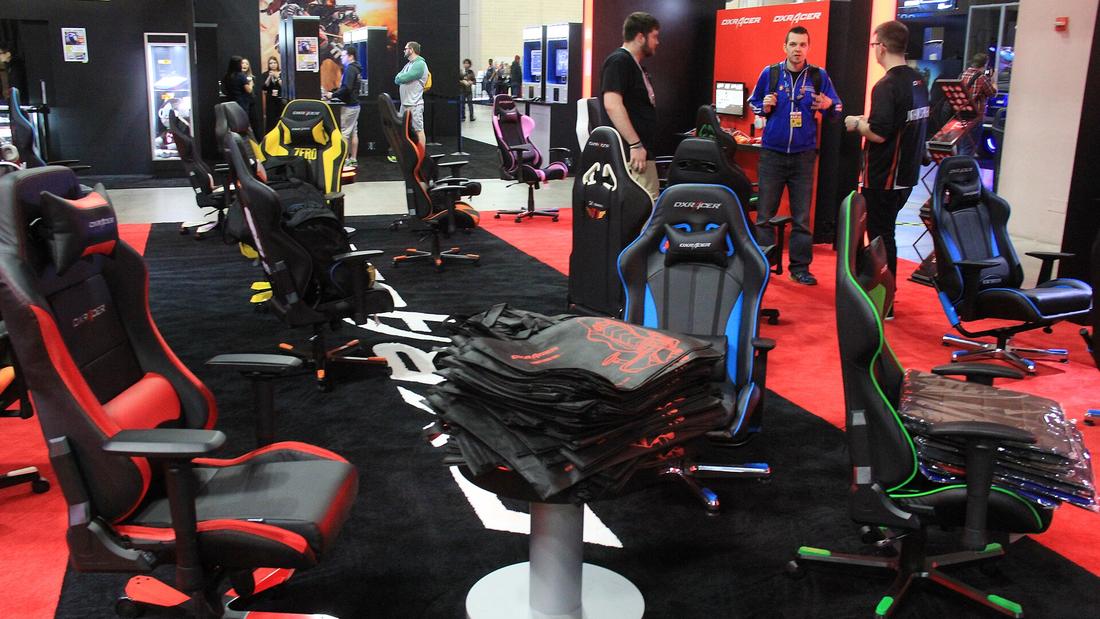
Real talk: the split seat in the photo above is the only one of these four you can see coming, because faux leather always tears first along the front edge you slide across getting in and out. The other three fail quietly and you notice them late. So when two chairs cost the same, spend thirty seconds on the base material and the gas lift class instead of the colour. That is the whole trick.
How to Size a Chair to Your Body Before You Buy
Every chair here publishes a fit range, and it is the spec most people skip. Then they wonder why a well-reviewed chair feels wrong. A review describes a chair against the reviewer’s body, not yours.
Height first, then weight. Both numbers are on the maker’s page, and being outside either one is not something a cushion can fix. Ratings do carry a safety margin, but sitting near the top of one for years is how a base cracks early.
Then measure. Sit on any chair you own with your feet flat, and measure from the floor to the top of your thigh. That is the seat height you want, and every chair publishes its range. A chair that cannot go low enough leaves your feet dangling. One that cannot go high enough puts your wrists above your elbows and your shoulders around your ears. If you land slightly too low, a separate footrest fixes it for pocket money.
Last, be honest about how you sit. If you lean back to watch things, the footrest pick earns its place. If you sit forward and forget to move for four hours, put the money into lower back support instead. A chair fixes posture only in the sense that it stops fighting you, which is why the rest of the desk matters too. Our guide to a second monitor that will not show up covers the other half of getting your neck straight, and if it is your gear rather than your seat holding you back, start with the cable feeding your PC.
Frequently Asked Questions
Is a gaming chair actually worth it?
It depends entirely on the alternative in front of you. Against a dining chair or a cheap supermarket task chair, yes, easily. Against a used Herman Miller or Steelcase at the same money, no. The catch is that the used chair needs a local market, transport, and tolerance for someone else’s wear. If you cannot tick all three, a mid-priced gaming chair is the sensible answer rather than a consolation prize.
Is a used office chair better than a new gaming chair?
At the same money, usually yes on materials and lifespan. An old Aeron or Leap was built to be repaired, and used ones are often still solid after a decade. What you give up is recline, delivery and choice, because you buy whatever your area happens to be selling. If leaning back matters to you, that trade is not automatically worth it.
How much should I spend on a gaming chair?
Between roughly a hundred and eighty and three hundred dollars if you can. That band is where lower back support gets built into the frame, the gas lift is rated properly, and the warranty is measured in years. Below about eighty dollars the parts stop being real. Above roughly three hundred you are buying a longer life and finer adjustment rather than comfort you can feel today.
Do gaming chairs cause back pain?
A chair does not cause back pain on its own, but the wrong one lets it happen. The usual culprits are a lumbar cushion that has slid down out of position, a seat too deep for your legs so the edge presses behind your knees, and a height that leaves your feet unsupported. Fix the height first, then the lumbar position, then the seat depth. Getting up every hour does more than any chair on this page.
How long should a gaming chair last?
Three to five years is a fair expectation in the middle of the market, and the warranty is your best clue. Corsair covers the TC100 Relaxed for two years and Razer covers the Iskur V2 X for three, which tells you roughly what each maker expects. Chairs under about eighty dollars often start sagging or wobbling inside a year, which is why they cost more over time rather than less.
What is a Class 4 gas lift and does it matter?
It is a strength grade for the cylinder that raises and lowers your seat, and Class 4 is the sturdy one used in proper office chairs. It matters because a failing cylinder is the most common way a chair dies. It sinks slowly while you sit, and it cannot be adjusted back. If a maker does not print a gas lift class anywhere on its product page, treat that silence as an answer.
The Bottom Line Before You Spend
That Reddit thread ranks first because it asked the honest question. So here is our answer to it. Buy for the parts that hold you up, not the shape of the backrest. Check the base material, check the gas lift class, and check your own height and weight against the numbers the maker publishes. Those checks take a minute and they decide almost everything.
For most people the Corsair TC100 Relaxed ends the search, because it is the cheapest chair here that gets the boring parts right. Take the GTPLAYER GT800A if this is your first real chair and money is tight, and the Razer Iskur V2 X if your lower back wants support that cannot slide out of place. And if you have a used furniture market down the road and a way to carry one home, go and sit in a second-hand office chair first. That advice is still good. It just is not good for everybody, and knowing which one you are is the whole decision.
Featured photo: Daniel Benavides, CC BY 2.0.