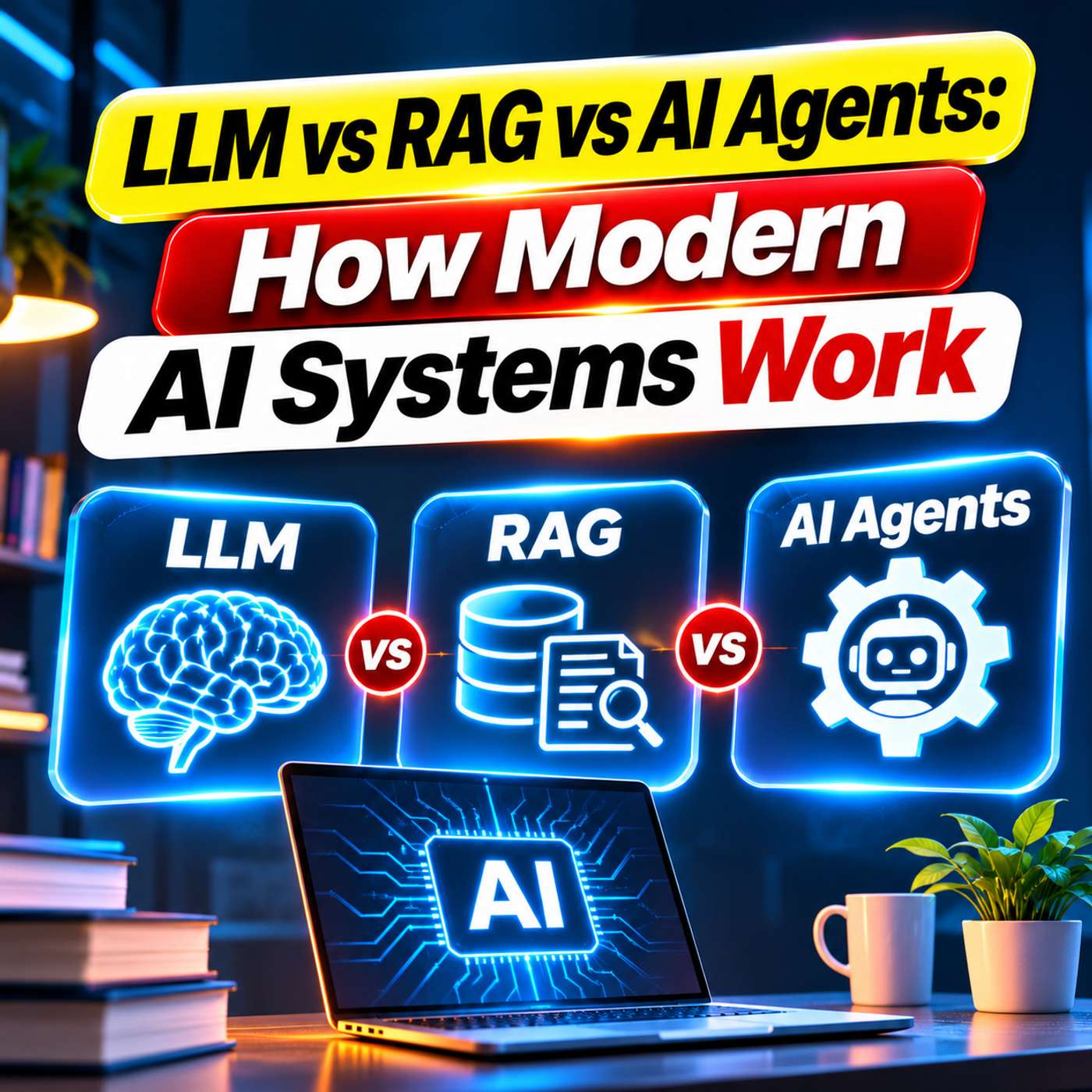


How does artificial intelligence actually work? What connects large language models (LLMs), AI agents, retrieval-augmented generation (RAG), Model Context Protocol (MCP), and system prompts into the powerful AI systems we use today?
In this episode of TechDaily.ai, host David and expert Sophia explore the architecture behind modern artificial intelligence, using a fascinating comparison between AI technology and the human brain.
Rather than getting lost in complex technical jargon, David and Sophia break down how AI models process information, learn from training data, retrieve external knowledge, execute tasks, and follow security instructions.
The conversation begins with a surprising question: Why can an AI system solve complex problems yet sometimes fall for a cleverly worded prompt?
The answer reveals how different components of modern AI work together—and where their limitations create new challenges.
In This Episode, You’ll Discover:
- How large language models (LLMs) generate responses using probability, tokens, and neural networks.
- Why pre-training and fine-tuning are essential to developing useful AI models.
- How retrieval-augmented generation (RAG) connects AI systems to external information and helps reduce hallucinations.
- How autonomous AI agents use reasoning, actions, and feedback loops to complete complex tasks.
- What Model Context Protocol (MCP) does and how it connects AI models with external tools, databases, and applications.
- Why prompt injection attacks exploit weaknesses in AI instruction-following.
- How system prompts establish behavioral guidelines, safety restrictions, and operating boundaries.
- Why AI developers face challenges when balancing advanced capabilities with security.
- How AI architecture mirrors aspects of human learning, cognition, decision-making, and behavior.
From AI Models to Autonomous Agents
A large language model may function as the computational brain of an AI system, but advanced AI applications require additional components.
RAG provides access to relevant external information. AI agents introduce the ability to act on tasks through repeated reasoning and observation. MCP helps connect those agents to external tools and services.
Together, these technologies enable AI systems to move beyond simple conversations toward more sophisticated automation and real-world applications.
The Hidden Security Challenges of AI
As AI systems gain more capabilities, they also introduce new security concerns.
David and Sophia examine how prompt injection attempts can manipulate AI behavior, why instruction-following models remain vulnerable to deceptive requests, and how system prompts are used to define operating rules.
The discussion highlights an important reality: Building capable AI systems requires more than intelligence. It also requires reliable safeguards, controlled access to tools, and careful management of how instructions are processed.
The Future of Artificial Intelligence
As AI models become increasingly capable of learning patterns, retrieving knowledge, and completing tasks, the distinction between human and machine intelligence raises fascinating questions.
Could future AI systems eventually resemble human cognitive processes so closely that our definition of intelligence begins to change?
Join David and Sophia for an accessible exploration of LLMs, RAG, AI agents, MCP, AI safety, and the engineering behind modern artificial intelligence.
Subscribe to TechDaily.ai for more discussions about artificial intelligence, emerging technology, AI automation, machine learning, and the future of intelligent systems.
Sponsor TechDaily.ai for just $25 and feature your message across major podcast platforms, including Spotify, Apple Podcasts, and Amazon Music.
Visit: https://techdaily.ai