Every TV looks incredible in the store. Then you get one home. The afternoon sun hits the wall, and the picture that wowed you goes gray and flat. So here is the truth about OLED vs Mini LED: neither one is the better TV. One of them is the better TV for your room. OLED owns the dark. Mini LED owns the light. Skip the spec sheets for now. Stand where the TV will live and look at the light around you. That one check settles the fight for almost everyone. It takes five minutes, not five weeks of review videos.
Quick disclosure so we are square: the product links below are affiliate links. If you buy through one, we earn a small commission at no extra cost to you.
- Your room picks the winner, not the spec sheet. Dark or dim room, buy OLED. Bright living room, buy Mini LED.
- OLED pixels make their own light and can switch fully off. That is why its black is perfect and nothing touches it in the dark.
- Mini LED pushes two to four times more brightness on full-screen scenes. Sports and daytime TV stay punchy with the curtains open.
- Burn-in on OLED is real, but one habit causes it: the same static image on screen for hours, every day. Movies and mixed TV will not do it.
- Mini LED buys more screen for the money. A flagship 65-inch Mini LED costs hundreds less than the OLED it fights.
- Dark-room gamers should go OLED. Its pixels react faster than any liquid crystal, so fast motion stays sharp.
Where will this TV live, and what fills the screen most nights?
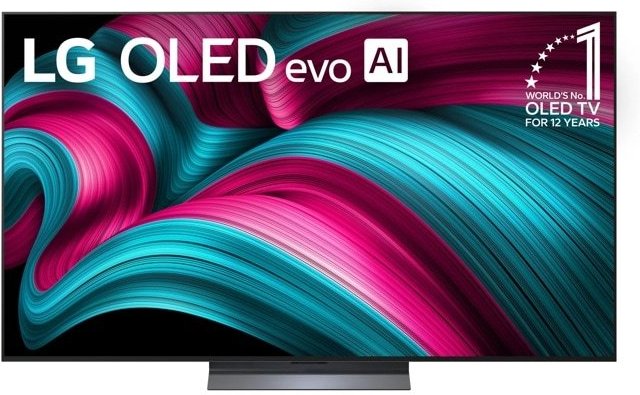
★ Your pick: LG C5
Perfect blacks turn a dim room into a private theater
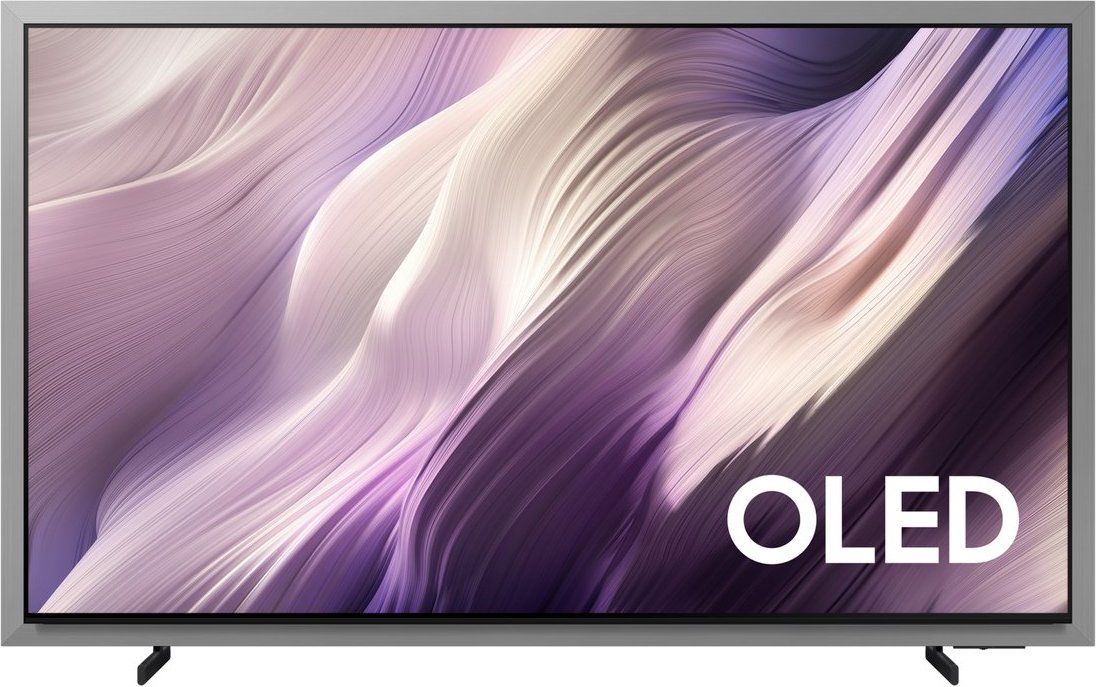
★ Your pick: Samsung S95H
The brightest, cleanest OLED picture sold in 2026
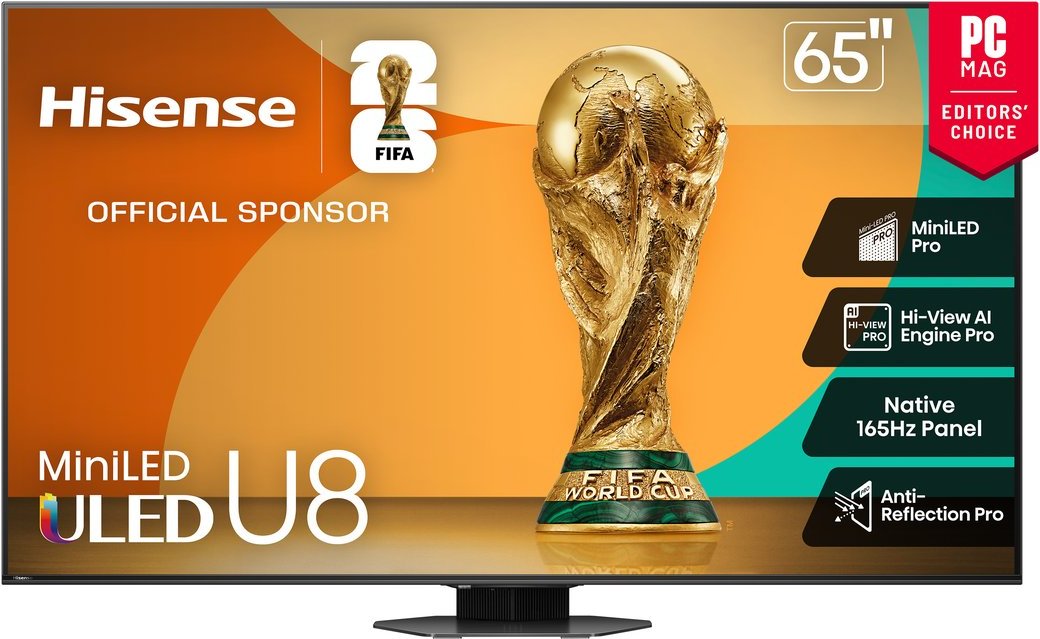
★ Your pick: Hisense U8QG
Flagship-class brightness without the flagship bill
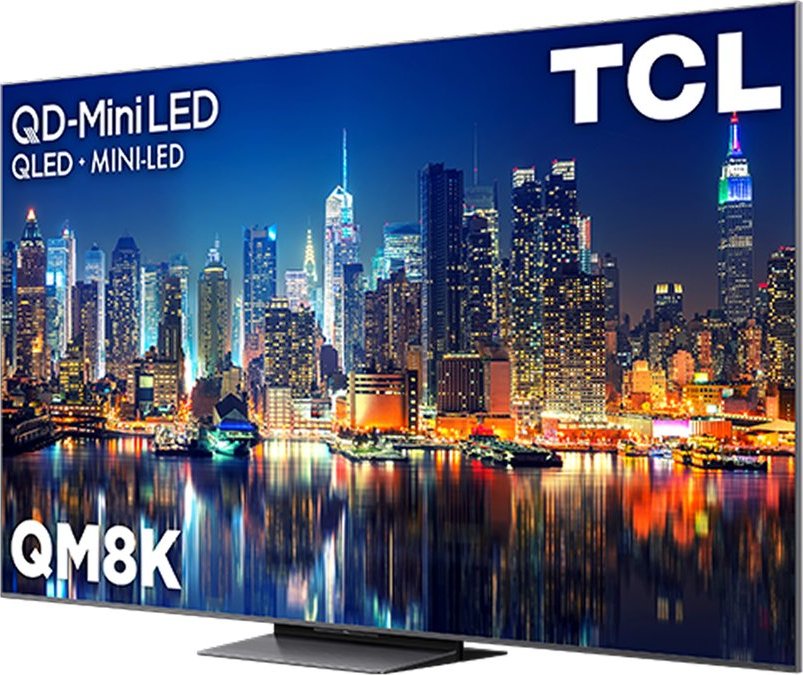
👑 Our Top Pick — Best Overall Value
TCL QM8K
Bright room, sports, movies — the most picture per dollar right now
Opens on our Top Pick. Tap an option to see the best match for you.
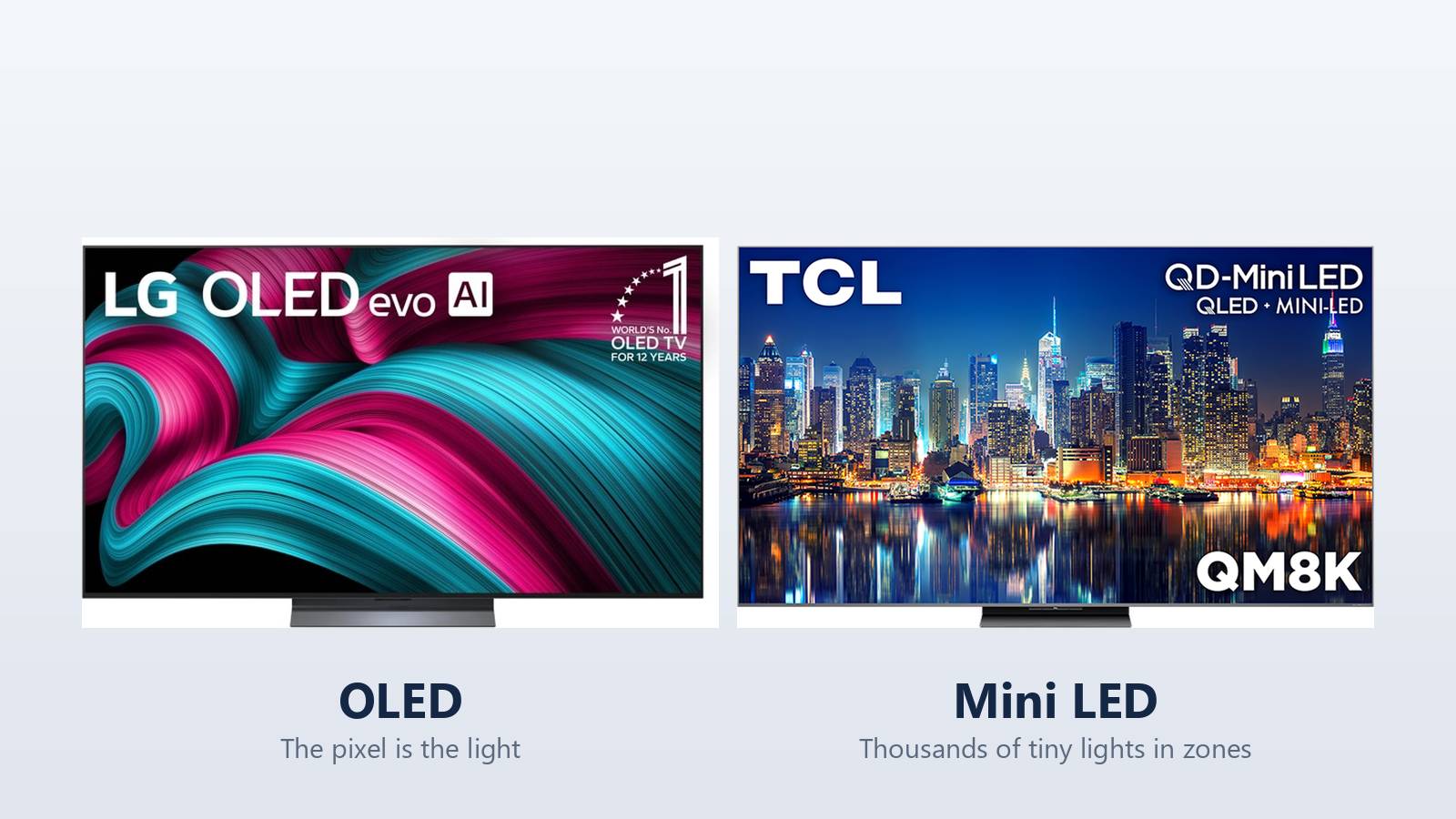
How OLED and Mini LED Make Their Light
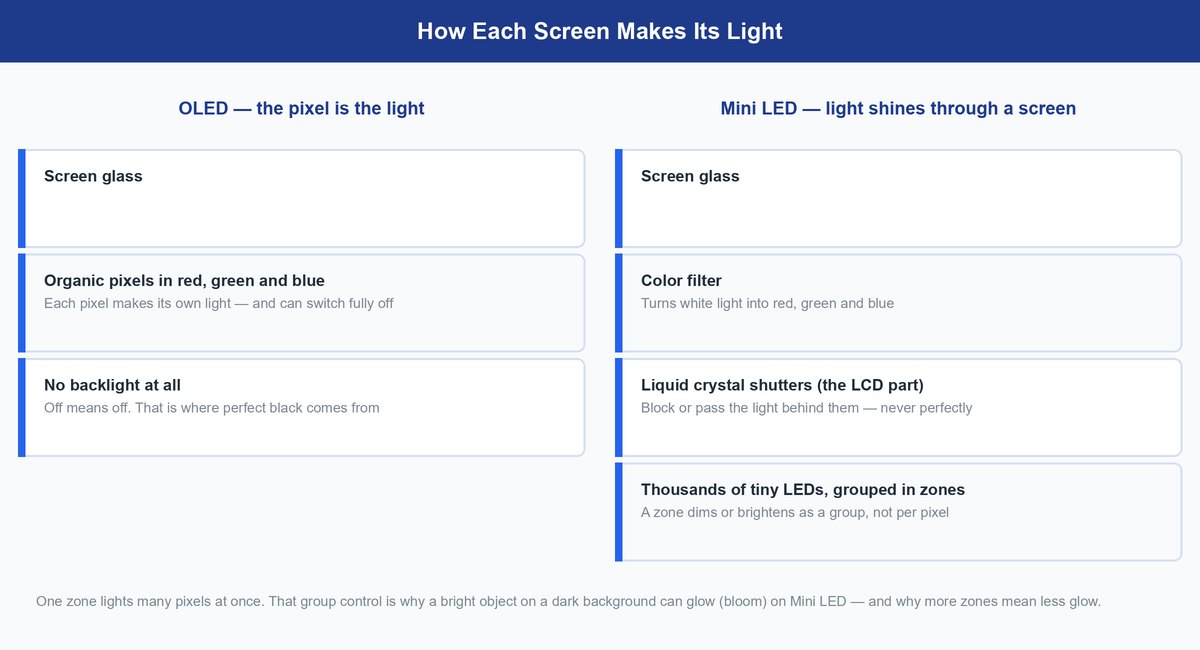
Forget the alphabet soup for a second. These two screens solve the same problem in opposite ways. Every difference you will ever notice flows from that.
OLED Pixels Make Their Own Light
An OLED screen is millions of tiny lights, one per pixel. Each one mixes its own red, green, and blue. There is no lamp behind the screen. When a pixel needs to show black, it turns off. Off means off — not dimmed, not filtered, off. That is why space scenes and dark movies look so deep on OLED. The trade-off: those tiny organic lights cannot run flat out across the whole screen. Fill the picture with a snowy ski slope and the TV quietly dims itself to protect the panel. In a dark room you will never notice. In a sunny one, you will.
Mini LED Shines Thousands of Tiny Lights Through a Screen
A Mini LED TV is a normal LCD screen with a much smarter flashlight behind it. Thousands of rice-grain LEDs sit in a grid. They are grouped into zones that brighten or dim together. Those LEDs are simple and tough, so the TV can floor them all day. That is exactly the power a bright room demands. The weak spot: a zone covers many pixels. Put one streetlamp on a black screen and its whole zone glows faintly around it. That halo effect is called blooming. More zones shrink the halo.
Worth knowing: zone count is the honest quality number on a Mini LED spec sheet. A few hundred zones looks good. Past a thousand, blooming mostly disappears in real content. And the “up to 5,000 zones” headlines usually apply only to the largest screen size in the line.
The Room You Watch in Decides the Winner
Here is the test. Sit where your couch is, at the time of day you actually watch. Count the light: windows with no blackout curtains, lamps you leave on, an open kitchen behind you. If the room is bright and stays bright, Mini LED wins, and it is not close. Its full-screen brightness runs two to four times higher than OLED can hold. A football pitch or a bright news studio keeps its punch instead of washing out.
Now flip it. If you watch at night, or you can kill the lights when a movie starts, OLED wins just as hard. In the dark, blooming has nowhere to hide on a Mini LED. OLED’s perfect black makes the picture float in the room. Dark-room viewers often call the jump to OLED bigger than the jump from 1080p to 4K. We made the same point about resolution in why 4K vs 1080p comes down to your couch: your viewing conditions beat the spec sheet every time.
Before you buy: the store display is rigged against this test. Showroom TVs run their loudest picture mode under bright retail lighting. That hides both OLED’s brightness limit and Mini LED’s blooming. Trust nothing in an aisle that you cannot re-check at home during the return window.
Burn-In Is Real but One Habit Decides Your Risk
Let us handle the scare word honestly. Half the internet oversells it; the other half pretends it is gone. OLED pixels are organic and they age as they work. A pixel that works harder than its neighbors, for long enough, ages faster. Leave the same news ticker, channel logo, or game scoreboard up for hours every day, and over years a faint ghost of it can etch in. That is burn-in. RTINGS’ long-running real-life burn-in test shows exactly that pattern: varied viewing leaves panels healthy, while static content grinds them down.
So the rule is simple. Mixed viewing — movies, shows, sports, different games — carries low real-world risk. Modern panels also run pixel-shift and refresh cycles behind the scenes to spread the wear. The true danger case is a screen that shows the same static image most of the day. Mini LED cannot burn in at all. Its inorganic LEDs age slowly and evenly, like every LCD TV you have ever owned.
One warning: if the TV will double as a PC monitor, with a taskbar parked on screen six hours a day, buy Mini LED and never think about this again. Every major TV brand’s warranty excludes burn-in. An etched taskbar is your bill, not theirs.
What Gamers Should Pick and Why
Gaming splits along the same room line, with one extra twist: speed. An OLED pixel changes state near-instantly. The liquid crystals in a Mini LED need a few milliseconds to twist. On screen, that means fast motion stays tack-sharp on OLED and smears slightly on LCD in the fastest shooters. Both techs now carry the features that matter. Variable refresh rate stops tearing. Auto low-latency modes cut lag. Everything worth buying runs at 120 Hz or faster.
So the call looks like this. Competitive and dark-room gamers should take OLED and enjoy the cleanest motion money buys. Marathon players who leave a HUD up all weekend, or anyone gaming in a bright room, should take Mini LED. The HDR highlights hit harder and the static-image worry disappears. If the TV is mainly a games machine, our guide to the three specs that decide the best TV for gaming goes deeper on ports and panel speed.
The Four TVs That Settle This in 2026
Four screens, four budgets. Each one is the right answer to a different room. All four are current models we verified on their makers’ own product pages.
1. TCL QM8K — Best Mini LED for Most Rooms
$1,500–$2,500 rangeUp to 3,800 zones144Hz nativeB&O soundGoogle TV
The QM8K is the TV this whole guide has been building toward. It is the one most people should buy. TCL’s flagship Mini LED has one party trick: a tiny lens over each LED, which TCL calls Halo Control. The lens shapes the light before it ever reaches the screen. Add up to 3,800 dimming zones as the sizes climb, and blooming nearly vanishes. It is the least halo any LCD shows at this money. Bright-room punch is absurd, too. TCL rates the series for up to 5,000-nit highlights. Real scenes land well below lab numbers, but it still walks past any OLED once sunlight enters the room.
The rest of the sheet reads like a wishlist. The native 144 Hz panel takes PC gamers past console speed. FreeSync Premium Pro stops tearing. The speakers are tuned by Bang & Olufsen — rare TV audio you can actually live with. Google TV runs the smart side without lag.
Against the other picks, the QM8K loses only in a pitch-dark room. There, the C5’s perfect black beats its very good black. It out-brights the U8QG with cleaner zone control, and it costs far less than the S95H. Buy it for a bright living room, sports, and family duty. Skip it only if you watch movies in the dark — that is OLED country.
Pros
- Up to 3,800 dimming zones with lens-shaped light control keep blooming near invisible
- Searing highlight brightness that shrugs off a sunlit room
- Native 144 Hz panel with FreeSync Premium Pro for serious gaming
- Bang & Olufsen-tuned speakers beat typical built-in TV sound
- Costs hundreds less than flagship OLED at every size
Cons
- Blacks are very good, not the perfect black OLED gives a dark room
- Faint blooming still shows on starfields and subtitles in the dark
- Only one of its four HDMI ports carries eARC, so receiver setups need planning
2. LG C5 — Best OLED for Dark Rooms
$1,500–$2,500 rangeOLED evo panelPerfect black144HzFour HDMI 2.1
The C5 is the OLED most OLED buyers should get. It is the reason the C-series outsells everything above it. The evo panel and LG’s Brightness Booster push highlights well past older budget OLEDs, so HDR sparkle actually sparkles. Every pixel still switches fully off. In a dim room the result embarrasses TVs at twice the price. No halo around credits. No gray fog over letterbox bars. Just image and void.
It is also quietly the best-equipped gaming TV here. All four HDMI ports run full 2.1 bandwidth. The panel reaches 144 Hz, with both G-Sync and FreeSync on board. No port juggling when a console, a PC, and a soundbar all want in. webOS stays fast. The anti-glare coating handles a lamp or two, though direct sun is still the enemy.
Head-to-head, the C5 gives up full-screen brightness to the QM8K and U8QG. A snowy match with the curtains open will look dimmer here. It also gives up the last word in color punch to the S95H’s quantum-dot panel. What it keeps is the crown for picture-per-dollar in a controlled room. Buy it if you watch at night and want the movie-theater effect at home. Skip it if the room is bright all day, or if a static desktop will live on it.
Pros
- Per-pixel light control gives genuinely perfect black in a dark room
- Brightness Booster lifts highlights well past older mid-range OLEDs
- Four full-bandwidth HDMI 2.1 ports at 144 Hz — no port juggling
- Supports every HDR flavor including Dolby Vision
- Sharper motion than any Mini LED here — near-instant pixel response
Cons
- Full-screen brightness cannot match Mini LED in a sunlit room
- Organic panel carries the burn-in caveat for static-content habits
- White subpixel slightly dilutes color at maximum brightness versus QD-OLED
3. Hisense U8QG — Best Brightness for the Money
$1,000–$1,500 rangeMini-LED ProUp to 5,000 zones by size165Hz panelAnti-glare
The U8QG asks one rude question: why pay flagship money for brightness? Hisense rates its Mini-LED Pro backlight for up to 5,000 nits and up to 5,000 dimming zones. The honest footnote: both figures scale with screen size, so a 65-inch lands lower than the headline. Even so, this is one of the brightest screens sold at any price. At this price, it is silly. Sunlight simply loses. An Anti-Reflection Pro coating also kills the mirror effect that bright rooms add on top.
Gamers get a surprise too. The native panel runs to 165 Hz, the fastest refresh in this roundup, with the low-lag and VRR support to use it. Google TV handles apps. Hisense’s Hi-View AI processor does the picture cleanup.
The trade-off against the QM8K is polish. The U8QG leans on brute-force light with simpler zone shaping. Blooming shows up sooner in dark scenes, and motion handling is a step behind. That is the deal: give up the last ten percent of polish, keep several hundred dollars. Buy it for a bright room on a real-world budget, or as the biggest screen your money can reach. Skip it if you are a dark-room perfectionist — the halos will find you.
Pros
- Brightness rated up to 5,000 nits — flagship-class punch at a mid-range price
- Up to 5,000 dimming zones on the largest sizes
- Native 165 Hz panel is the fastest refresh in this roundup
- Anti-Reflection Pro coating tames sunny-room mirror glare
- Routinely undercuts rival flagships by hundreds
Cons
- Zone control is cruder than TCL’s, so blooming appears sooner in the dark
- Headline zone and nit figures apply to the biggest screens, not the 65-inch
- Motion processing trails the premium brands in fast sport
4. Samsung S95H — Best Picture Money Can Buy
$3,000–$3,500 classQD-OLEDGlare-free screen165Hz2026 flagship
The S95H is Samsung’s 2026 flagship, and the current answer to “which TV is simply the best.” It is a QD-OLED: the same self-lit pixels as any OLED, but with quantum dots converting the light. Colors stay rich even at full blast, where a normal OLED’s white subpixel washes them slightly. Samsung pairs that panel with a truly matte Glare Free screen. This is the one OLED that fights a bright room instead of surrendering to it, because reflections die on contact.
The spec sheet is fully maxed. Motion Xcelerator runs to 165 Hz for PC-grade gaming speed. The NQ4 AI Gen3 processor does the best upscaling Samsung has shipped. Samsung Vision AI runs the smart platform. One honest catch: Samsung still refuses Dolby Vision and backs HDR10+ instead. Most streaming apps handle both, but Dolby loyalists should know.
Against the field, the S95H beats the C5 on brightness, color, and glare handling. It beats the Mini LEDs on contrast. It is the pick with no picture-quality asterisk — the asterisk moved to the receipt, because it costs roughly double the QM8K. Buy it if the picture is the hobby and the budget is real. Skip it if “95 percent as good for half the money” sounds like the smarter sentence. It usually is.
Pros
- QD-OLED panel: perfect black plus the richest color of any TV type
- Matte Glare Free coating makes it the one OLED that works in bright rooms
- 165 Hz Motion Xcelerator with full VRR for high-end gaming
- NQ4 AI Gen3 processor delivers class-leading upscaling of older content
- Zero blooming, ever — there are no zones to bloom
Cons
- Costs roughly twice the TCL QM8K for the same screen size
- No Dolby Vision support — HDR10+ only
- Still an organic panel, so extreme static-content habits carry the usual caveat
MicroLED and RGB Mini LED Can Wait
Two new acronyms are circling, and neither should delay your buy. RGB Mini LED swaps the white backlight LEDs for ones that emit red, green, and blue directly. Better color, better efficiency — and the first sets from Hisense, TCL, and Sony are only now trickling out at early-adopter money. MicroLED is the true endgame: self-lit inorganic pixels, OLED contrast, zero burn-in. It is still priced like a car and sized like a wall. Both will matter someday. Neither changes what a sane person buys in 2026. Buy for your room now, and let the future stay the future’s problem.
Frequently Asked Questions
Is OLED or Mini LED better for a bright room?
Mini LED, clearly. It holds two to four times more full-screen brightness than OLED, so daytime TV and sports keep their punch with the curtains open. The one OLED exception is Samsung’s S95H, whose matte glare-free coating genuinely fights sunlight.
Does Mini LED get burn-in like OLED?
No. Mini LED backlights use inorganic LEDs behind a normal LCD panel, and that combination has no burn-in mechanism. You can park a taskbar or news ticker on one for years. Only OLED’s organic pixels can wear unevenly.
Which is better for gaming, OLED or Mini LED?
Dark-room and competitive gamers should pick OLED. Its pixels react near-instantly, so fast motion stays sharp. Bright-room gamers, and marathon players who leave HUDs on screen all day, are better served by Mini LED’s brightness and zero burn-in risk.
How many dimming zones does a Mini LED TV need?
A few hundred zones looks good. Past a thousand, blooming mostly vanishes in real content. Treat huge “up to” zone claims with care: the headline number usually belongs to the largest screen size in the line, not the one you are buying.
How long do OLED and Mini LED TVs last?
Both are rated for tens of thousands of hours — decades at normal viewing. The difference is how they age. Mini LED dims slowly and evenly. OLED can wear unevenly if the same static image dominates the screen every day. Mixed viewing keeps either healthy.
Why is OLED more expensive than Mini LED?
OLED panels are harder to make. Millions of organic emitters must be laid down without a single dead spot, and many panels fail the test. A Mini LED set is a mature LCD with a cleverer backlight. The same screen size costs hundreds less to build — and to buy.
The Room Test One Last Time
Stand where the couch is. Look at the light. A bright, lived-in room wants the TCL QM8K — or the Hisense U8QG if the budget is tighter. That is Mini LED muscle sunlight cannot flatten. A dim room where movies get the lights killed wants the LG C5 and its perfect black. And if you want the argument to simply end, the Samsung S95H is the best picture sold in 2026, at a price that assumes you mean it. The spec sheets will keep shouting nits and zones at you all year. Your room answered the question before they started.