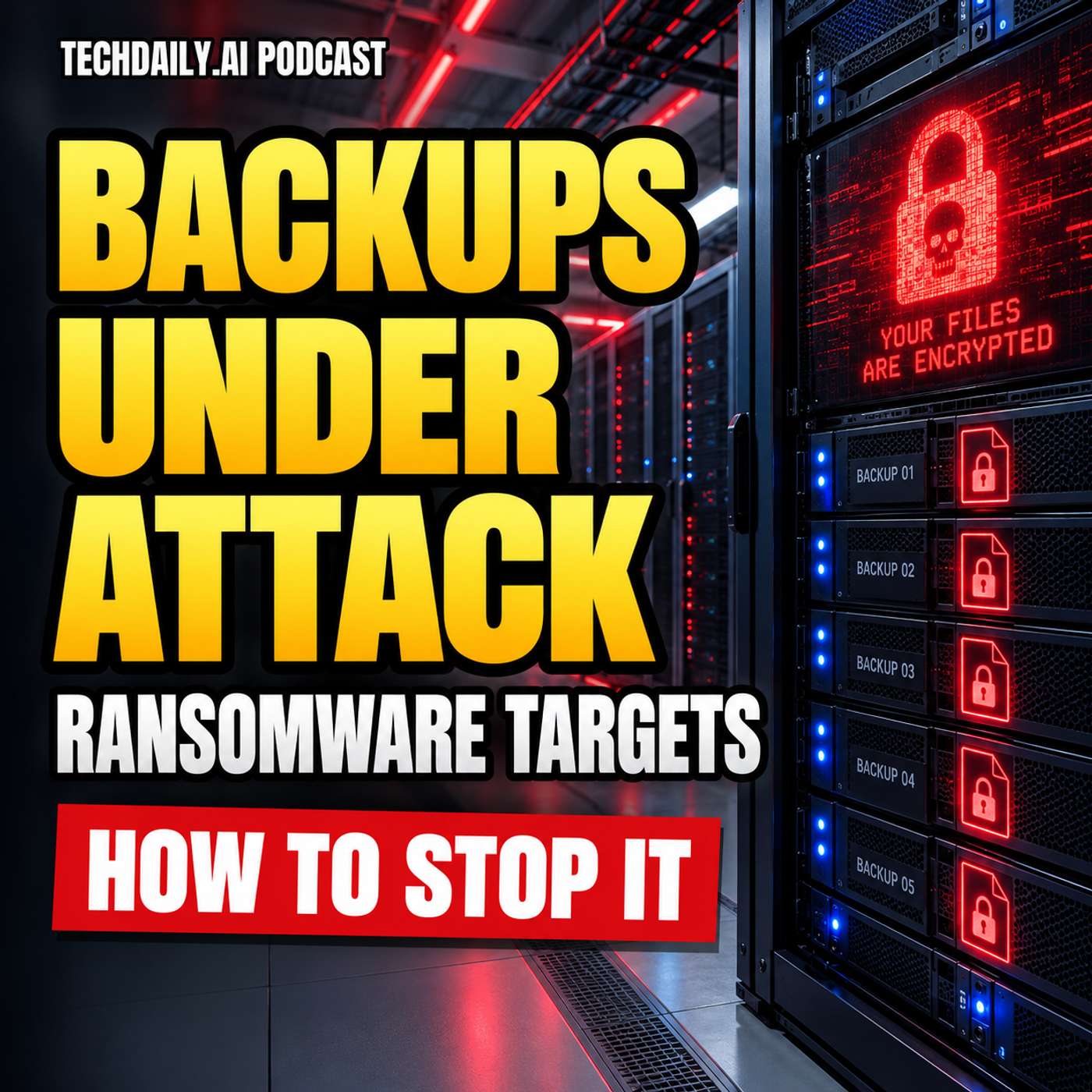


Your backups may be the very first thing a ransomware attacker tries to destroy.
For years, the 3-2-1 backup rule was considered the gold standard for protecting critical data: keep three copies, store them across two different media types, and maintain one copy offsite. That strategy was built for an era when hardware failure, fires, floods, and physical storage problems were the biggest threats.
Modern ransomware changed the equation.
In this episode, David and Sophia trace the evolution of backup architecture from the classic 3-2-1 rule to the modern 3-2-1-1-0 strategy designed for an era of connected cloud infrastructure and sophisticated cyberattacks.
You’ll hear how attackers can use compromised administrative credentials to discover backup systems, delete recovery points, and destroy the safety net before encrypting production data.
The conversation explores:
• Why traditional 3-2-1 backups were so effective against hardware failure
• How cloud storage changed the meaning of different backup media
• Why constantly connected backups can become ransomware targets
• How immutable WORM storage prevents backups from being changed or deleted
• How S3 Object Lock and similar cloud controls create a logical air gap
• What the extra “1” means in the 3-2-1-1-0 backup strategy
• Why a successful backup job does not guarantee a successful recovery
• How isolated sandbox testing verifies that systems can actually be restored
• How disaster recovery as a service can restore entire business environments
• How individuals and small businesses can apply the same principles with external drives, cloud backups, and version history
The episode also tackles “Schrödinger’s backup”: the uncomfortable reality that you may not know whether a backup truly works until you attempt to restore it.
And the discussion ends with an even bigger question. If we create immutable digital vaults capable of surviving attacks, disasters, and even the devices that created the data, how do we make sure the right people can still access that information decades from now?
Tune in to rethink what a backup really is—and whether your current recovery strategy would survive a modern attack.
Subscribe, share the episode, and visit techdaily.ai to explore more conversations about technology, cybersecurity, data protection, and the systems shaping our digital world.