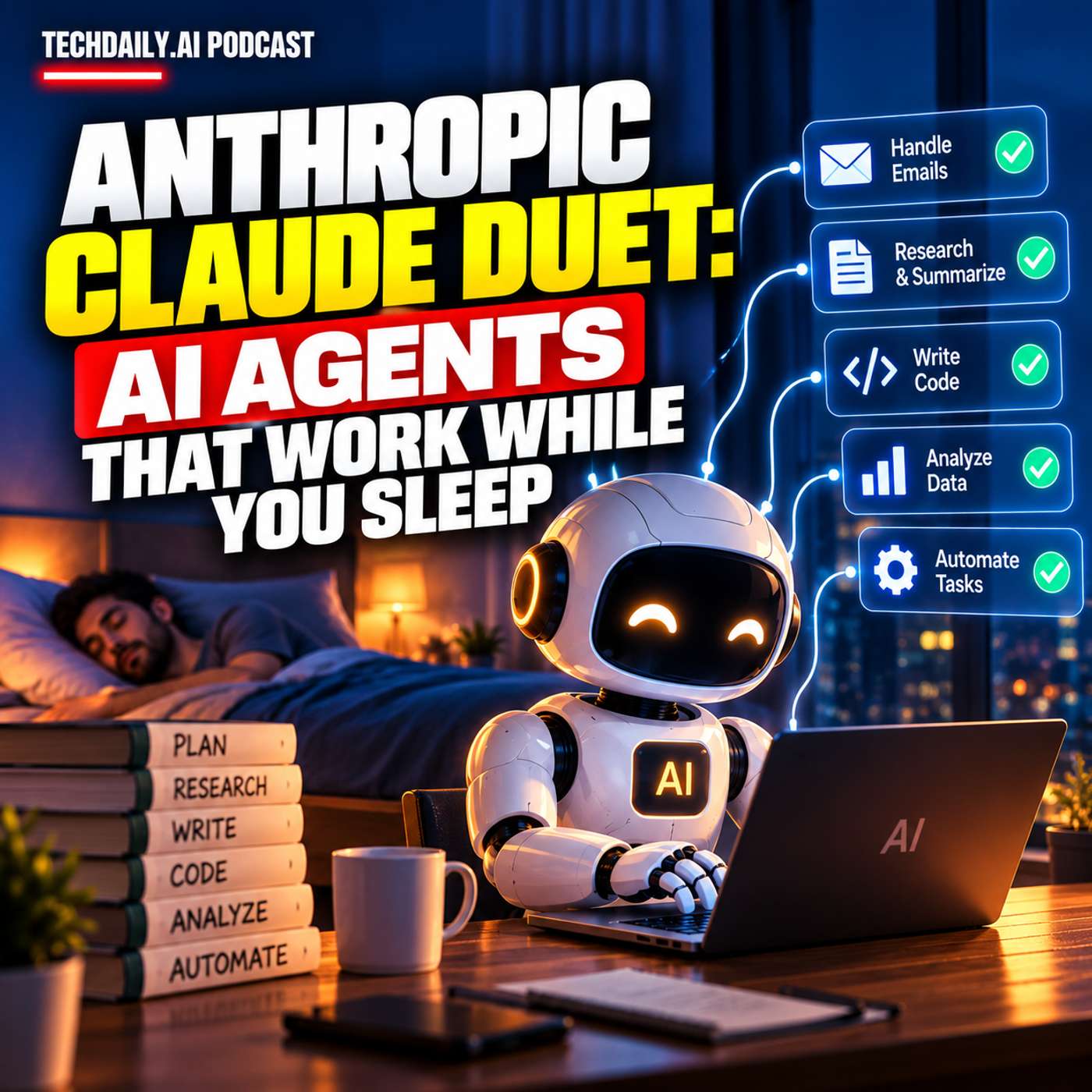


What if your AI assistant could manage emails, schedule appointments, build business dashboards, and complete complex tasks while you’re asleep? Anthropic’s Claude Duet introduces a vision of artificial intelligence that goes beyond answering questions to taking action on your behalf.
In this episode of TechDaily.ai, David and Sophia explore Anthropic’s Claude Duet, an autonomous AI agent designed to handle everyday digital tasks, execute complex workflows, and operate in the background without constant human supervision.
Powered by the Opus 5.5 model, Claude Duet is described as using a dedicated cloud-based virtual machine to manage tasks across connected applications. From organizing schedules and generating financial forecasts to building interactive dashboards, this approach could reshape how individuals and businesses interact with AI.
But greater autonomy brings serious questions. Can an AI agent be trusted with sensitive emails, financial information, and personal data? How does Anthropic balance automation, privacy, security, and affordability?
In this episode, we explore:
- How Claude Duet moves beyond traditional AI chatbots to autonomous task execution.
- How Opus 5.5 powers multi-step reasoning and AI workflow automation.
- Why dedicated cloud-based virtual machines matter for background AI agents.
- How AI assistants could automate scheduling, business reporting, and productivity tasks.
- Why Anthropic’s proposed $20 subscription strategy could challenge competing AI agents.
- How batched background processing helps manage computational costs and usage limits.
- How OAuth authentication and semantic classifiers are intended to protect sensitive information.
- Why user trust, data privacy, and security are critical to autonomous AI adoption.
- How Claude Duet compares with competing proactive AI systems such as OpenAI Dots.
The transition from passive chatbots to proactive AI agents could fundamentally change our relationship with technology. Instead of constantly directing software, users may increasingly supervise digital assistants that independently manage tasks and deliver completed results.
Yet the bigger question remains: How much access and decision-making authority should we give an AI system?
As AI agents become more capable of learning personal preferences, managing workflows, and making decisions, the boundary between a helpful digital assistant and an extension of our digital identity may become increasingly difficult to define.
Join David and Sophia for a conversation about Claude Duet, Anthropic’s autonomous AI strategy, AI agent security, and the future of personal and business automation.
Subscribe to TechDaily.ai on Spotify, Apple Podcasts, Amazon Music, or your favorite podcast platform for more discussions on artificial intelligence, emerging technologies, AI automation, and the future of work.
Enjoyed this episode? Share it with someone interested in autonomous AI agents and the next generation of digital assistants.