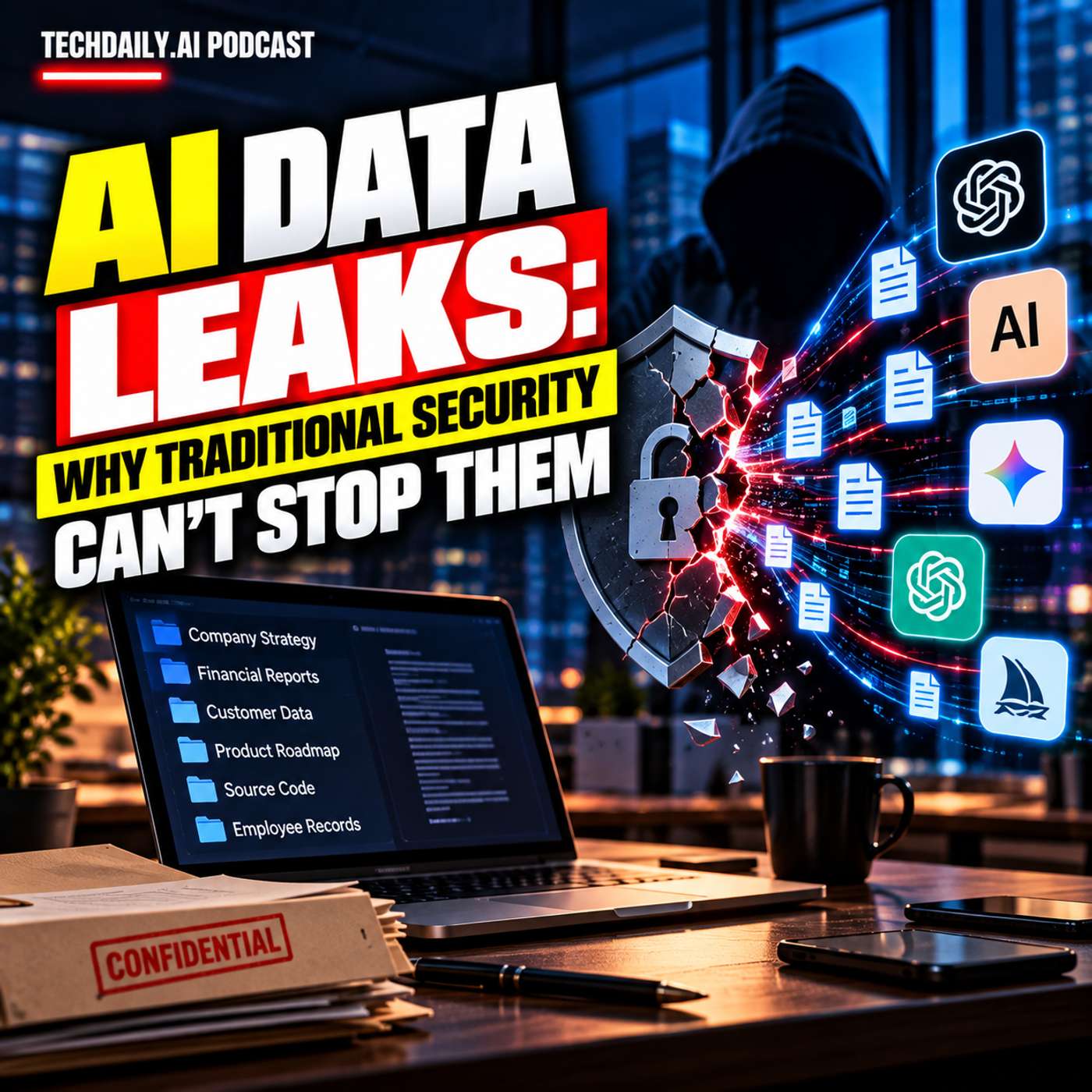


Do you really know where your company’s sensitive data goes when employees use AI? From confidential documents uploaded to public chatbots to autonomous AI agents sharing information across connected systems, artificial intelligence is creating new data security risks that traditional protection tools weren’t designed to handle.
In this episode of TechDaily.ai, David and Sophia explore the hidden architecture of AI data exposure, the growing threat of shadow AI, and why businesses need a new approach to protecting sensitive information.
The discussion examines a concerning statistic cited in the episode: 31% of organizations have experienced an AI-related data privacy violation. But the bigger challenge isn’t simply preventing employees from sharing confidential files. It’s tracking how information moves, transforms, and spreads through AI models, retrieval-augmented generation (RAG) pipelines, vector databases, and autonomous AI agents.
As businesses accelerate AI adoption, traditional data loss prevention (DLP) solutions face growing challenges in monitoring complex AI workflows. Sensitive information can move beyond its original file, appear in AI-generated summaries, or pass between multiple connected agents without adequate visibility.
In this episode, you’ll discover:
- How shadow AI and unauthorized AI tools create hidden enterprise security risks.
- Why uploading confidential business information to public AI chatbots can expose sensitive data.
- How RAG pipelines can reveal internal documents when access permissions aren’t properly configured.
- Why vector databases and AI embeddings complicate traditional data security monitoring.
- How autonomous AI agents and subagents can spread sensitive information across connected systems.
- Why traditional DLP tools struggle to track AI-generated content and transformed data.
- How workload and workforce monitoring help organizations identify AI data exposure.
- Why data lineage tracking is essential for securing AI workflows.
- How continuous data classification and unified security visibility can strengthen AI data protection.
- How GDPR, the EU AI Act, SOC 2, ISO 27001, and HIPAA factor into enterprise AI security discussions.
The conversation also examines the importance of tracking both human activity and machine-driven data movement. From employee copy-and-paste actions to AI-generated child files and vector transformations, organizations need visibility into the entire information lifecycle.
David and Sophia explore how a unified approach to AI security could connect endpoint monitoring, cloud data discovery, and AI agent activity to help security teams identify vulnerabilities, investigate incidents, and protect sensitive business information.
As AI agents become increasingly autonomous, the challenge of securing enterprise data will only grow. Could the future of cybersecurity involve autonomous security agents monitoring other AI systems?
Join us for an exploration of AI data leaks, shadow AI, enterprise cybersecurity, RAG security, and the technologies shaping the future of AI data protection.
Subscribe to TechDaily.ai on Spotify, Apple Podcasts, Amazon Music, or your favorite podcast platform for more discussions on artificial intelligence, cybersecurity, enterprise technology, and emerging digital threats.
Enjoyed this episode? Share it with IT professionals, cybersecurity teams, business leaders, and anyone responsible for protecting sensitive company information.