Every few years the TV world hands us a new acronym and swears this one changes everything. Most of the time it does not. This time might be different. Walk the halls of any big trade show right now and the crowd is not gathered around the OLEDs. It is gathered around a wall-sized panel with color so pure and so bright it looks fake, and the little sign underneath says something new: rgb led tv. Sony demoed a 115-inch version so eye-searing it became the thing everyone filmed on their phones, and the credit for putting it on my radar goes to a quick TechLinked segment. But the tech underneath is bigger than one giant prototype, and it is worth understanding before you spend a dollar on your next TV.
Here is the honest version, from someone who has stared at more backlight test patterns than is healthy: this is the most meaningful change to LCD TVs in a decade. It is also nowhere near your price range yet. Both things are true, and the gap between them is the whole story.
- An rgb led tv ditches the plain white backlight and lights the screen with thousands of tiny red, green, and blue LEDs that make color directly, instead of forcing white light through a color filter.
- The payoff is huge color that stays rich even when the picture is blindingly bright, which is exactly the situation where OLED has to quietly dim its colors down.
- It is still an LCD at heart, so it does not get OLED’s perfect, pixel-level black. You trade a little of that for a lot of brightness and zero burn-in worry.
- Every big brand has a version with its own name: Sony’s True RGB, Hisense’s RGB Mini-LED, Samsung’s Micro RGB, LG’s Micro RGB evo. Same core idea, different badge.
- The catch is money. The sets that exist today run from a few thousand dollars to nearly thirty thousand. This is early-adopter tech, not a Black Friday deal, and that will not change for a couple of years.
What an RGB LED TV Actually Is (and Why the Hype Is Real)
Start with the TV you probably own. Nearly every “LED TV” and “QLED” on the market is really an LCD screen with a light behind it. That light is a sheet of white (technically blue) LEDs. To turn that white glow into a red apple or a green field, the TV shines it through a color filter, like sunlight through stained glass. It works, but it is wasteful: the filter blocks most of the light to make a color, so you lose brightness and the colors never get as pure as the source.
An rgb led tv rips out that whole compromise. Instead of white LEDs plus a filter, the backlight itself is made of separate red, green, and blue LEDs. The color is created right at the light source, before the picture ever reaches the LCD layer. No stained glass throwing away most of your light. Best Buy, which now sells these from five different brands, puts a number on it: these sets reproduce about 76 percent of the colors the human eye can see, which it calls roughly twice as accurate as many TVs on shelves today.
Keep in mind: the LCD layer is still there doing the pixel-by-pixel work. The revolution is entirely in the backlight. That is why purists correctly call it “a much better LCD,” not a replacement for OLED.
Every manufacturer slapped its own name on the same basic move, which is where the confusion starts. Sony calls its version True RGB. Hisense says RGB Mini-LED. Samsung markets Micro RGB, and LG has Micro RGB evo. When you strip the marketing off, they are all doing the same fundamental thing: colored light at the source. If you want a refresher on how the panel in front of that backlight can fail on its own, our guide on why a Samsung TV shows a black screen is a useful companion read.
How the New Backlight Really Works (Color at the Source)
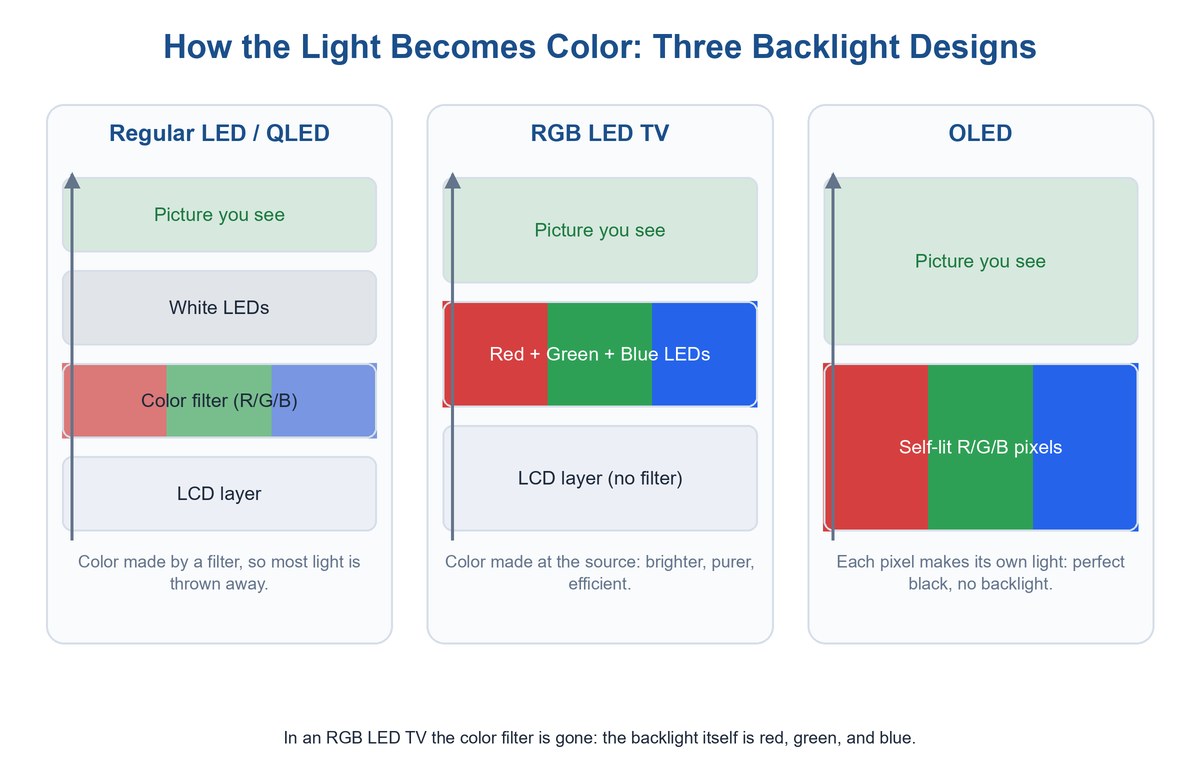
The easiest way to get it is to picture the two designs stacked up, layer by layer.
How the Old Way Squeezes Light Through a Color Filter
In a normal Mini-LED or QLED, light starts white, travels forward, and only becomes colored when it passes through a filter right before your eye. Think of a flashlight pointed at a stained-glass window. The glass makes the color, but it does it by absorbing everything else, so a huge chunk of the light and its purity dies in the glass. That is why older LCDs can look a bit washed out or “milky” in really bright, colorful scenes.
How the New Way Makes Color at the Source
An rgb led tv flips the order. The red, green, and blue are generated by the LEDs themselves, at the very back, and the panel just controls how much of each to let through. Nothing is wasted making the color, because the color was never white to begin with. Sony packs these tiny diodes at roughly one-centimeter spacing across the whole back of the panel and drives the red, green, and blue groups independently, which is what earned its “True RGB” name in the first place.
Why That One Change Fixes So Much at Once
Because color and brightness are now controlled together, in the same tiny zones, the TV can do things a filter-based set simply cannot. It can pump out extreme brightness without the color going pale. It can dim a dark corner while a bright corner stays vivid. And because there is no filter stealing light, it is more efficient with the light it makes. One design change, three real wins.
Note: this only works well if the set has a lot of these RGB zones and a smart algorithm driving them. Sony’s own argument is that the win comes from LED density and the software, not from any single diode being special. A cheap RGB backlight with too few zones would throw away most of the benefit.
Why RGB LED TVs Make Colors Pop the Way OLED Struggles To
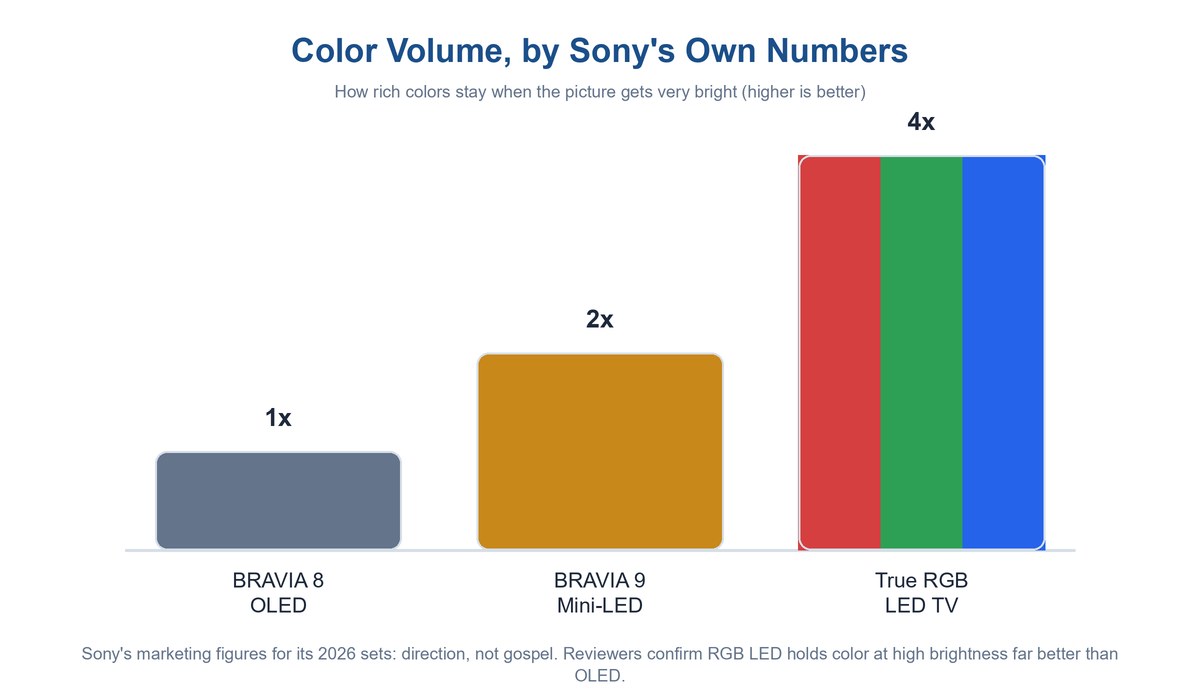
Here is the concept that matters most, and it has a clunky name: color volume. Forget the jargon and picture it this way. Any TV can show a deep red when the screen is dim. The hard part is keeping that red just as deep and rich when the whole scene gets blindingly bright, like sunlight glinting off a car or an explosion filling the frame. That “keeping the color rich even at full brightness” is color volume, and it is where this tech flexes.
OLED, for all its gifts, has a physical problem here. To make a bright white, an OLED pixel has to add a lot of white light, which washes the color out. Push an OLED to its brightest and its colors get thinner. An rgb led tv does the opposite: it has so much colored light on tap that a bright scene stays saturated instead of fading to pastel. Sony claims its True RGB sets deliver up to four times the color volume of its own BRAVIA 8 OLED and about twice that of its BRAVIA 9 Mini-LED, and can hold nearly 4,000 nits of steady brightness while doing it.
That is the manufacturer’s own number, so salt it accordingly, but independent testing backs the direction. When TechRadar measured Hisense’s flagship RGB set, it covered 92.6 percent of the enormous BT.2020 color space and 99.4 percent of the DCI-P3 space used by today’s movies. The best OLEDs beat it slightly on P3 but fall behind on that wider BT.2020 target, which is the color space the next decade of content is aiming at.
Tip: if you mostly watch in a dark room and love film, OLED’s advantage in perfect black may still matter more to you than color volume. Color volume is the killer feature in a bright living room, sports bar, or sunlit den, not a blacked-out home theater.
How It Stacks Up Against OLED, QLED, and Mini-LED
This is the question everyone actually asks, so let me answer it straight, one rival at a time.
Against OLED, Brighter and Burn-In-Free but Not Perfect Black
OLED still owns two things: absolutely perfect black, because each pixel switches fully off, and zero blooming. An rgb led tv cannot match that, because its light comes from a backlight behind the pixels, not the pixels themselves. What it wins in return is enormous, sustained brightness and immunity to burn-in, the slow ghosting that can haunt an OLED that shows the same news ticker or game HUD for years. If you watch a lot of bright content, or you game with static menus, that trade tilts hard toward RGB LED.
Against Regular QLED and Mini-LED, a Real Generational Jump
Against the filter-based Mini-LEDs and QLEDs it is replacing, there is no contest on color. Same LCD panel, same local dimming idea, but purer color and higher usable brightness because the filter tax is gone. If you already like how a good Mini-LED looks, this is that, with the color ceiling lifted. This is the upgrade that actually justifies the “generational” word marketing loves to overuse.
Against QD-OLED, the Closest Fight
QD-OLED, the Samsung and Sony hybrid that bolts quantum dots onto an OLED, is the real rival, and it is a genuinely close fight. QD-OLED delivers gorgeous, near-100-percent color coverage with OLED’s perfect blacks. Where the rgb led tv pulls ahead is raw brightness and holding color at that brightness, plus the burn-in question. Where QD-OLED wins is blooming-free contrast and, for now, price and availability. Honestly, for most buyers this is the only comparison that is close enough to lose sleep over.
The Honest Tradeoffs Nobody Prints on the Box
Every glowing demo hides a few asterisks. Here are the ones that matter before you get swept up.
It’s Still an LCD, So Some Blooming Remains
Because the light sits behind the pixels, a bright object on a black background, think white subtitles over a night sky, can still leak a faint halo into the space around it. This is called blooming, and it is the one gremlin OLED does not have. The good news is that Sony’s version is clever here: when it blooms, the halo takes on the color of the bright object instead of glowing plain gray, which makes it far less distracting. Better, but not gone.
The Price Right Now Is Genuinely Brutal
Let me be blunt, because the demos never are. The Hisense 116-inch set that kicked off this whole race launched at priced like a car, and even its 100-inch sibling is not far behind. These are the prices of a used car, not a living-room upgrade. RGB LED as a category simply does not exist under a few thousand dollars yet.
The catch: the eye-candy brightness numbers, like Hisense’s headline 8,000 nits, are peak figures measured on a tiny bright patch of the screen. Real full-screen brightness is a fraction of that. Do not read a peak-nit number as “the whole screen gets that bright,” because it does not.
The Tech Is Still Finding Its Footing
This is a first-generation technology in shipping products. Early sets from different makers vary a lot in how many zones they use, how good their processing is, and how they handle off-angle viewing. A brilliant panel with weak software can still look worse than a mature Mini-LED. The category will get more consistent, but right now the badge alone does not guarantee a great picture.
The 2026 RGB LED TV Lineup, From Sony to Hisense
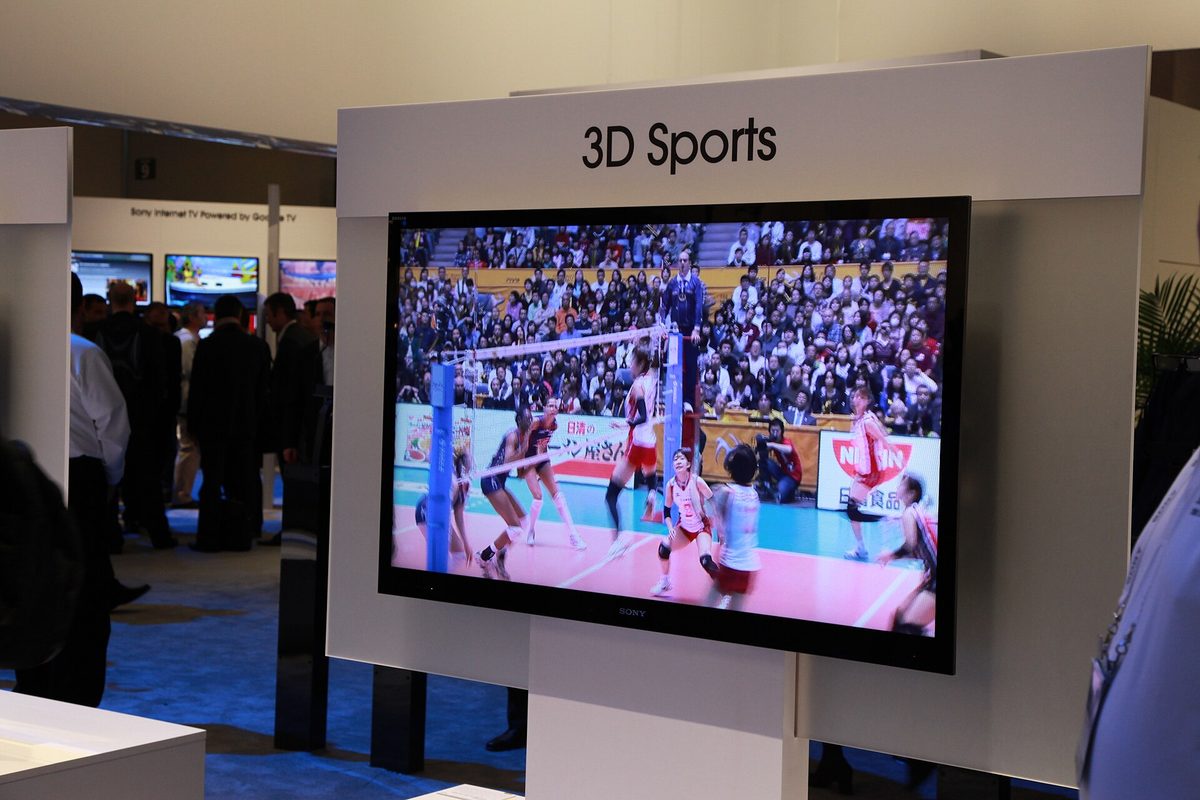
If you want to actually see one of these, here is who is selling what, and what makes each different.
Sony True RGB and the BRAVIA 9 II
Sony’s True RGB is the most talked-about because Sony leaned into the density-and-algorithm approach and the results, roughly 4,000 stable nits with monstrous color volume, look stunning in person. It headlines the flagship BRAVIA 9 II and steps down into the 7 II. Sony frames it as the biggest color-volume jump in its TV history, and its reported lineup pricing starts in four figures for the smaller sizes and climbs steeply from there.
Hisense RGB Mini-LED and the 116UX That Started It
Hisense got to market first and loudest with the 116UX, the 116-inch monster claiming up to 8,000 nits of peak brightness. It is the set most reviewers point to as proof the concept works, and also the one whose sticker proves how early we are. Hisense’s smaller 100UX brings the same idea down to a slightly-less-absurd number.
Samsung Micro RGB and LG Micro RGB evo
Samsung’s Micro RGB and LG’s Micro RGB evo are the same core idea wrapped in each company’s ecosystem and processing. Both are betting that their picture engines, not just the backlight, are the differentiator. Expect these to be the sets that eventually push the technology toward normal flagship prices as production scales.
TCL and the SQD Mini-LED Curveball
TCL is the interesting contrarian. Instead of a full RGB backlight, it is pushing SQD Mini-LED, a refined quantum-dot approach it argues gets most of the color benefit for less cost. Its 98-inch X11L launched at roughly a third of the Hisense flagship, undercutting the RGB competition. Whether SQD or true RGB wins the mid-market is the fight actually worth watching.
So, Should You Buy an RGB LED TV or Wait?
Here is my straight answer. If you are shopping right now with a normal budget, this is not your TV, and you should not feel a shred of FOMO about it. A great OLED or a strong Mini-LED at under three thousand dollars will make you very happy for years, and by the time you are ready to replace it, RGB LED will have come down to earth.
If you have twenty-plus thousand dollars burning a hole and you want the brightest, most colorful wall of light money can currently buy, the flagship Hisense or Sony sets genuinely deliver something no OLED can. Just go in knowing you are paying the early-adopter tax for a first-generation product.
For everyone in between, the smart move is patience. The real prize is not the car-priced 115-inch demo. It is the affordable 65-inch rgb led tv that is two or three years away, once the panels get cheap and the software matures. That is the set that will actually replace the TV in your living room. Watch this space, keep your money in your pocket for now, and let the early adopters pay to shake out the bugs.
Frequently Asked Questions
Is an RGB LED TV better than OLED?
It depends on your room and your eyes. An RGB LED TV wins on brightness, color at high brightness, and it never risks burn-in. OLED wins on perfect black, zero blooming, and thin-and-light design. In a bright room you will likely prefer RGB LED; in a dark home theater, OLED still has the edge.
Is RGB LED the same as RGB Mini-LED or Micro RGB?
Basically, yes. They are brand names for the same core idea: a backlight made of individually driven red, green, and blue LEDs. Hisense says RGB Mini-LED, Samsung says Micro RGB, LG says Micro RGB evo, and Sony calls its take True RGB. The badge changes; the concept does not.
Does an RGB LED TV get burn-in like OLED?
No. Burn-in is a risk specific to self-emissive OLED pixels that age unevenly. An RGB LED TV is still an LCD with a separate backlight, so a static logo or game HUD will not permanently ghost onto the screen the way it can on an OLED.
How much does an RGB LED TV cost right now?
A lot. Today’s sets run from TCL’s cheaper SQD approach up through Hisense’s giant 100- and 116-inch models, which cost as much as a used car, with Sony’s smaller sizes reportedly starting lowest of the lot. Truly affordable, mainstream-priced RGB LED TVs do not exist yet.
Is it still an LCD TV underneath?
Yes, and that is the key thing to understand. The LCD panel and its pixels are unchanged. The entire innovation is in the backlight behind them, swapping white-plus-filter for direct red, green, and blue light. That is why it improves color and brightness but cannot deliver OLED’s per-pixel perfect black.
When will RGB LED TVs become affordable?
Not in 2026, and probably not in 2027 at true mainstream prices. First-generation sets are flagship-only. History with every panel technology says prices fall as production scales, so a mid-range RGB LED TV in the one-to-two-thousand-dollar range is a realistic two-to-three-year wait, not something to hold your breath for this year.