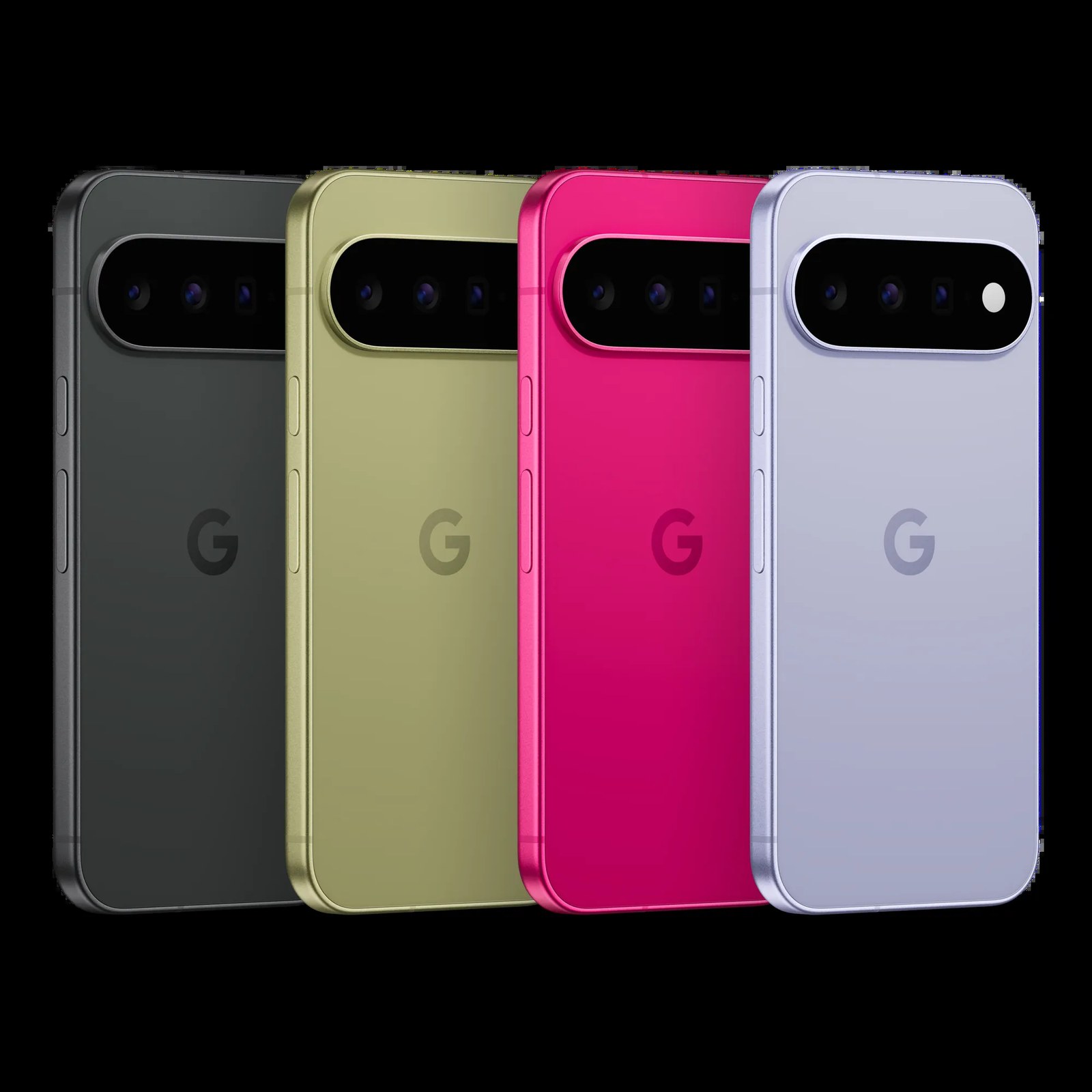
Three weeks before Google’s event, the Pixel 11 rumor pile could already be sorted into confirmed, rumored, and guesswork. Now that the phone is real, that ledger can be graded. Some of what the leaks said was exactly right. Some was flatly wrong. And a few claims that looked strongest before launch are still unresolved, because Google never addressed them.
This page does two jobs. It tells you what the Pixel 11 actually is and costs, and it shows you which kinds of pre-launch evidence were worth trusting — the part that stays useful the next time a phone leaks.
Published 12 August 2026, the day Google announced the phone. Every price and specification below was taken from Google’s own store and blog pages on this date. Featured image: official Google product image.
- Google announced four phones on 12 August 2026: the Pixel 11 at $899, the Pixel 11 Pro at $1,099, the Pixel 11 Pro XL at $1,299, and the Pixel 11 Pro Fold at $1,899. All four go on sale on 20 August 2026.
- The leaked price ladder was correct on every model — including the figures from deleted retail listings that were widely flagged as unreliable.
- The base phone now starts at 256GB with 12GB of RAM. The 128GB tier is gone, so the extra $100 buys double the storage rather than nothing.
- “Pixel Glow” shipped, but it is called HiLight, and Google lists it on the Pro, Pro XL and Pro Fold only. If you buy the $899 Pixel 11, you do not get the light.
- The most confident-sounding pre-launch claims — a MediaTek modem, a 2nm chip, better face unlock — are the ones Google never mentioned. They remain unverified.
- If you were waiting for the Pixel 10 to get cheaper, that went the wrong way. Google’s store has moved the Pixel 10 back to its $799 list price now that the pre-launch clearance has ended.
What Google Actually Announced on 12 August 2026
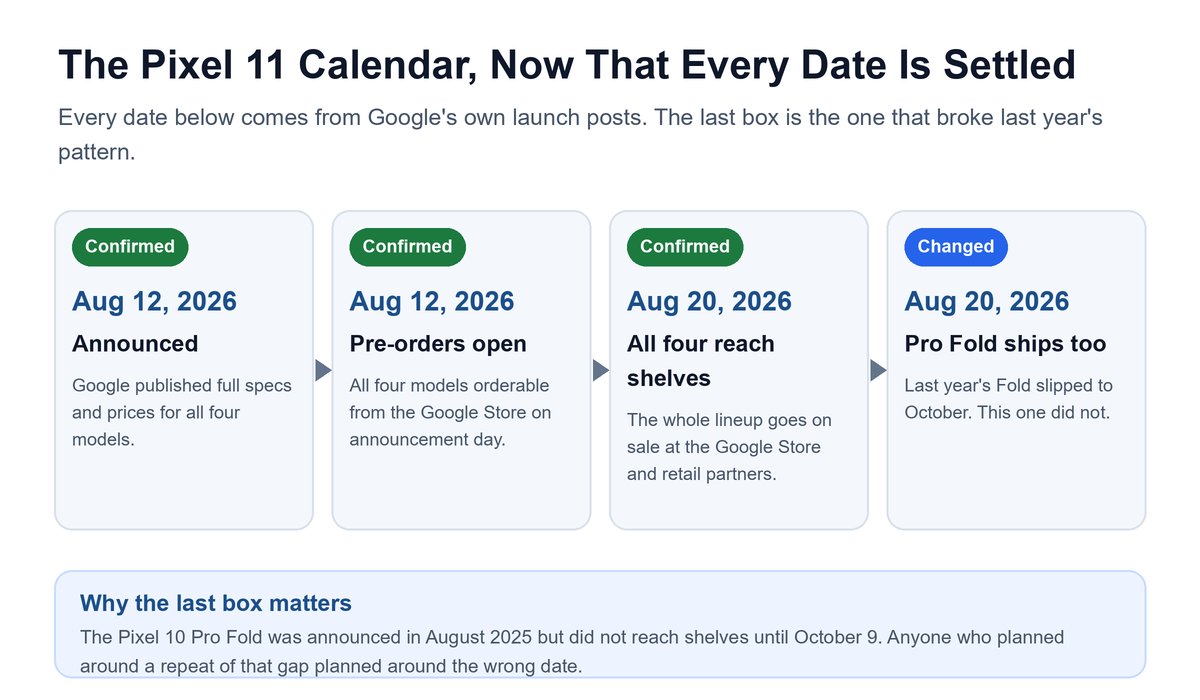
Google unveiled the new lineup on 12 August 2026: four phones — Pixel 11, Pixel 11 Pro, Pixel 11 Pro XL and Pixel 11 Pro Fold — alongside the Pixel Watch 5 and a first-party finder tag called Pixel Tag.
Per Google’s own launch post, the three non-folding models opened for pre-order on announcement day “starting at $899, $1099, and $1299,” and all three “will be on shelves at the Google Store and our retail partners on August 20.”
| Model | Price | Screen | Base storage / RAM | Battery |
|---|---|---|---|---|
| Pixel 11 | $899 | 6.3-inch, 60–120Hz | 256GB / 12GB | 4,985 mAh typical |
| Pixel 11 Pro | $1,099 | 6.3-inch, 1–120Hz | 256GB / 12GB | 4,850 mAh typical |
| Pixel 11 Pro XL | $1,299 | 6.8-inch, 1–120Hz | 256GB / 12GB | 5,115 mAh typical |
| Pixel 11 Pro Fold | $1,899 | Foldable | 256GB / 16GB | 24+ hours claimed |
All four run Android 17 on Google’s new Tensor G6.
The Specifications That Actually Changed Something
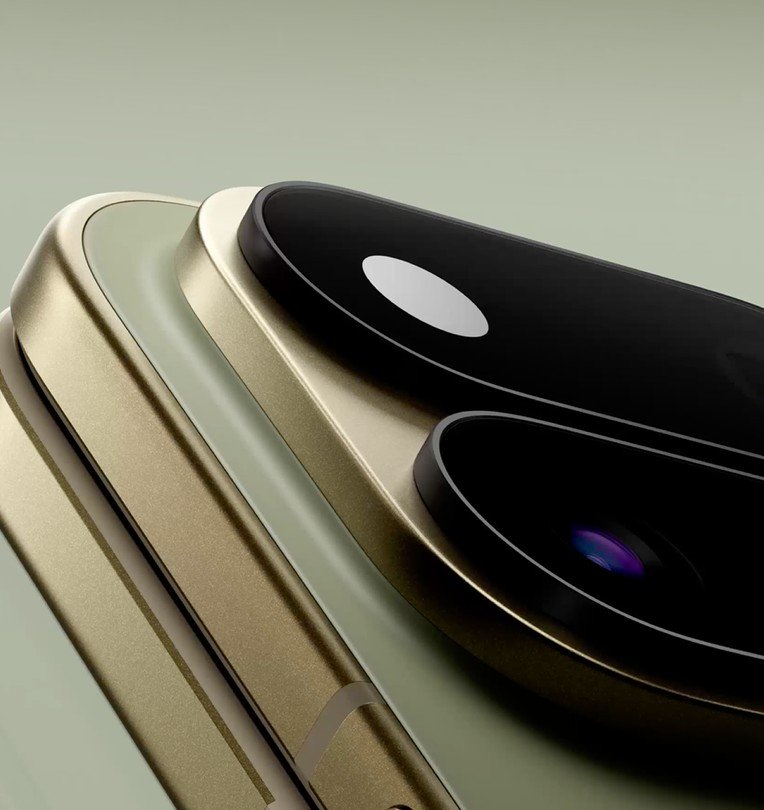
Three things on Google’s Pixel 11 spec sheet matter more than the rest.
Storage and memory moved. The $899 base model ships with 256GB and 12GB of RAM, with a 512GB option above it. There is no 128GB version.
Charging got faster, and unevenly so. The Pixel 11 and Pixel 11 Pro reach about 55% in 30 minutes on a 30W USB-C PPS charger. The Pro XL reaches about 75% in 30 minutes on a 45W charger — Google’s own framing is “15 hours of battery life in 15 minutes.” All three add Qi 2.2 wireless charging at up to 25W.
The cameras split more sharply than before. The base Pixel 11 has a 48MP wide, 13MP ultrawide and 10.8MP 5x telephoto, with Super Zoom to 30x. The Pro and Pro XL get a 50MP wide, a 48MP ultrawide with autofocus, a 48MP 5x telephoto, and Pro Zoom to 120x — plus a 42MP selfie camera against the base model’s 10.5MP.
Keep in mind: these are Google’s own figures, not test results. Nobody has independently measured this phone’s battery life or low-light photos yet, and the gap between a spec sheet and a review is exactly where phone buying goes wrong.
The Rumor Scorecard, Settled Against Google’s Own Pages
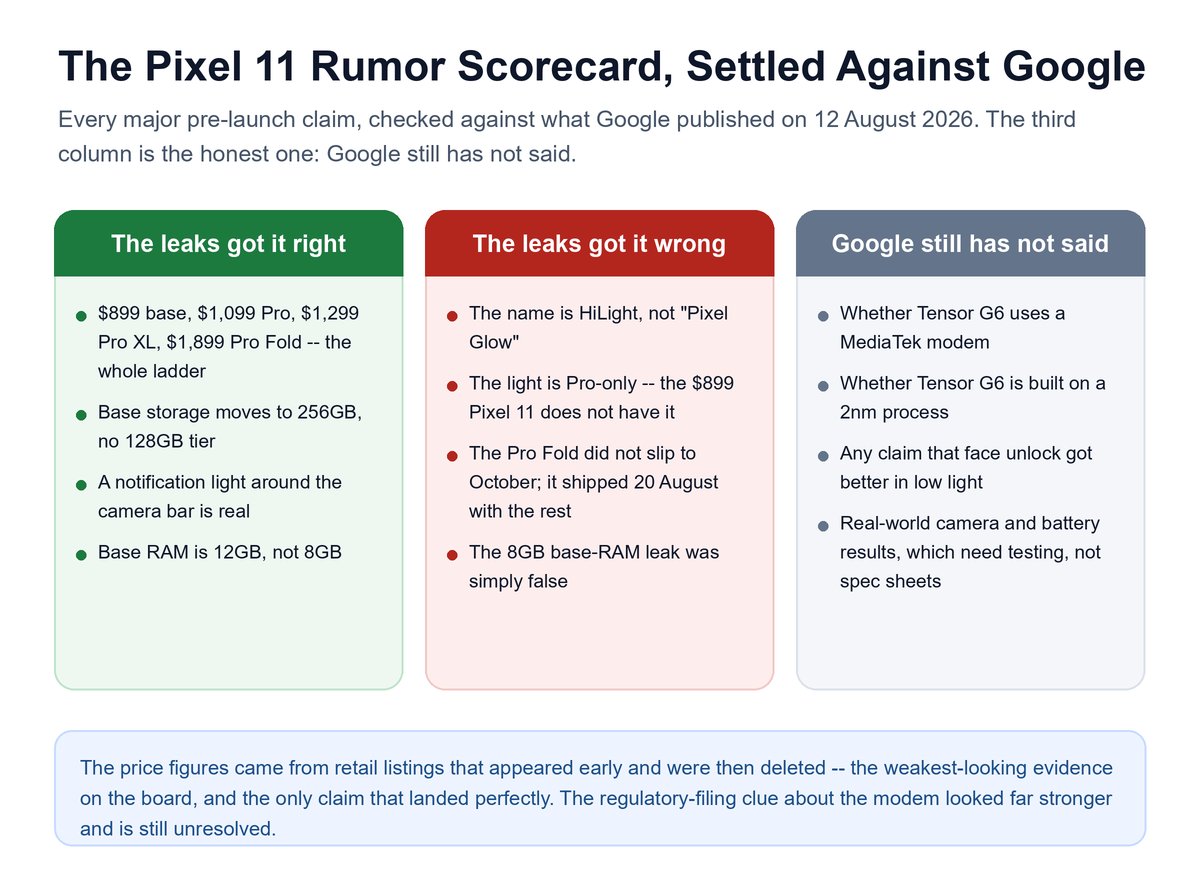
Here is the ledger settled. The pattern is not the one most people would have predicted.
The leaks got right: the entire price ladder — $899, $1,099, $1,299, $1,899 — matched what Google announced, model for model. So did the move to 256GB base storage with no 128GB tier, the 12GB base RAM figure, and the existence of a notification light around the camera flash.
The leaks got wrong: the light is not called Pixel Glow. Google calls it HiLight, and describes it as “colored LED lights built around the camera’s flash” that glow for calls from chosen contacts and pulse in different patterns while Gemini is listening, thinking or responding. More importantly, Google lists it on the Pro, Pro XL and Pro Fold — not on the $899 Pixel 11. The competing 8GB base-RAM leak was simply false. And the widely held assumption that the Pro Fold would slip to October, as the Pixel 10 Pro Fold did, was wrong: Google says it hits shelves on August 20 with everything else.
Google never addressed: whether Tensor G6 drops Samsung’s modem for MediaTek’s M90, whether the chip is built on a 2nm process, or whether face unlock improved in low light. None of the three appears anywhere in Google’s spec sheets or launch posts.
The Lesson Is Not the One You Would Expect
Before launch, the price leak graded as “plausible, unverified” — it came from retail listings that were pulled down, and those listings are famous for carrying placeholder values. The modem claim graded higher, as “strongly indicated,” because Android Authority found MediaTek’s algorithms named in FCC radiation-test paperwork on 10 July 2026, and a regulatory filing is normally sturdier evidence than a leaked price tag.
That grading was backwards. The deleted listings were perfect. The regulatory clue produced a claim Google still has not confirmed a month later.
The correction is not “trust retail listings more.” It is that evidence type predicts what kind of claim survives, not how likely it is. Retailers must load real prices to sell, so their listings are strong on price. Regulatory filings prove radio hardware exists but say nothing about which chip ships in which market. The single-channel face-unlock rumor, relayed by 9to5Google on 17 July 2026, remains one person’s claim — neither confirmed nor denied.
The Price Went Up Exactly as Leaked, and Here Is Why
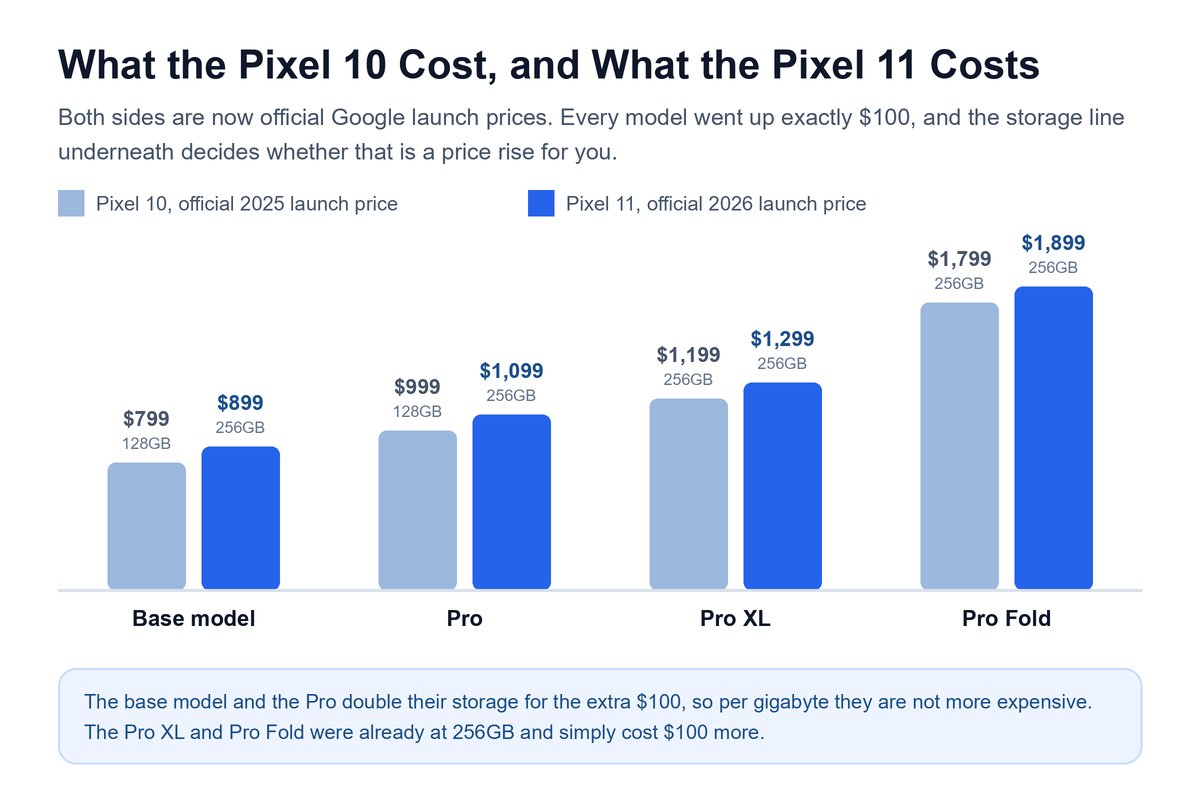
Every model rose exactly $100 over its Pixel 10 equivalent. That is not Google being opportunistic; it is Google paying a bill the whole industry got.
Why a Memory Shortage Set This Price
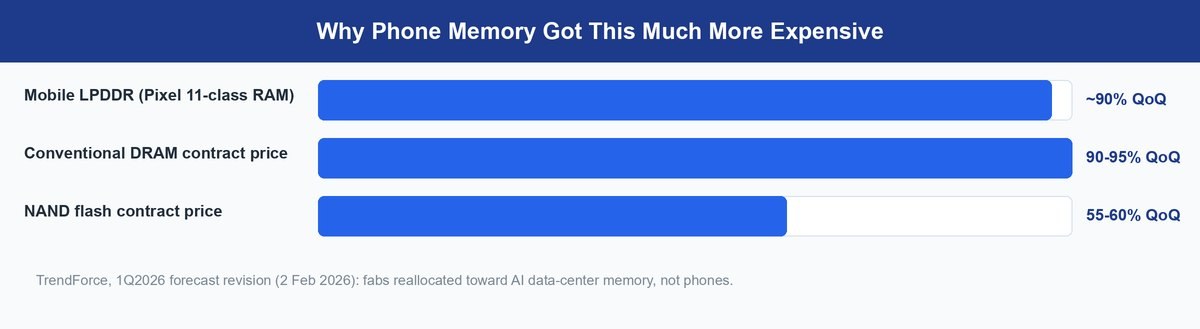
Phones contain RAM and flash storage, both made in fabs now being reallocated to AI data centers. In its February 2026 assessment, TrendForce raised its first-quarter 2026 forecast for conventional DRAM contract prices to a 90 to 95 percent jump quarter over quarter. Mobile LPDDR was projected to surge about 90 percent, and NAND flash 55 to 60 percent — in a single quarter.
IDC’s December 2025 analysis expected smartphone prices to rise 3 to 5 percent in a moderate scenario, 6 to 8 percent in a worse one, and expected makers to hold RAM steady rather than upgrade it.
What actually happened splits the difference in an interesting way. The base phone’s sticker rose 12.5 percent, well past IDC’s worse case — but it also doubled its storage and kept 12GB of RAM. Per gigabyte, the $899 Pixel 11 is not more expensive than the $799 Pixel 10 was. Google did not hold memory flat and eat the cost; it raised the price and handed over more memory.
The catch: that only helps you if you wanted 256GB. If you were the person who deliberately bought the 128GB model to save money, your cheap door closed. The entry price to a new Pixel flagship is now $899, whatever the per-gigabyte math says.
At $899, this also launches above Apple’s base iPhone, which inverts the pitch Google leaned on for a decade. If you are weighing platforms anyway, our breakdown of how iPhone and Android differ in daily use is worth reading first.
The Pixel 10 Discount Window Has Closed
This is the part of the pre-launch calculus that expired, and it is worth being blunt about.
In mid-July 2026, Google’s store had the Pixel 10 at $599 and the Pixel 10 Pro at $699 — clearance pricing ahead of the launch. That was the strongest value in the lineup, and buying then beat waiting.
Those promotions ended. As of 12 August 2026, Google’s store lists the Pixel 10 at $799 and the Pixel 10 Pro at $999 — back to full list price. A reader who waited to see the Pixel 11 before deciding now faces a worse menu than the one they walked away from: the old phone costs $200 more than it did in July, and the new one costs $899.
That will not stay true forever. Outgoing flagships usually settle into a lower permanent price a few months after a successor arrives, and third-party retailers discount on their own schedule. But right now, on Google’s own store, the cheap Pixel 10 is gone.
Note: Google’s launch-window offers run to 27 August 2026 and are worth checking against the sticker — trade-in credit of up to $600 on the Pixel 11 Pro and up to $700 on the Pro XL, plus a choice of $250 off a Pixel Watch 5 or $200 in store credit with a Pro or Pro XL. Trade-in “up to” figures assume a recent phone in good condition, so run your own device through the estimator rather than the headline number.
Should You Buy the Pixel 11? By Situation
The answer splits cleanly by what is already in your pocket.
If You Own a Pixel 9
Probably buy — but buy the discounted Pixel 10 rather than the Pixel 11 if you can find one.
Your Pixel 9 gets full Android versions, not just security patches, into 2031 under Google’s seven-year update commitment. Nothing about the calendar forces your hand. What you would gain from a Pixel 11 is a genuinely better camera system, two generations of chip, and a support horizon pushed to roughly 2033.
That is a real upgrade. It is not an $899 upgrade for most people. A Pixel 10 at a genuine discount delivers most of the same jump, and discounts should return to that model now that it is officially last year’s phone — though 2026’s component costs may keep them shallower than usual.
If You Own a Pixel 10
Keep it. This one is not close.
Your phone is under a year old, updates run to roughly 2032, and the complete upgrade list is: a faster chip, a sharper selfie camera, faster wired charging, and — only if you step up to a Pro — a notification light. HiLight is a lovely idea and phones should never have dropped notification LEDs. It is still a several-hundred-dollar feature to buy and a free one to live without.
Tip: if the camera is what tempts you, note that the base Pixel 11’s rear hardware is closer to your Pixel 10 Pro’s than to the Pixel 11 Pro’s. Moving from a Pixel 10 Pro to a Pixel 11 costs money and gets you a worse zoom system. Compare the model you own to the model you are buying, not to the generation.
If Your Phone Broke This Week
Buy something today; the deliberation is over. The question is only which.
A Pixel 11 at $899 is a fine answer if you were going to spend that anyway. If you were not, the Pixel 10a at $499 does most of what a flagship does, and our guide to the best phones under $500 covers where it lands against rivals.
The move to avoid is panic-buying at full retail from a carrier on a 36-month plan. A broken phone creates urgency, and urgency is what carrier financing is built to harvest.
If You Are Hunting for a Deal
Wait, but wait for the right thing.
Do not wait for the Pixel 11 to get cheaper — brand-new flagships rarely move in their first months, and 2026’s component costs work against discounting. Wait instead for the Pixel 10 to settle into its post-successor price. One caution: the same IDC analysis warns that in 2026 outgoing models are unlikely to see the usual price erosion, so set a price alert rather than a calendar reminder, and do not assume last year’s discount curve.
Frequently Asked Questions
Is the Pixel 11 out yet?
Yes. Google announced the Pixel 11, Pixel 11 Pro, Pixel 11 Pro XL and Pixel 11 Pro Fold on 12 August 2026, opened pre-orders the same day, and all four go on sale at the Google Store and retail partners on 20 August 2026.
How much does the Pixel 11 cost?
The Pixel 11 starts at $899, the Pixel 11 Pro at $1,099, the Pixel 11 Pro XL at $1,299 and the Pixel 11 Pro Fold at $1,899. Each is $100 more than its Pixel 10 equivalent. The base Pixel 11 and Pixel 11 Pro now start at 256GB rather than 128GB, so that $100 also buys double the storage.
Did the Pixel 11 get the glowing light everyone leaked?
Yes, but not on every model and not under the leaked name. Google calls it HiLight — colored LED lights built around the camera flash that glow for calls from chosen contacts and signal when Gemini is listening, thinking or responding. Google lists it on the Pixel 11 Pro, Pro XL and Pro Fold. The $899 Pixel 11 does not have it.
Is it worth upgrading from a Pixel 9 or Pixel 10?
From a Pixel 10, no — it is under a year old, supported to roughly 2032, and the gains are marginal. From a Pixel 9, the jump is real, but a discounted Pixel 10 usually delivers most of it for far less than $899. Your Pixel 9 receives full Android updates into 2031 either way.
Does the Pixel 11 use a MediaTek modem?
Google has not said. Pre-launch reporting from FCC filings suggested Tensor G6 replaces Samsung’s modem with MediaTek’s M90, but Google’s spec sheets and launch posts do not name a modem supplier or a manufacturing process, so the claim is unconfirmed. Independent teardowns and signal testing will settle it, not the spec sheet.
Will the Pixel 10 get cheaper now?
Eventually, but it got more expensive first. Google’s pre-launch clearance put the Pixel 10 at $599 in July 2026; as of 12 August 2026 it is back to its $799 list price on Google’s store. Outgoing flagships typically settle lower a few months after a successor ships, though IDC expects less discounting than usual in 2026, so a price alert beats buying at list today.
The Bottom Line
The Pixel 11 is a $100-more phone that hands you twice the storage, a meaningfully better Pro camera system, and — on the Pro models only — the notification light people have wanted back for a decade.
The buying advice is unglamorous. If you own a Pixel 10, keep it. If you own a Pixel 9, wait for the Pixel 10 to fall rather than paying $899. If your phone just died, buy the tier you were already budgeting for and stop optimizing. And if you are hunting a bargain, the bargain in this generation is the previous generation, once it finishes returning to list price and starts falling again — more slowly than it would have in a normal year.
As for the ledger: the leaks that looked flimsiest were perfect on price, and the ones that looked rigorous are still unproven. That is worth remembering in about eleven months, when this all starts again.