Every laptop forum argues is a mac worth it on a loop: build quality, the trackpad, app compatibility, the Apple tax. Ten pages of opinion, not one line of arithmetic.
So we ran the arithmetic — a five-year cost model, not a spec sheet: what you hand over on day one, what it is still worth when you let it go, and how long each side keeps getting patched in between. A laptop is a five-year lease you pay up front and cash out at the end, and almost nobody prices the cash-out, which is where this argument is actually decided.
The answer splits three ways. One of those ways is a flat no.
- Over five years the mid-tier MacBook costs about $140 less to own than a comparable Windows ultrabook, and the pro tier about $340 less
- At the bottom of the market the Mac loses outright by roughly $180 — a $650 Windows machine starts too far ahead for resale to catch
- The whole Mac advantage lives in the exit price, so if you never sell, the Mac loses at every tier
- Resale figures come from companies that buy and resell laptops for a living — worth knowing before treating them as neutral
- Windows 10 hit a hard wall on 14 October 2025; the free reprieve since then only covers PCs that enrolled
- Apple publishes no support policy, so the six-to-seven-year window everyone quotes is a pattern, not a promise
Disclosure: TechDaily earns a commission on purchases through links on this page. It does not change the numbers or which machine we recommend.
Which is closest to your situation?
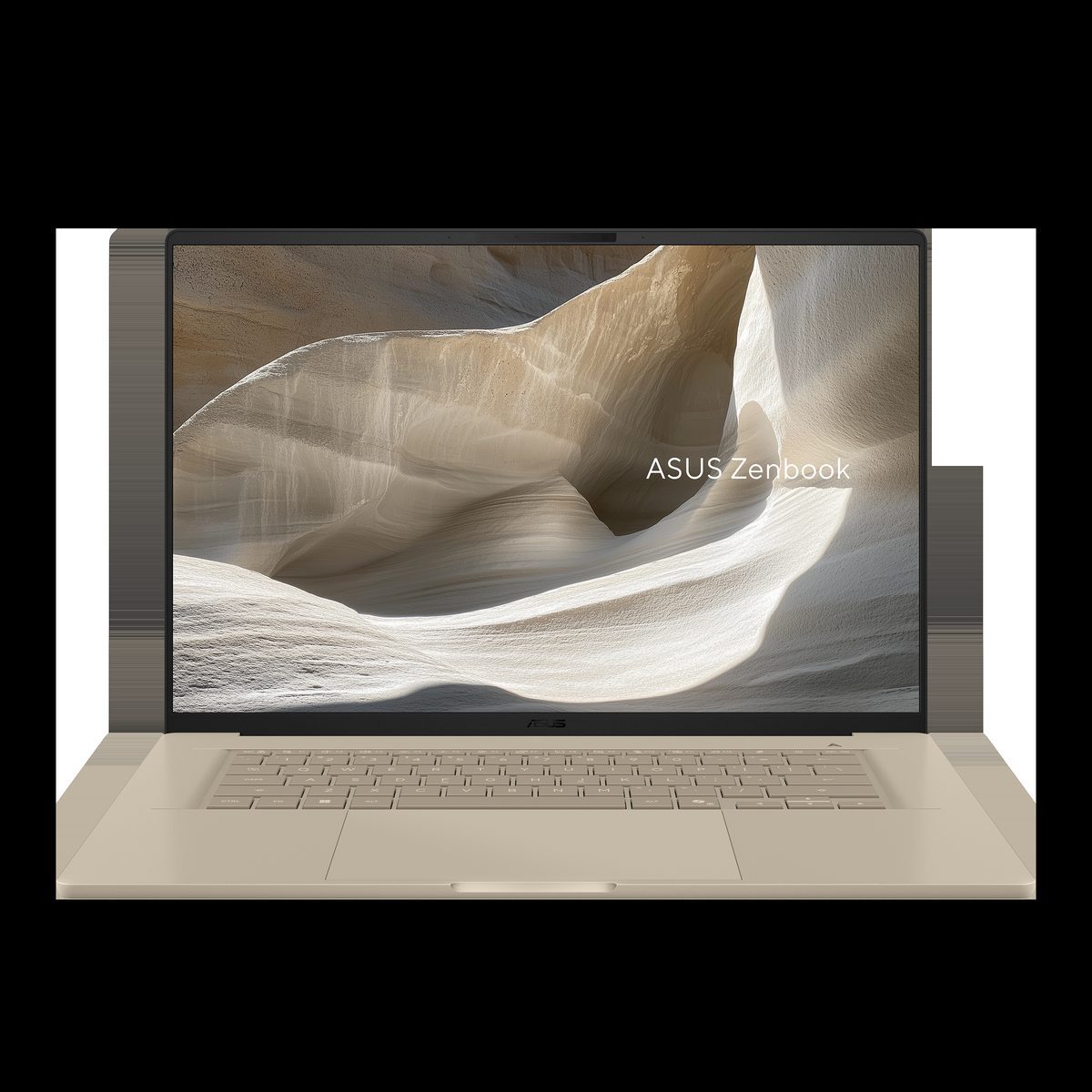
★ Your pick: ASUS Zenbook 14
Windows starts $450 cheaper down here, and no residual value closes a gap that size.
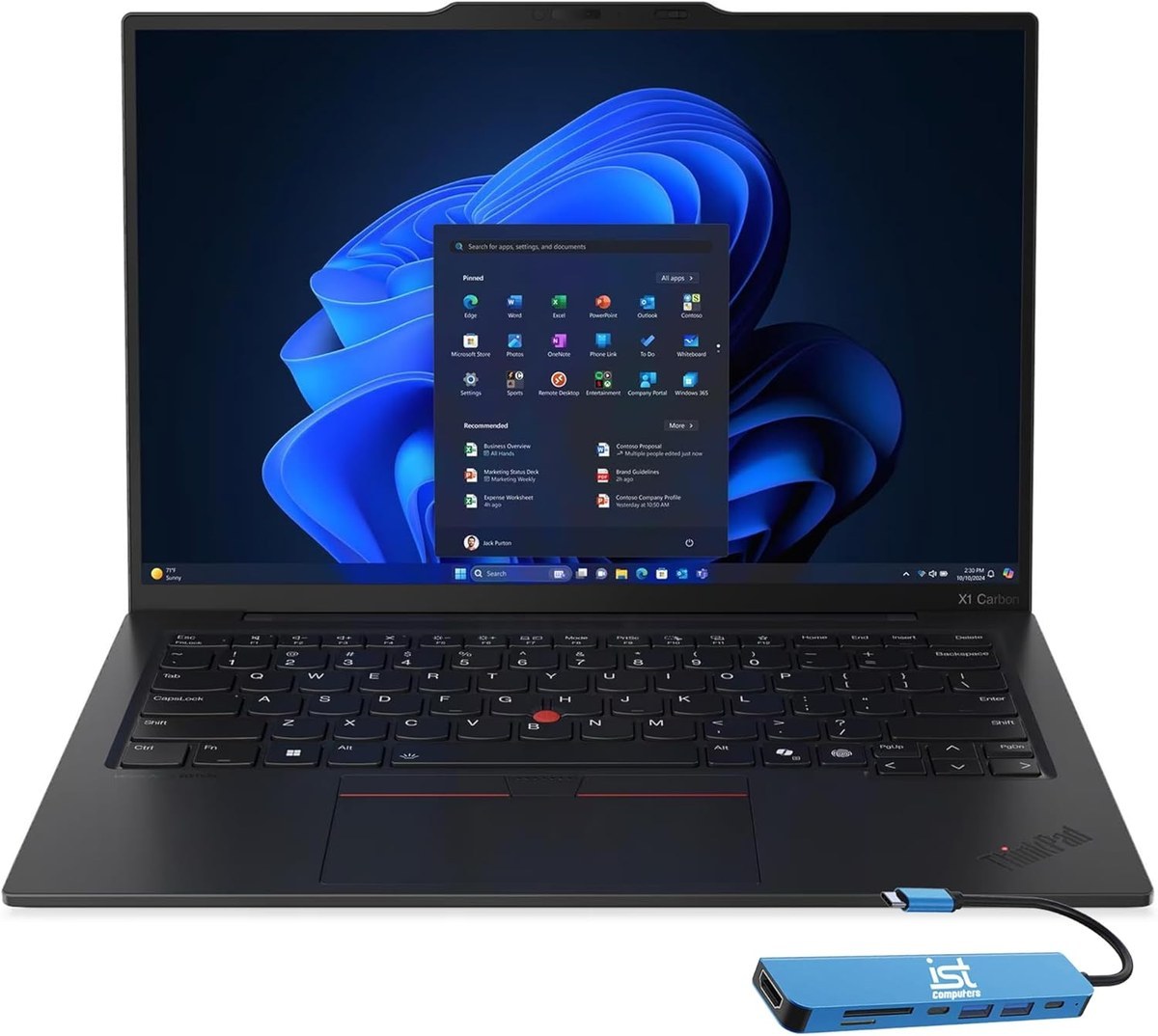
★ Your pick: Lenovo ThinkPad X1 Carbon
If you never sell, resale is worth nothing to you. Buy the cheaper sticker.

★ Your pick: Gaming laptop with an RTX GPU
No resale math fixes a missing graphics card. The Mac has no answer here at any price.
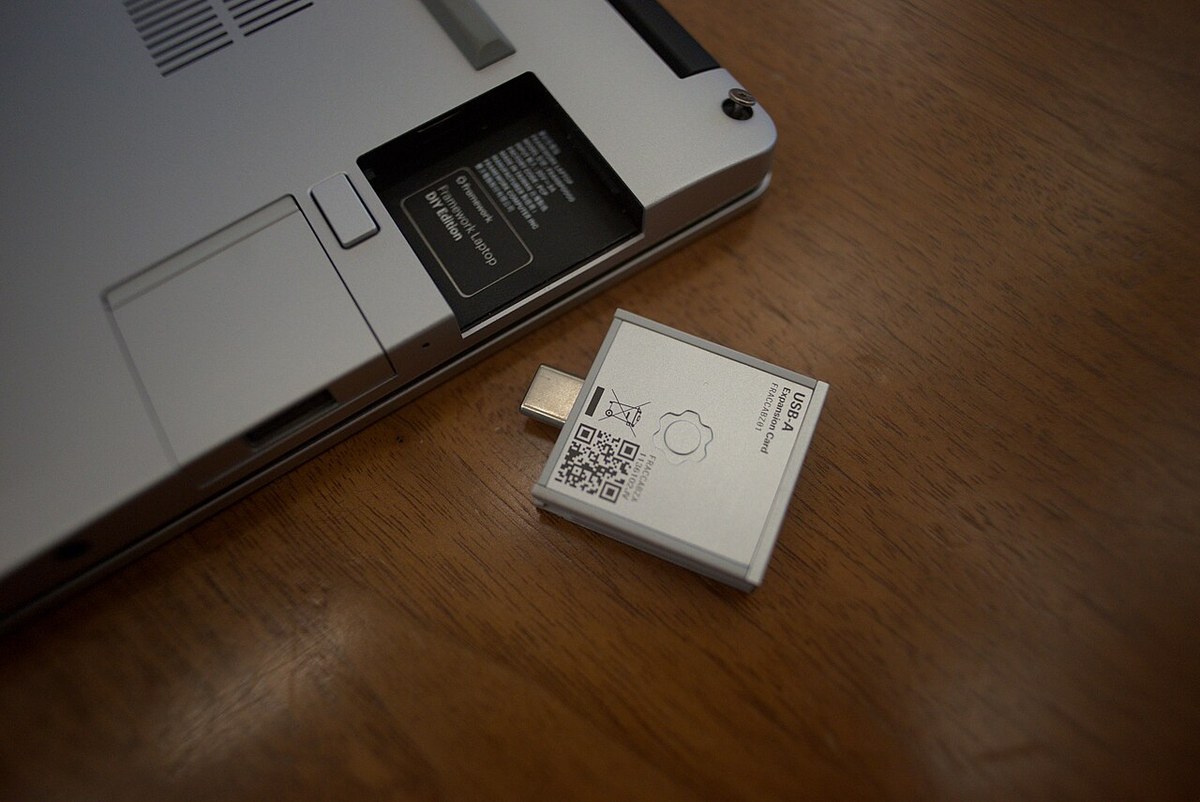
★ Your pick: Framework Laptop 13
User-repairable by design, which is the right call if you fix your own gear.
★ Your pick: MacBook Pro 14-inch with M5 Pro
The biggest residual gap in dollar terms, worth roughly $340 over five years at $2,000.
👑 Our Top Pick — Best Overall Value
MacBook Air 15-inch with M5
About $1,144 net after resale, roughly $140 less than a comparable Windows ultrabook, plus the bigger screen.
Opens on our Top Pick. Tap an option to see the best match for you.
The Six Machines This Model Actually Recommends
1. MacBook Air 15-inch with M5 — Best Overall Value
$1,299M5 chip15-inchWi-Fi 7
$99 more than the matched Windows ultrabook, $140 cheaper net over five years.
Pros
- About $140 cheaper to own over five years than a matched Windows ultrabook
- Best resale value in this comparison at a mainstream price
Cons
- No discrete GPU
- Only wins if you actually sell it in three to five years
2. ASUS Zenbook 14 — Best Budget Windows Pick
≈ $650Windows 1114-inch ultrabook
A real $650 price point Apple does not compete at.
Pros
- $449 cheaper upfront than the entry MacBook Air
- Full Windows software and peripheral compatibility
Cons
- Weaker resale value at every horizon than a Mac (about 18 percent at five years against 35 percent)
3. Lenovo ThinkPad X1 Carbon — Best for Keeping a Laptop Until It Dies
≈ $1,200Windows 11Business-grade build
Matched against the mid-tier Air in our model.
Pros
- Resale is irrelevant if you never sell, which erases the Mac’s only edge
- Business-grade keyboard and durability testing
Cons
- Loses to the Mac by about $99 over five years if you do end up selling
4. Gaming Laptop With an RTX GPU — Best for Gamers
Discrete RTX GPUWindows 11
Apple ships no discrete GPU at any price.
Pros
- Real GPU for gaming, CUDA and simulation workloads the Mac cannot run
- Full anti-cheat and game-catalogue support
Cons
- No resale advantage offsets high-wattage running costs
5. Framework Laptop 13 — Best for Repairability
User-repairableModular design
The opposite bet to the resale argument above.
Pros
- Swap the battery, ports, even the mainboard yourself
- Can outlast the five-year window this model is built around
Cons
- Resale market for modular laptops is far less mature than for Macs or ThinkPads
6. MacBook Pro 14-inch with M5 Pro — Best for Pro Workloads
$2,000 (matched)M5 Pro chip14-inch
Matched dollar-for-dollar against an equally priced Windows machine, the resale gap alone is worth roughly $340 over five years.
Pros
- Largest resale-driven savings in our model, about $340 at the $2,000 tier
- Handles sustained compute and rendering the Air is not built for
Cons
- Overkill if you never touch a sustained workload
Why the Sticker Price Is the Wrong Number to Compare
Every price comparison you have read stops at checkout: Mac costs more, argument over. That assumes the laptop is worth nothing the moment you own it, which the used market flatly contradicts. Nobody compares two cars on sticker alone, because one hands back more at trade-in. What you pay minus what you get back is net cost, and it is also self-reinforcing: high resale value makes Macs cheaper to own, which sustains demand, which keeps resale value high. A spec-for-spec price comparison prices the product and ignores the market it sits inside.
The Three Matched Pairs This Model Is Built On
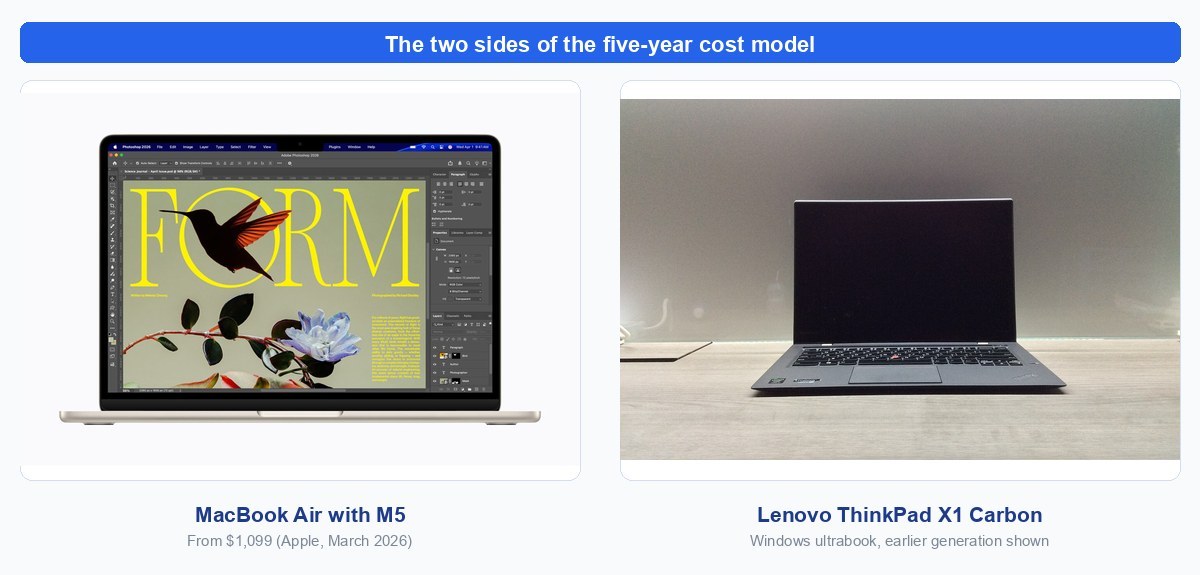
We priced three tiers with one out-of-warranty repair allowance of $300 per side, each a five-year hold sold at the end in working condition.
The Entry Tier at Roughly $650 to $1,100
The MacBook Air 13-inch with M5 starts at $1,099, per Apple’s own announcement in March 2026, with 512GB of storage and Wi-Fi 7. Against it we put a $650 Windows ultrabook, a real and crowded price point — Apple’s weakest ground by a distance.
Keep in mind: Apple sells the same 13-inch Air to students and staff at $999 and the 15-inch at $1,199. If you qualify, knock $100 off every Mac number on this page before you compare anything.
The Mid Tier at Roughly $1,200 to $1,300
The 15-inch Air at $1,299 against a $1,200 premium Windows ultrabook, the Dell XPS 13 and ThinkPad X1 Carbon class — similar build, screens and buyers. The fairest fight here, and the one most people are having.
The Pro Tier, Matched at $2,000
Apple’s MacBook Pro line now runs M5, M5 Pro and M5 Max, and store price moves with configuration, so rather than quote a number that may not match your cart, we modelled both sides at $2,000 flat — same money in, so the only variable is what comes out.
What Five Years Actually Costs on Each Side
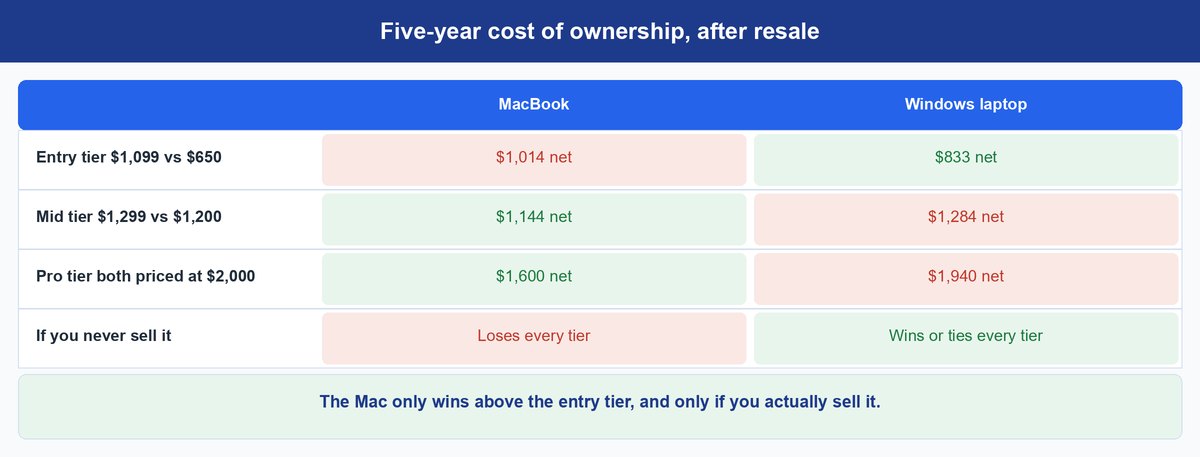
| Tier | Buy price | Repair allowance | Resale at year 5 | Net five-year cost | Per year |
|---|---|---|---|---|---|
| Entry, MacBook Air 13-inch | $1,099 | $300 | $385 | $1,014 | $203 |
| Entry, Windows ultrabook | $650 | $300 | $117 | $833 | $167 |
| Mid, MacBook Air 15-inch | $1,299 | $300 | $455 | $1,144 | $229 |
| Mid, Windows ultrabook | $1,200 | $300 | $216 | $1,284 | $257 |
| Pro, MacBook at $2,000 | $2,000 | $300 | $700 | $1,600 | $320 |
| Pro, Windows at $2,000 | $2,000 | $300 | $360 | $1,940 | $388 |
Read the middle rows first, where most buyers live: the Mac costs $99 more up front and ends up $140 cheaper to own. At the pro tier, where both machines cost the same, the residual gap alone hands the Mac buyer about $340 — the opposite of the “Apple tax” story, and invisible if you stop reading at checkout.
The top two rows break the pattern. At the entry tier the Mac ends up roughly $180 more expensive over five years; a $449 head start is too much ground for resale to make up.
Delete the resale column entirely — what happens if you keep the machine until it is worthless — and net cost is just price plus repairs. The Mac loses the entry tier by $449, loses the mid tier by $99, and ties at the pro tier. Not one win. The premium is only recovered on the way out, by people who walk to the exit.
Where the Mac Premium Comes Back on the Way Out
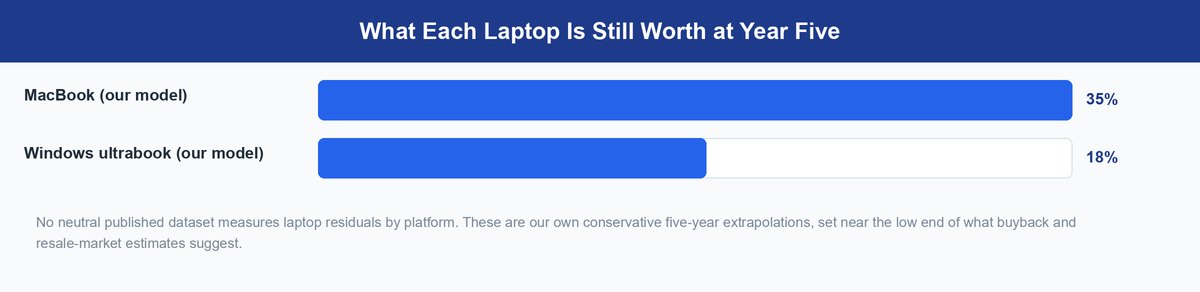
Where do those resale numbers come from? We went looking for one clean, citable source and did not find it. Laptop buyback quotes and resale-marketplace trackers disagree with each other by tens of percentage points depending on who is estimating and how; the only thing that holds steady across every one we checked is direction — Macs consistently outlast Windows laptops on resale value, though the exact percentage moves a lot.
Caveat: a company that buys your old laptop profits from quoting you low, and a valuation site profits from the traffic its numbers attract. Neither is neutral or peer-reviewed. Treat any precise resale percentage you read online, including ours below, as a trade estimate dressed up as research.
Our five-year figures, 35 percent for a MacBook and 18 percent for a Windows ultrabook, are our own extrapolation, set near the pessimistic end of that spread. Drop the Mac to 30 percent and the mid-tier advantage shrinks to about $75 — the direction survives, the size of the win does not.
Tip: if you plan to sell at all, sell at year three rather than year five — the Mac’s residual is still around half its purchase price there, and the gap against Windows is widest.
How Long Each Machine Keeps Getting Security Updates
A laptop stops being an asset the day it stops getting patched, so support windows belong in a cost model even though nobody puts them there.
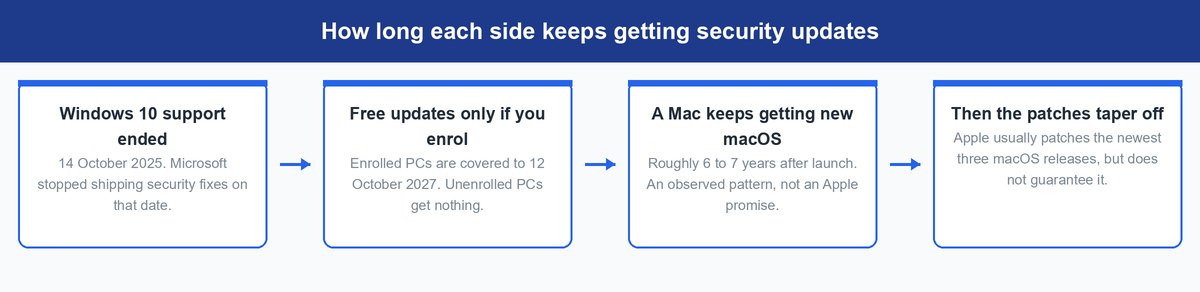
Windows 10 reached end of support on 14 October 2025, per Microsoft’s own lifecycle page. Technical support, updates and security fixes all stopped on that date for millions of working machines, mostly because they failed the Windows 11 hardware requirements.
The catch: the reprieve since is real but conditional. Microsoft’s consumer Extended Security Updates programme runs to 12 October 2027, free if you sync your PC settings or spend 1,000 Rewards points, or $30 if you pay — but only if you enrol. A Windows 10 machine nobody enrolled has had no security fixes since October 2025.
Apple publishes no support policy at all. What exists is a pattern: Macs have typically stayed on the new-macOS list for roughly six to seven years after introduction, and endoflife.date notes Apple usually patches the latest three releases, though “isn’t consistently applied” and older versions aren’t guaranteed.
Microsoft gave everyone a hard date and a conditional extension; Apple gives a track record and no commitment. Any article promising Apple guarantees seven years of support is inventing a promise Apple never made.
The Costs This Model Deliberately Leaves Out
We put the same $300 repair allowance on both sides because no neutral dataset compares repair costs across platforms; the common belief that Mac repairs run higher may be right, but we won’t bake an anecdote into a table and call it a finding. Raise the Mac allowance yourself if you believe it — every extra $100 costs the Mac $100 of advantage, and the mid tier’s $140 margin vanishes at $150 more. Extended warranties, software licensing and battery replacement are also left out, as roughly comparable either way.
When You Should Not Buy the Mac
The section the enthusiasm usually skips. Four situations kill the argument above, and none are edge cases.
You Keep Machines Until They Are Worthless
The entire Mac advantage is the exit price; if your laptop’s retirement plan is a drawer, you never collect it, and with resale removed the Mac loses every tier.
You Are Shopping at the Bottom of the Market
A capable $650 Windows laptop exists; a $650 Mac does not. That $449 gap is bigger than five years of residual advantage.
You Need a Discrete Graphics Card
Apple’s chips are strong for their power draw, but there is no discrete GPU option, and simulation, CUDA-dependent and much engineering software lands on Windows for reasons resale cannot fix.
You Game on Your Laptop
The cleanest no on the page. The catalogue and anti-cheat support aren’t there, and buying a Mac to game on means a premium for a worse version of what you want.
Who Actually Comes Out Ahead Here
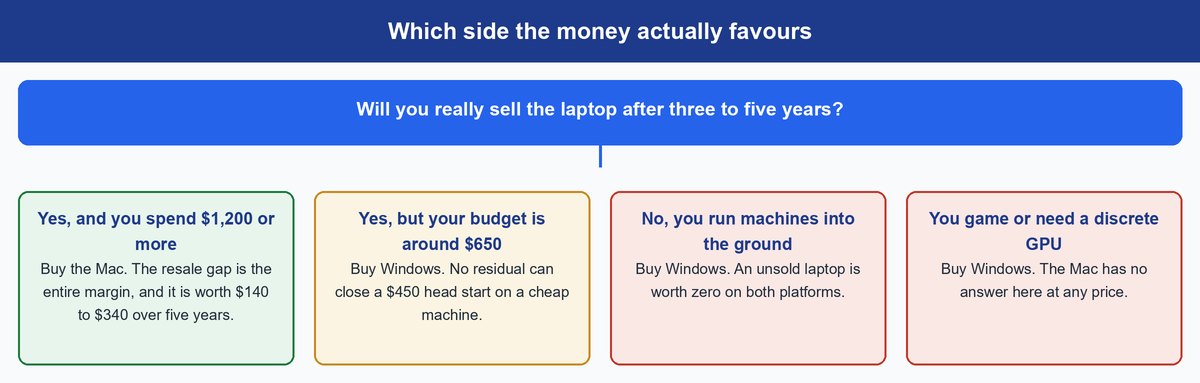
Buy the Mac at $1,200 or more if you keep laptops three to five years and actually sell electronics when done — the residual is a benefit you have to claim. Buy Windows under $900, or if you run machines into the ground, game, or need a GPU. Buying for school shifts the calculation; see our guide to picking a laptop for college.
Somewhere in the middle, five years separates these platforms by about the price of one nice dinner a year — buy the one you would rather use.
Frequently Asked Questions
Is a Mac worth it if I never plan to sell it?
No — the clearest finding in the model. Strip resale out and the Mac loses the entry tier by about $449, loses the mid tier by $99, and ties at the pro tier. It wins nothing. If your laptops end up in a drawer rather than on a marketplace, buy the cheaper sticker.
How long do MacBooks actually last?
Longer than the warranty, shorter than the internet claims. The hardware often runs past seven years, but useful life is set by software support, and Macs have typically stayed on the new-macOS list for six to seven years from introduction — an observed pattern, not an Apple commitment, since Apple publishes no support policy.
Do MacBooks really hold their value better than Windows laptops?
Yes, but treat any single number, including ours, with suspicion. Estimates for a three-year-old MacBook range from the mid-30s to high-60s percent of original price depending on who is estimating, and no source we found is commercially neutral, though Windows laptops land lower in every one we checked. Our own model uses 35 percent for a MacBook and 18 percent for Windows at five years, set near the low end on purpose.
Is a MacBook Pro worth it over the Air?
Only if your work needs it. At the $2,000 tier the resale gap is worth about $340 over five years against a similarly priced Windows machine — but that argues for buying a Mac at that price, not a Pro over an Air. If you never touch sustained rendering or heavy compiles, the 15-inch Air is better value.
What happens to my Windows 10 laptop now that support has ended?
It still works, it just stops getting fixes. Windows 10 reached end of support on 14 October 2025, and Microsoft’s Extended Security Updates programme covers enrolled devices until 12 October 2027, free via synced PC settings or 1,000 Rewards points, or $30 once. The word doing the work is enrolled — a machine nobody signed up has been unpatched since October 2025.
Is a Mac worth it for video editing?
For most editors, yes — this is where the premium is easiest to justify. Apple silicon handles common editing codecs efficiently at low power, and the resale value means the machine you upgrade from in three years funds a chunk of the next one. The exception is a pipeline built on GPU-specific tools expecting a discrete card, where Windows is safer.
The Bottom Line on the Apple Premium
The Apple premium is real, and over five years most of it comes back — a duller answer than either camp wants. What is more interesting is where it comes back from: not the aluminium, the chip or the trackpad, but a second-hand market that keeps agreeing these machines are worth buying used. Apple’s pricing power now leans on strangers on resale sites as much as on anything Apple builds, a strong position and a strangely fragile one.
And it only pays you if you sell. Everyone quoting Mac resale value should have to answer one question first: when did you last actually sell a laptop?