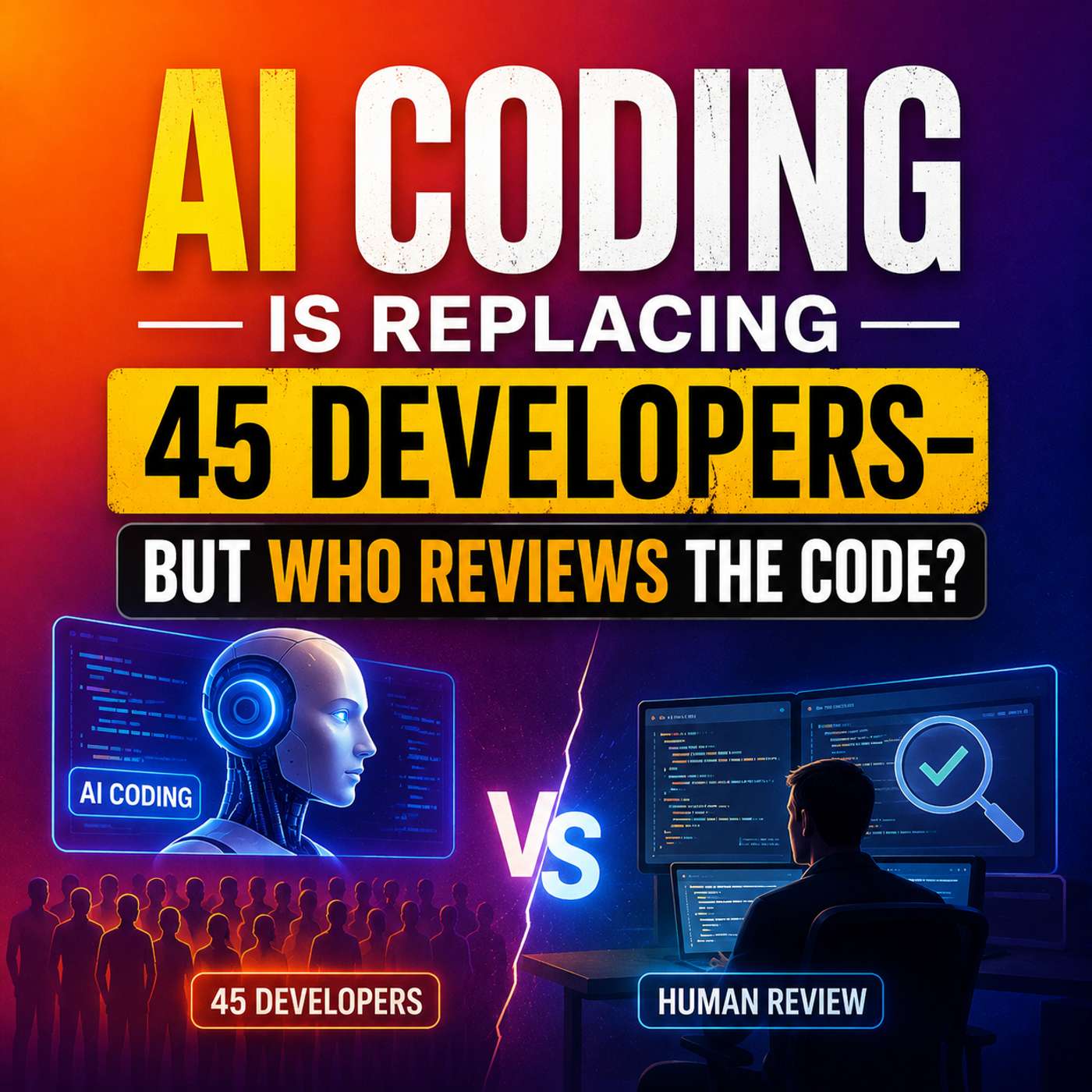


One software developer can now generate the coding output of an entire 45-person engineering department. But the bigger story isn’t how much code AI can produce—it’s what happens when humans stop checking it.
In this episode of Tech Daily.AI, David and Sophia explore data showing how AI coding agents are radically changing software development, developer productivity, infrastructure costs, and code review.
The median developer generates roughly 700 lines of code per week with AI tools, while top 1% power users can produce between 30,000 and 40,000 lines. That enormous increase creates a new problem: traditional human code review simply can’t keep pace.
The episode explores:
- Why AI coding power users can generate the output of dozens of developers
- How massive AI-generated code volumes can overwhelm traditional code review
- Why coding agents spend most of their workload reading existing code rather than generating new code
- How the classic 10-to-1 ratio of reading versus writing code appears in AI workflows
- Why input tokens can become a major hidden cost for AI coding platforms
- How KV caching and context reuse can dramatically change AI infrastructure economics
- Why evaluating models by cost per request can be misleading
- How cost per accepted line of code changes the model-selection equation
- Why intelligent task routing could send simple work to cheaper models and critical architectural work to more capable models
- The growing risk of developers allowing AI-generated commits without manual review
The most consequential shift may be behavioral. The transcript describes a jump from roughly 10% to 40% of developers allowing AI agents to create commits without manual review around March 2026. That raises a critical question for the future of software engineering: if AI can generate code faster than humans can possibly inspect it, what becomes the new safety net?
AI coding is moving software development from manually writing syntax toward orchestrating machines capable of generating enormous amounts of logic. The productivity opportunity is extraordinary—but so are the potential consequences for technical debt, security, quality assurance, and long-term system reliability.
Listen to the full episode to explore what happens when AI becomes the primary code writer—and human review becomes the bottleneck.
Subscribe to Tech Daily.AI for more conversations about the technologies reshaping how the digital world is built.