

What happens when an AI coding agent can work across an entire software stack, test its own changes, visually inspect the results, and create review-ready pull requests—all without waiting for a developer to configure a local environment?
In this episode of Tech Daily AI, David and Sophia break down Inspect, Ramp’s internal background coding agent that the episode says initiates roughly half of the company’s merged pull requests across its front-end and backend repositories.
The key isn’t simply better AI-generated code. It’s the infrastructure surrounding the agent.
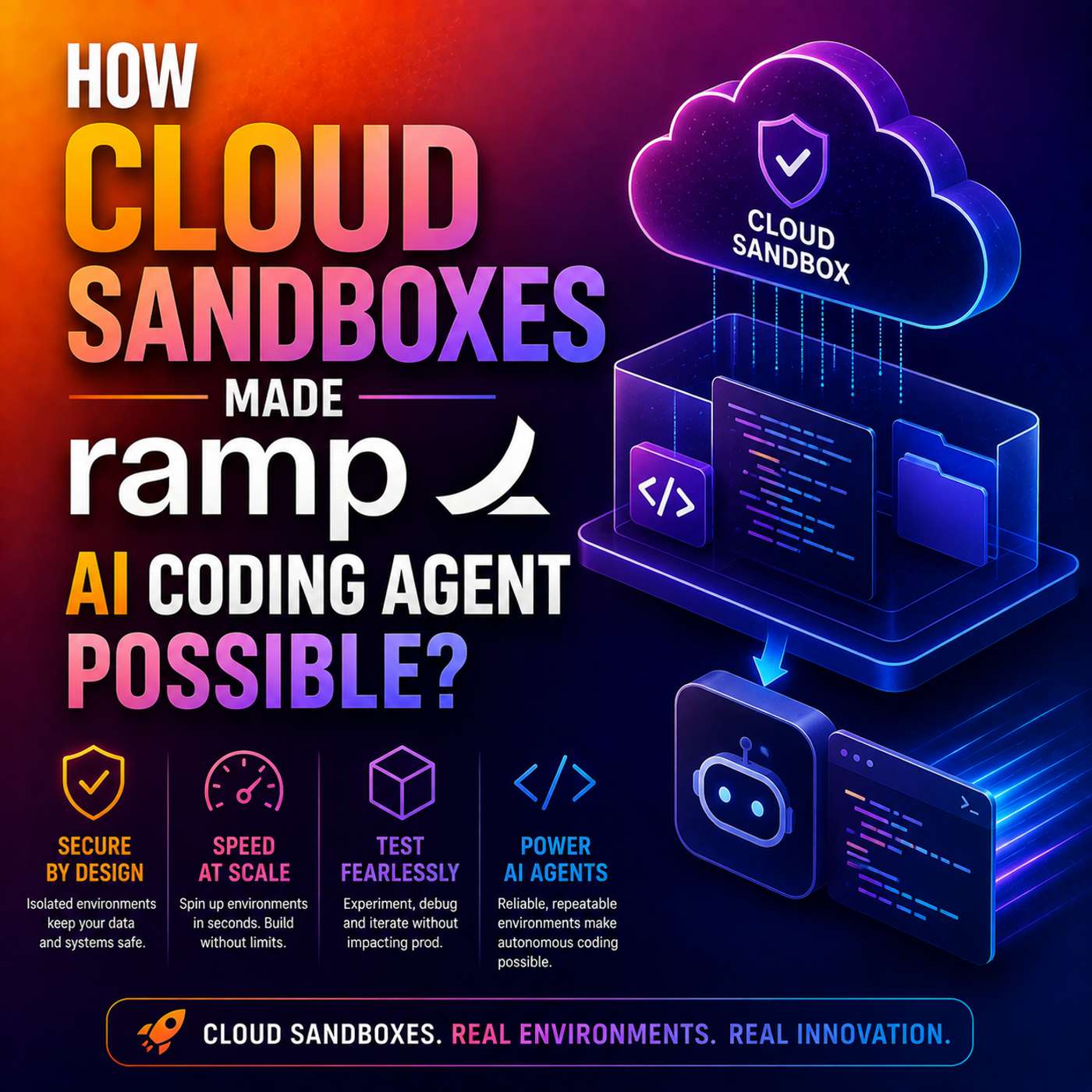
You’ll hear how Ramp built a cloud-based development environment designed to give Inspect the same tools, services, and feedback loops a human engineer would need to complete real production work.
Topics covered include:
- Why local AI coding agents struggle with complex enterprise environments
- How background agents remove the limitations of individual developer laptops
- How Modal sandboxes give Inspect a complete cloud development environment
- Why PostgreSQL, Redis, RabbitMQ, Temporal, VS Code, and browser tooling run inside the sandbox
- How a VNC stack and Chromium allow the agent to visually verify front-end changes
- How screenshot-based feedback helps Inspect catch layout problems before review
- Why keeping services inside one sandbox reduces communication latency
- How filesystem snapshots dramatically reduce environment startup time
- How a recurring job keeps dependencies, repositories, and builds ready to use
- How distributed dictionaries and queues help coordinate concurrent AI sessions
- How Slack, web interfaces, and a Chrome extension make Inspect accessible beyond engineering
- Why designers and product managers can initiate technical changes without configuring development environments
- How Ramp enables hundreds of AI-powered computing sessions to operate in parallel
- Why the next software engineering bottleneck may be infrastructure for parallel AI agents rather than code generation itself
The episode also explores one of the most striking claims in the transcript: more than 80% of Inspect’s own code is now being written using Inspect.
As autonomous coding agents become more capable, the role of the software engineer may increasingly shift from writing every line of implementation to designing systems, reviewing architecture, and directing fleets of agents working simultaneously.
Listen through to the end for a bigger question about where this model could lead: What happens when AI agents move beyond writing software and begin provisioning, monitoring, and managing the infrastructure required to run it?
Subscribe to Tech Daily AI for more deep dives into AI, software engineering, cloud infrastructure, and the technologies reshaping how modern software gets built.