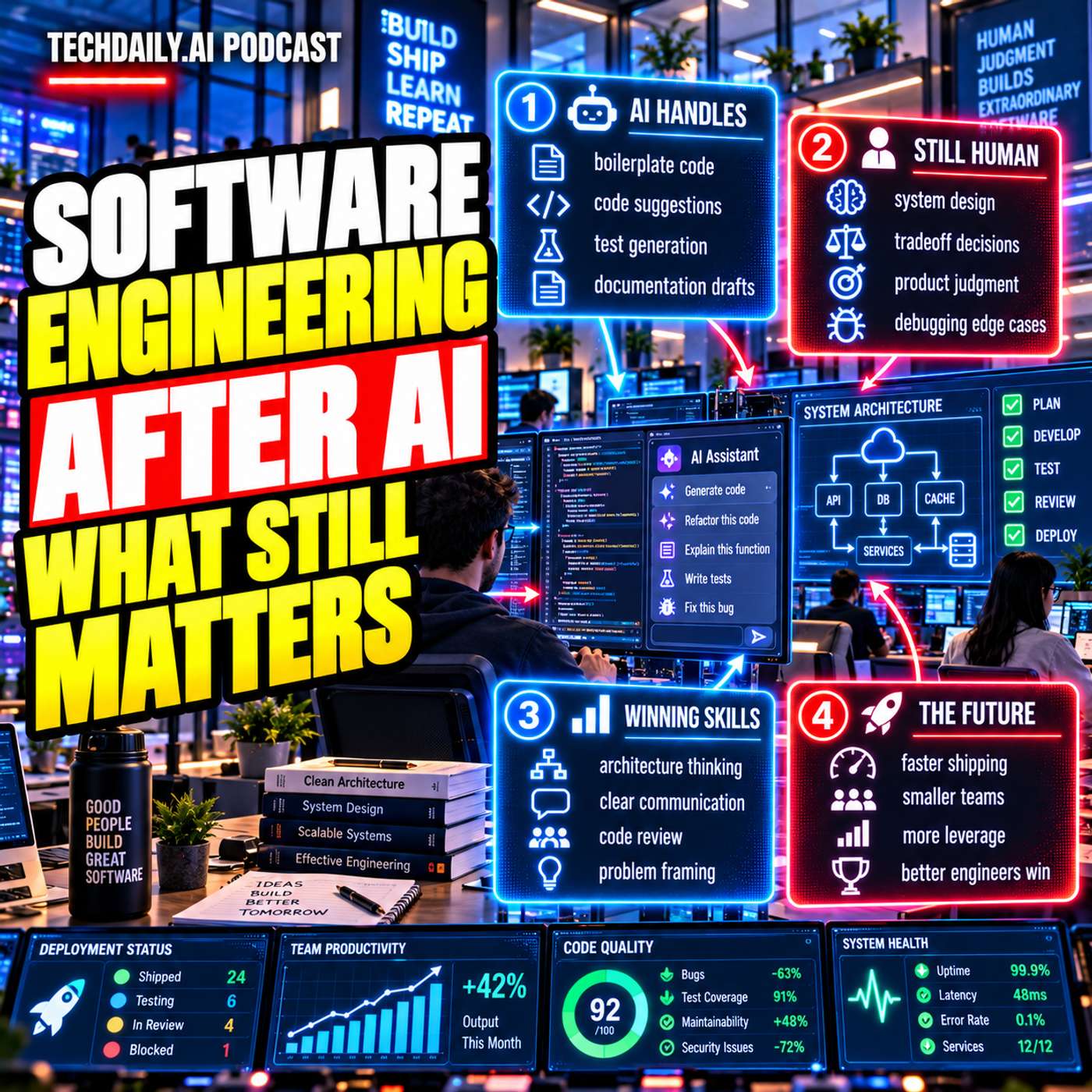


Software engineering is changing faster than almost anyone expected.
In this episode of techdaily.ai, David and Sophia examine the state of the technology industry in 2026 and explore how autonomous AI coding agents are reshaping the way software is built, reviewed, tested, and maintained.
Developers are increasingly moving away from writing code line by line. Instead, engineers are managing multiple AI agents in parallel, reviewing outputs, coordinating isolated work environments, and directing increasingly automated development pipelines.
The result is a dramatic shift from software developer to something closer to a digital systems orchestrator.
In this episode, you’ll hear about:
• Why engineers are managing multiple autonomous coding agents at once
• How agentic development is changing the traditional IDE
• Why companies are building internal AI coding tools and agent harnesses
• How AI-generated code is creating massive review and infrastructure challenges
• Why human code review is struggling to keep up with AI-generated output
• How smart model routing can reduce AI development costs
• Why constant context switching is contributing to engineering burnout
• How classic software engineering principles are becoming more important—not less
• Why small teams, rigorous testing, tracer bullets, and clear architecture still matter
• How AI is accelerating enormous code migrations and refactoring projects
• Why engineers may eventually stop reading much of the code AI systems generate
• How human value is shifting from raw coding ability toward domain expertise, judgment, and leadership
One of the most important lessons is that AI has not eliminated the need for strong engineering discipline.
In fact, the opposite may be true.
As AI agents generate more code at greater speed, teams increasingly depend on automated testing, scalable architecture, focused development practices, and strict validation to keep software reliable.
The episode also explores a deeper career shift. If AI can handle more of the raw implementation work, simply knowing how to write syntax becomes less valuable. The competitive advantage moves toward knowing what should be built, understanding the business or technical domain deeply, and being able to guide both people and AI systems toward the right outcome.
The tools may look like science fiction, but many of the principles keeping modern software development stable remain surprisingly familiar.
Listen to the full episode to explore how AI coding agents, autonomous development, software testing, engineering leadership, and domain expertise are redefining what it means to be a software engineer in 2026.
Subscribe to techdaily.ai for more conversations about artificial intelligence, software development, emerging technology, and the changing future of work.