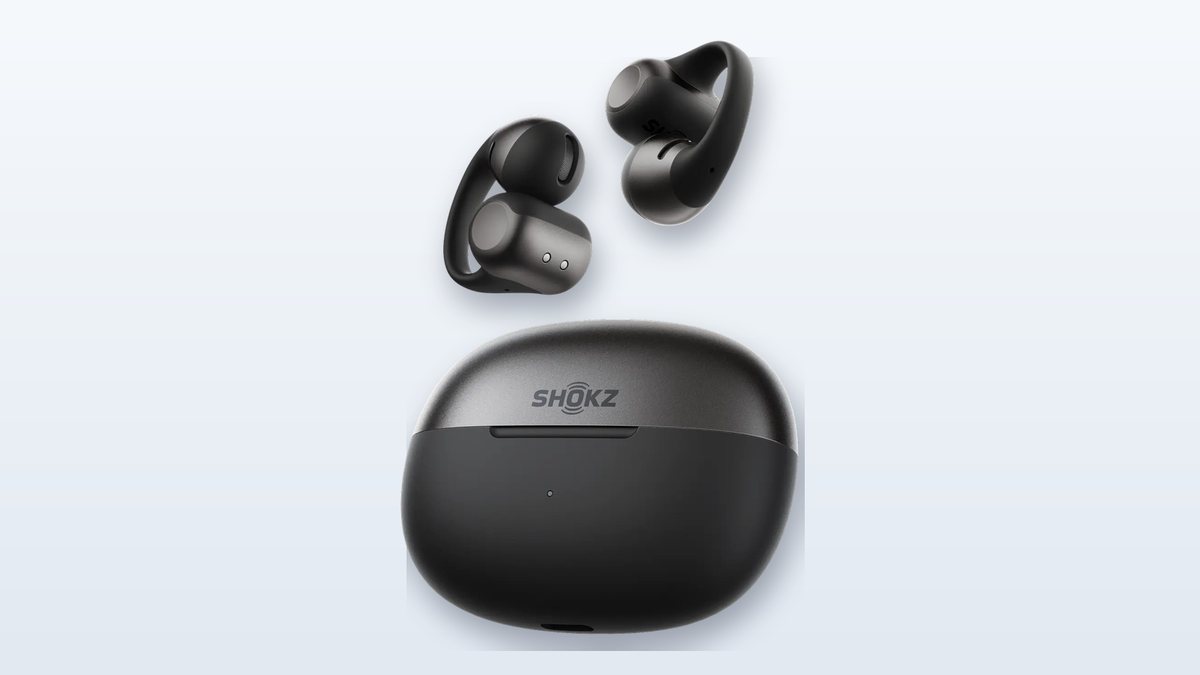
Nearly every open-ear roundup makes the same mistake. It lines up six pairs and ranks them on bass and soundstage — the exact axis this category was designed to lose. You do not buy open-ear because it sounds better than a sealed earbud. It does not. You buy it because you can hear a car, a coworker or your own front door while music plays, and because nothing is jammed in your ear canal for eight hours.
So this list is built the way the decision actually works: fit type first, because that decides whether the thing stays on your head at hour four. Every price below was checked against the manufacturer’s own store on August 10, 2026.
- The best open ear earbuds for you are decided by fit type — clip-on, ear-hook or bone conduction — long before sound quality enters the argument
- Clip-ons like the Shokz OpenDots 2 ($199.95) grip the ear rim, so they work with glasses, small ears and behind-the-ear hearing aids where hooks do not
- Ear-hooks like the Shokz OpenFit Pro ($249.95) are the running answer, because a hook is a mechanical latch and a clip is only a friction fit
- Open-ear is not bone conduction — one fires air at your canal, the other vibrates your cheekbone, and they fail differently
- Want bass you can feel, or quiet on a plane? Buy sealed earbuds instead. Nothing here fixes that
The fine print: TechDaily earns a commission on some links in this article. It never changes what we recommend.
Why do you want open-ear in the first place?
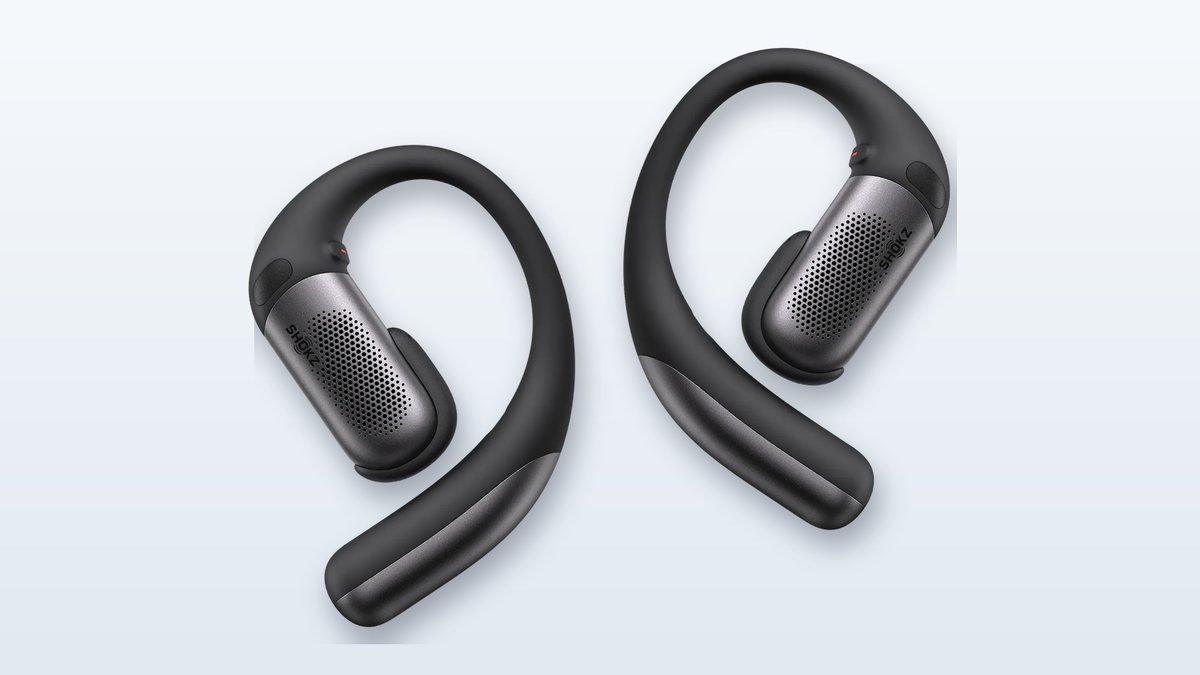
★ Your pick: Shokz OpenFit Pro
A hook cannot be shaken loose, and 50 hours (24 with noise reduction on) means charging monthly
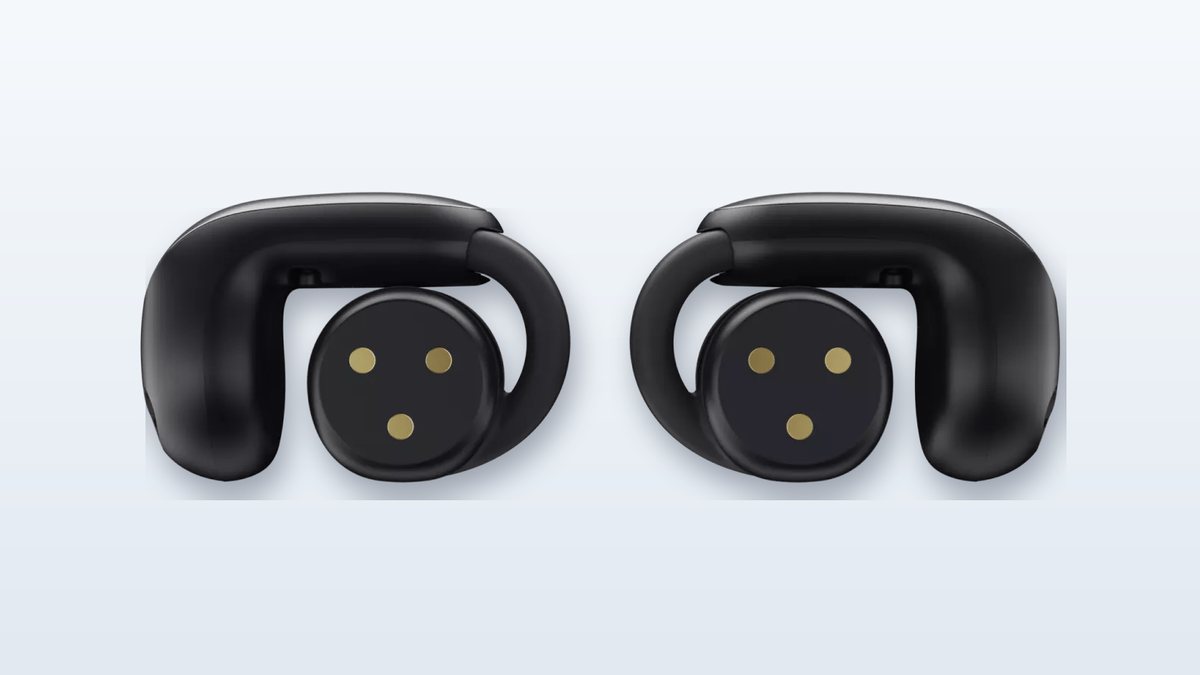
★ Your pick: Bose Ultra Open Earbuds
The most comfortable all-day cuff here
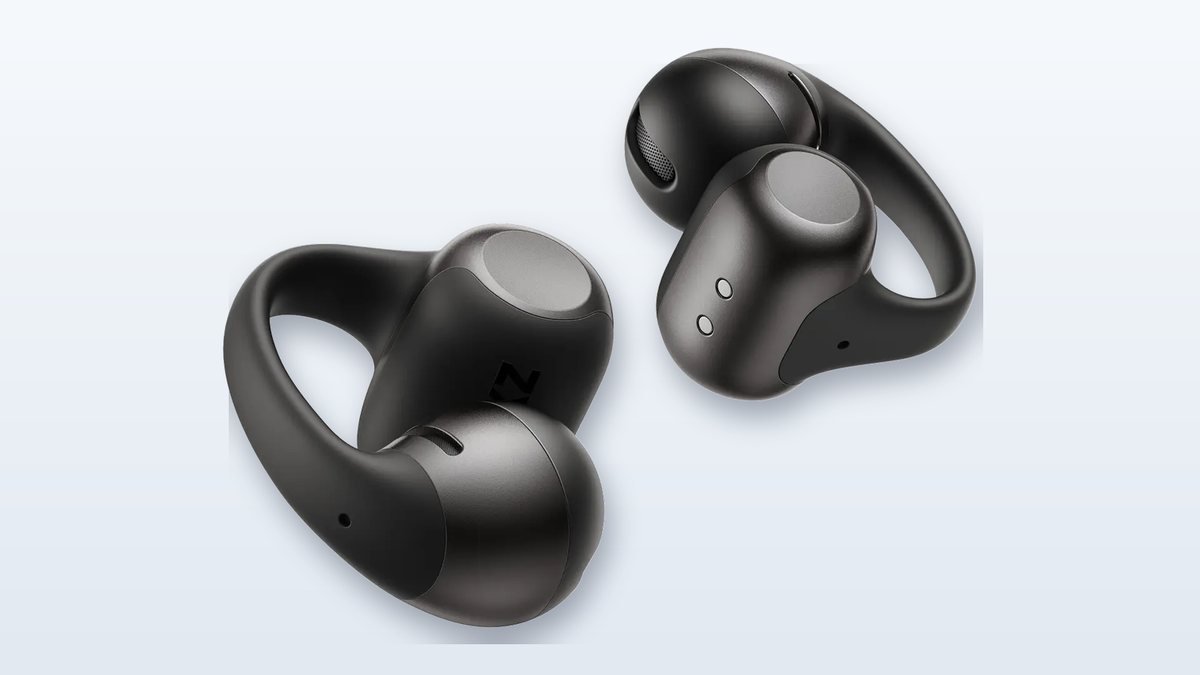
★ Your pick: Shokz OpenDots 2
A clip sits on the ear rim, so nothing fights your temple arms
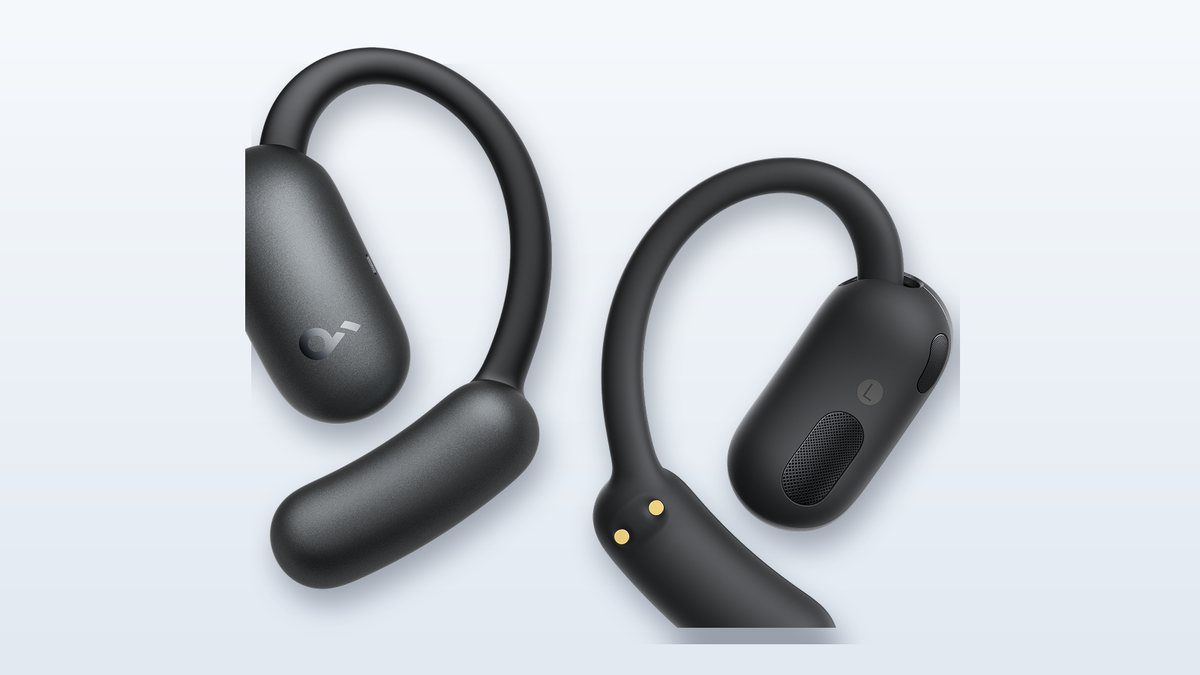
★ Your pick: Soundcore AeroFit 2
Four-level adjustable hooks for $129.99
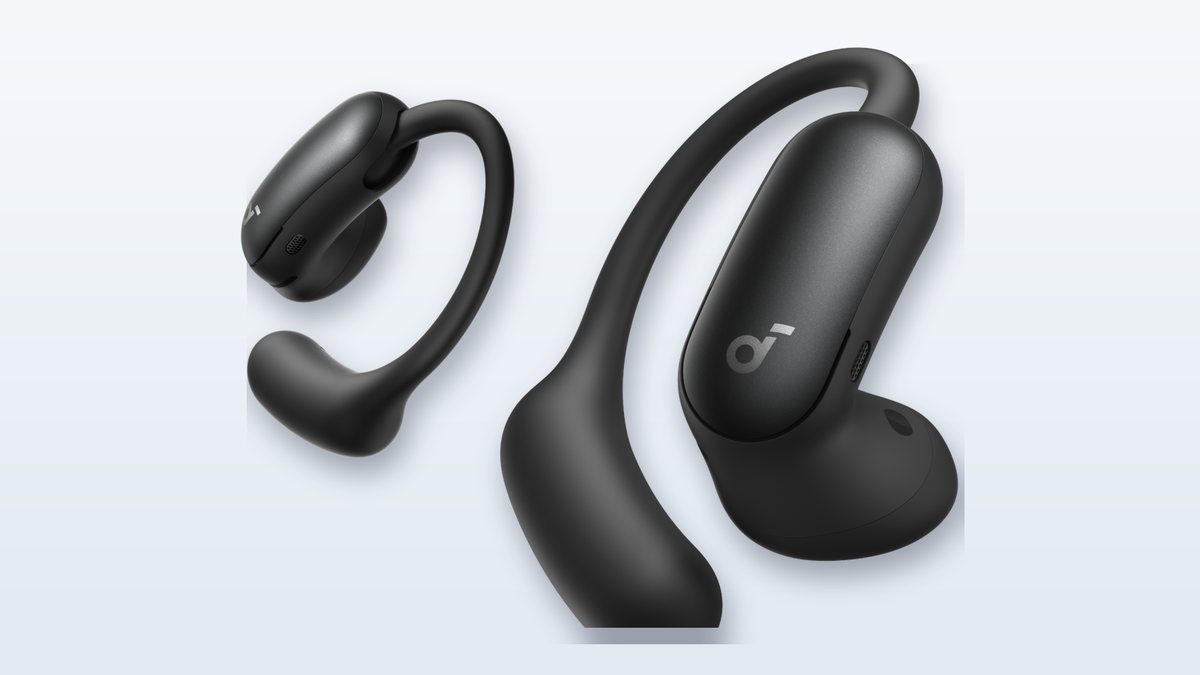
★ Your pick: Soundcore AeroFit 2 Pro
Adjust the hook and it converts to sealed noise cancelling
👑 Our Top Pick — Best Overall Value
Shokz OpenDots 2
The clip fits almost any ear, and $199.95 buys 40 hours with the case
Opens on our Top Pick. Tap an option to see the best match for you.
Open-Ear Earbuds Trade Bass for Awareness by Design
A sealed earbud builds a small pressurised chamber between the driver and your eardrum. That seal is what gives you thumping low end, and it is why noise cancelling works at all — the electronics only have to erase what leaks past the rubber.
Open-ear throws the chamber away. The driver sits outside the canal and fires at the opening, so there is no pressurised bass, no isolation and no true noise cancelling. What you get back is the whole outside world, all the time. For many people that is the entire purchase: runners hear traffic, parents hear the kid upstairs, offices stop being a yank-one-bud-out dance.
The trade is permanent, and on a bus you lose the bottom half of the mix to engine rumble. If that describes your listening life, this is the wrong shelf — read our earbuds versus headphones breakdown and buy something with a seal.
How the Three Open-Ear Fit Types Sit on Your Head
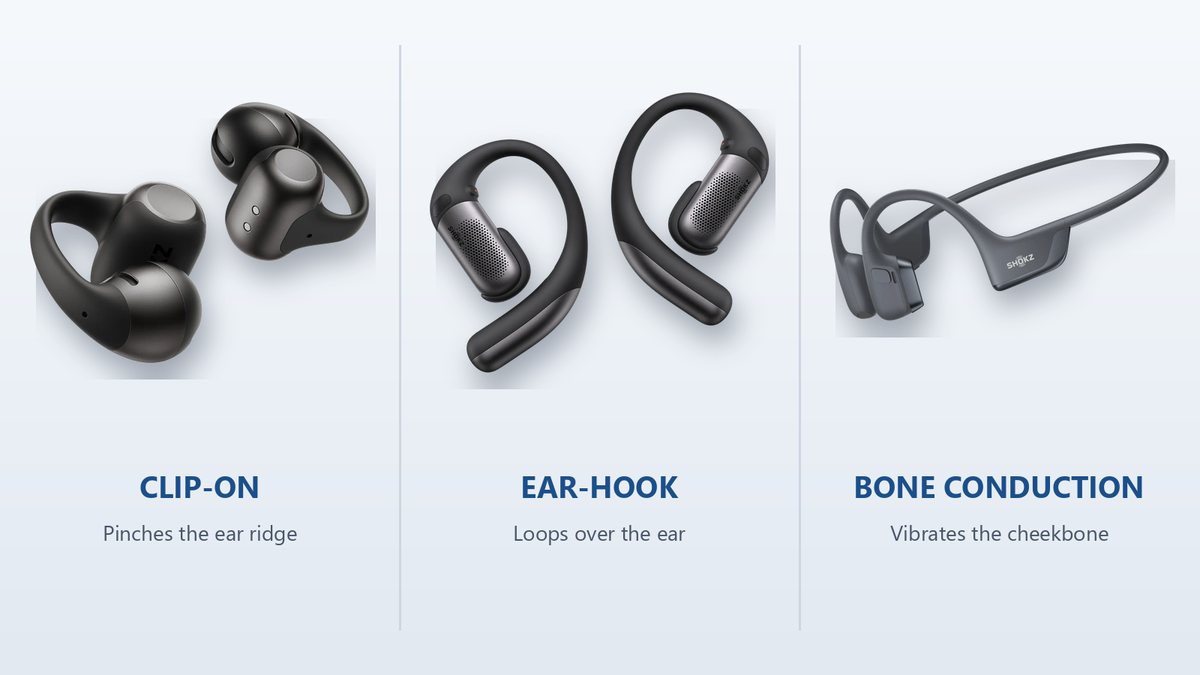
Fit type is the first fork in the road, and each style fails differently.
Clip-On Buds Grip the Ear Rim
A clip wraps the outer rim of your ear like an earring, driver in front of the canal, counterweight behind. Nothing enters the canal and nothing loops over the ear, which is why this is the style for glasses wearers, hearing-aid wearers and ears too small for a hook. The weakness is grip under load — it holds by pressure on cartilage, so hard sprinting can shift it.
Ear-Hooks Loop Over the Whole Ear
An ear-hook runs a silicone arm over the top of your ear and parks the driver in front of the canal. It is the most secure open-ear design by a wide margin, because a hook is a latch rather than a friction fit. The cost is real estate: it wants the exact groove your glasses arm and helmet strap want.
Bone Conduction Skips the Ear Entirely
Bone conduction pads rest on your cheekbone and vibrate the skull, sending sound through bone instead of air. Your canals stay empty, which is why swimmers and helmeted cyclists keep buying it. The cost is fidelity — weak bass, muted treble, a tickle on the cheek when loud.
The Best Open Ear Earbuds You Can Buy Right Now
Five picks, one per reason to want open-ear. Nothing Ear (Open) and Honor Earbuds Open are the closest things to a sixth pick; both are good, neither beats the five above at a specific job.
1. Shokz OpenDots 2 — Best Overall Open-Ear Pair
$199.95Clip-On Fit40 Hours With CaseIP57 Buds
Shokz launched the OpenDots 2 on June 4, 2026, and it answers the “why am I buying open-ear” question better than anything here. The clip grips the ear rim, so canal size is irrelevant — it fits people who have never found an earbud that stays put. Each bud weighs about 6.4 grams, a little more than a US nickel per ear. Dual 11.8 mm drivers fire at an angle down the canal instead of spraying sideways, so podcasts sound like a person rather than a phone speaker. Battery is about 10 hours a charge, 40 with the wireless case.
One detail reviewers get wrong: the microphone. The three-mic system includes a bone-conduction sensor used only for calls — it reads jaw vibration to isolate your voice from wind and café noise. Music still arrives through air. Anyone calling these bone-conduction earbuds has confused the mic with the driver.
Keep in mind: the buds are rated IP57 but the case only IP54. The buds survive a downpour. Do not let the case take one.
The cheaper sibling, OpenDots Air, is $129.95 with 36 hours total and IP55.
Pros
- Fits ears that reject everything else
- very light
- best clip battery
- smart call mic
Cons
- Modest bass
- case far less water resistant
- sprinting can shift the clip
2. Bose Ultra Open Earbuds — Best for All-Day Desk Comfort
$299 at BoseCuff FitImmersive AudioNo Noise Cancelling
Bose uses a cuff rather than a clip — a barrel hanging outside the ear on a joint that pinches the rim — and it is still the comfort benchmark. Hours pass and you forget they are on when the job is “wear these from nine to five”. Immersive Audio is the other reason people pay: it pushes the stereo image out in front of your face rather than leaving it stuck between your ears. Bose lists them at $299 with most colourways in stock as of August 10, 2026, and discounts them hard at sale events — this pair has traded near $199. There is no noise reduction here at all.
Pros
- Best comfort in the category
- convincing spatial audio
- excellent build
Cons
- Most expensive at list price
- zero noise reduction
- bulky under a hat
3. Shokz OpenFit Pro — Best for Running and Long Days
$249.95Ear-Hook Fit50 Hours TotalOpen-Ear Noise Reduction
If you run, hooks beat clips, and this is the most complete hook on sale. The silicone arm loops the whole ear, so hill repeats and head-down sprints do not move it, and battery runs about 50 hours total with the wireless case with noise reduction off, or about 24 hours with it on — a monthly charge, not a Sunday-night ritual. Shokz’s open-ear noise reduction, which is not noise cancelling and should never be sold as such, shapes what the driver does so speech cuts through steady road hum.
The catch: the hook lives in the same groove as your glasses arm and a helmet strap. One is fine, two is tolerable, three will hurt within the hour.
Need neither the battery nor the noise reduction? Drop to the OpenFit 2+ at $199.95 or the OpenFit 2 at $179.95.
Pros
- Does not move when you do
- huge battery
- clearest sound here on a noisy street
Cons
- Priciest Shokz pair
- conflicts with glasses and helmets
- too bulky to sleep in
4. Soundcore AeroFit 2 Pro — Best If You Still Want Silence Sometimes
$179.99Convertible FitLDAC Hi-ResReal ANC Mode
This is the clever one. Adjust the ear hook and the AeroFit 2 Pro converts between an open-ear form and a sealed form with active noise cancelling. Soundcore fits 11.8 mm composite drivers, LDAC hi-res streaming for Android and four microphones, and says it fits roughly 90% of ears larger than 5/8 inch across, with a 30-day money-back window behind that claim.
Pros
- Two devices for one price
- LDAC hi-res
- strong mic array
- long return window
Cons
- Heavier than a pure clip
- ANC trails sealed buds
- more fiddling than one-mode pairs
5. Soundcore AeroFit 2 — Best Budget Open-Ear Buds
$129.99Ear-Hook Fit4-Level Adjustable HookLDAC Hi-Res
At $129.99 this is the value pick, and its headline feature matters most to anyone earbuds have failed before — the hook adjusts through four positions, moving the driver nearer to or further from your canal, which Soundcore says covers over 99% of ear shapes. Behind it sit 20 mm x 11.5 mm racetrack drivers, LDAC and wireless charging.
Tip: that adjustment is not just a comfort dial. Soundcore’s own figure puts the nearest position at up to 7.5 dB more bass than a fixed hook, so set it on day one with a bass-heavy track playing rather than leaving the factory notch.
Pros
- Cheapest competent open-ear
- the hook genuinely fits small ears
- LDAC and wireless charging
Cons
- Plastic-heavy build
- no noise reduction
- busy app
What the Person Next to You Actually Hears
Most roundups skip this, and it is the most common open-ear regret. There is no seal, so the driver firing into your canal also fires into the room. The only question is how much escapes.
Three things drive the leak. Volume is the big one, and it is not linear — the last fifth of the slider leaks far more than the first four fifths. Frequency is second: bass dies quickly in open air while midrange carries, so a podcast gives you away long before a bass-heavy mix at the same volume. Distance is third, falling off sharply within a metre or two.
So in a quiet office at half volume, expect someone a desk away to hear a thin trace of midrange and no bass. Past roughly 70% in that room, speech starts becoming recognisable to the person beside you. On a train the ambient noise buries the leak entirely — and pushes you to raise the volume, which is the real hazard. The CDC’s hearing loss prevention guidance puts prolonged-exposure risk above 85 decibels, and open-ear tempts you upward precisely because the world is competing with your music.
Not ideal for: a silent library, an open-plan meeting, or a red-eye flight. If most of your listening happens in quiet rooms full of other people, this category will embarrass you.
Whether Open-Ear Works With Glasses, Helmets, and Hearing Aids
This is a geometry problem, not a spec problem. The space around your ear is finite, so compatibility is decided by the shape you chose.
| Fit type | Glasses | Bike or ski helmet | Behind-the-ear hearing aid |
|---|---|---|---|
| Clip-on | Excellent — sits on the rim, clear of the temple arm | Good — low profile under most straps | Best option — shares the ear rather than covering it |
| Ear-hook | Workable — hook and arm share one groove | Poor — hook, strap and helmet edge all compete | Not compatible — the hook needs the aid’s space |
| Bone conduction | Good — pads sit on the cheekbone | Best — nothing on or over the ear | Depends on the aid; the band crosses the head |
Two rules do most of the work. Put the earbuds on before your glasses — seating the clip or hook first drops the temple arm outside the earbud instead of trapping it underneath. And if you wear a behind-the-ear hearing aid, a clip-on is effectively the only style that works, because it is not competing for the space the aid already occupies.
Open Ear vs Bone Conduction Is About Where Sound Enters
The two terms get used interchangeably and they are not the same product. Open-ear fires air at your canal from just outside it, so your eardrum still does the work. Bone conduction bypasses the outer and middle ear entirely.
That decides everything downstream. Keeping the eardrum in the chain means open-ear sounds like a small speaker — imperfect bass, but recognisable music. Bone conduction sounds thinner and turns buzzy when pushed, because you are shaking a skull instead of moving air. Choose it only when your ears must stay completely unobstructed: swimming, certain hearing conditions, or a job where anything in the ear breaks policy. The Shokz OpenRun Pro 2 at $179.95 is the reference there.
When to Buy Sealed Earbuds Instead
The honest ending most roundups will not write. Buy something with a seal if you want bass you can feel, if you fly or commute by rail where cancelling beats awareness, if you take calls in loud rooms and need to hear the other person, or if you share a quiet space all day where the leak above becomes somebody else’s problem.
Sealed buds are also where the fit innovation still is — our AirPods Pro 3 and AirPods 4 comparison is this same argument in the sealed world. This category earns bad reviews only when people buy it for the wrong job.
Frequently Asked Questions
Are open ear earbuds worth it?
Yes, if you need to hear the world while you listen — running near traffic, working in an office, minding kids, or wearing earbuds for hours at a stretch. No, if you want bass, isolation or quiet on a plane.
What are the best open ear earbuds for running?
Ear-hooks, because a hook is a mechanical latch and a clip is only a friction fit. The Shokz OpenFit Pro at $249.95 is the strongest option, with roughly 50 hours of total battery with noise reduction off (24 hours with it on) and open-ear noise reduction that keeps music intelligible over road noise. The AeroFit 2 at $129.99 is the budget hook.
Do open ear earbuds leak sound other people can hear?
Always — there is no seal to stop it. In a quiet room at half volume, expect a neighbour to hear a thin trace of midrange and no bass. Past roughly 70% in that room, speech starts becoming recognisable to the person beside you.
What are the best open ear earbuds for small ears?
Clip-ons, because they grip the outer rim instead of depending on canal or hook geometry. The Shokz OpenDots 2 at $199.95 is the pick, with the OpenDots Air at $129.95 as the cheaper version. Among hooks, the Soundcore AeroFit 2 adjusts through four positions to suit smaller ears.
Is open ear the same as bone conduction?
No. Open-ear fires air at your canal from outside it, so your eardrum still does the work. Bone conduction vibrates your cheekbone instead, bypassing the eardrum entirely. The OpenDots 2’s bone-conduction microphone is for calls only, not listening.
What are the best budget open ear earbuds?
The Soundcore AeroFit 2 at $129.99, with LDAC hi-res audio, wireless charging and an adjustable hook at roughly half the price of the flagships. The Shokz OpenDots Air matches it at $129.95 with a clip-on fit.
Conclusion
Pick the fit first. Bone conduction only when your ears must stay entirely free. Then, and only then, argue about drivers. If you want one answer, the Shokz OpenDots 2 at $199.95 is the pair most people should buy.