
The renewal quote is why most people type “Proxmox vs VMware” into a search bar. Broadcom now sells VMware as a per-core subscription, and the new bill can be a multiple of the old one. So here is the short answer for 2026. If you run a homelab or a cost-driven small or mid estate, Proxmox wins by default. It does the same core jobs for a fraction of the price. VMware still earns its bill in three cases: your software vendors certify only against vSphere, NSX or vSAN carry real load in your stack, or your org needs a vendor to own the risk. Everything below is the math behind that answer.
This page began life as a TechDaily podcast episode. Prefer to listen first?
- The price gap is the story. VMware is billed per CPU core; Proxmox is billed per CPU socket. On one dual-socket, 64-core host, that’s roughly $22,400 a year at analyst list prices against €1,100 a year — for the same core jobs.
- The feature war is mostly over. Proxmox VE 9.2 added automatic load balancing, the last headline gap. Its new central manager is still young, though — we say so plainly below.
- The speed test everyone quotes is real, and Proxmox won 56 of 57 runs. It’s also four years old. Treat it as a hint, not proof.
- Free ESXi is back, but it’s a lab tool. No vCenter means no cluster, and your backup product loses its supported hook.
- The real decision is a risk trade. VMware sells cover you can point at in a meeting. Proxmox sells the same capabilities cheap and asks your team to be the glue. Count your cores, your certifications, and your Linux hands.
The Renewal Quote Turned a Feature War Into a Risk Trade
For years this comparison was a feature checklist. VMware had the mature toys; Proxmox was catching up. That framing died in two steps. Broadcom bought VMware in late 2023 and moved everything to per-core subscriptions — we covered the fallout in our piece on Broadcom’s price hikes. Then Proxmox spent 2025 and 2026 closing its last visible gaps.
The migration wave that followed is measured now, not predicted. CloudBolt’s research found 86% of companies actively reducing their VMware footprint. That’s not a survey about feelings; it’s what teams did after the first renewal cycle hit.
Why did Broadcom do it? The economics are simple. Per-core pricing is built for its biggest, densest customers — the ones running huge estates where VMware’s full stack pays for itself. If you’re not one of them, you’re paying a price set for someone else’s data center.
And the choice ripples further than the hypervisor — the base software that splits one physical server into many virtual ones. It decides what hardware you buy next (core-dense boxes punish per-core billing), which backup product you keep, and who you hire. That’s why this is a risk trade, not a spec sheet fight.
VMware Charges per Core While Proxmox Charges per Socket
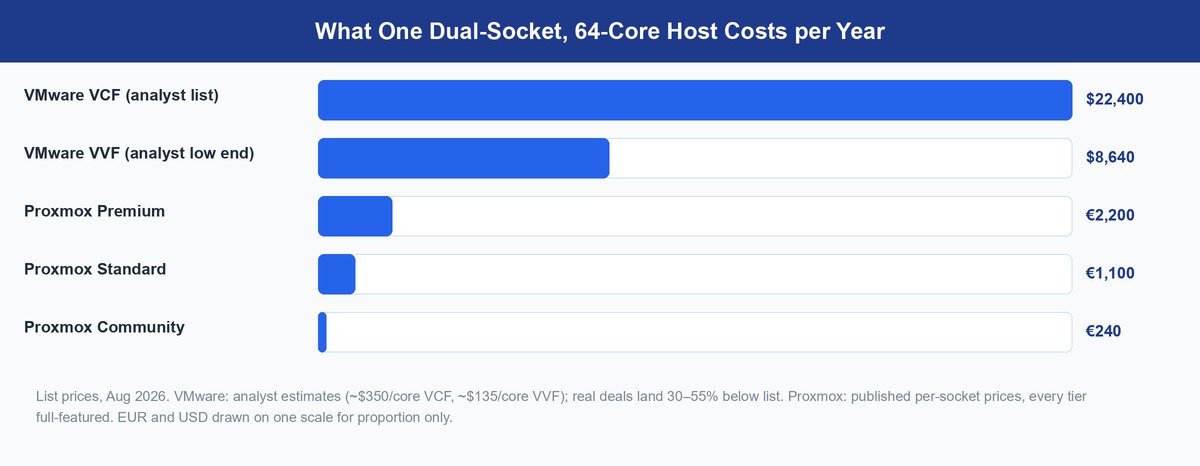
Two billing words decide most of this. Per-core means you pay for every CPU core in the box — a modern server chip can carry 32, 64, or more. Per-socket means you pay once per physical CPU chip, no matter how many cores it holds.
Broadcom publishes no public price list; every deal is negotiated. Analyst estimates put VMware Cloud Foundation at roughly $350 per core per year at list, and the lighter vSphere Foundation at about $135 to $190 per core. Treat those as analyst figures, not a rate card.
Proxmox publishes its prices on an open page, per socket, per year:
| Proxmox VE tier | Price per socket, per year | What changes |
|---|---|---|
| Community | €120 | Stable enterprise repo, no support tickets |
| Basic | €370 | 3 tickets, 1-business-day response |
| Standard | €550 | 10 tickets, 4-hour response |
| Premium | €1,100 | Unlimited tickets, 2-hour response |
Every tier has every feature. Clustering, live migration, high availability, backups — none of it is paywalled. The tiers only change how fast someone answers your ticket, and the paid support tiers include Proxmox Datacenter Manager.
Now the worked example. Take one dual-socket host with 64 total cores. VMware Cloud Foundation at list: 64 cores times $350 is about $22,400 a year. vSphere Foundation at the low analyst figure: about $8,640 a year. Proxmox Standard: two sockets times €550 is €1,100 a year. Same host. The gap is the argument.
Do the math: every VMware CPU socket licenses at least 16 cores, even if the chip has fewer. In small estates, analysts reckon that adds 10 to 25 percent of “phantom cores” — capacity you pay for but don’t own.
Before you sign: analysts report real VMware deals landing 30 to 55 percent below list, and Broadcom has already walked back licensing terms once after customer backlash. Never accept the first renewal quote.
The 2026 Feature Scorecard Is Closer Than It Has Ever Been
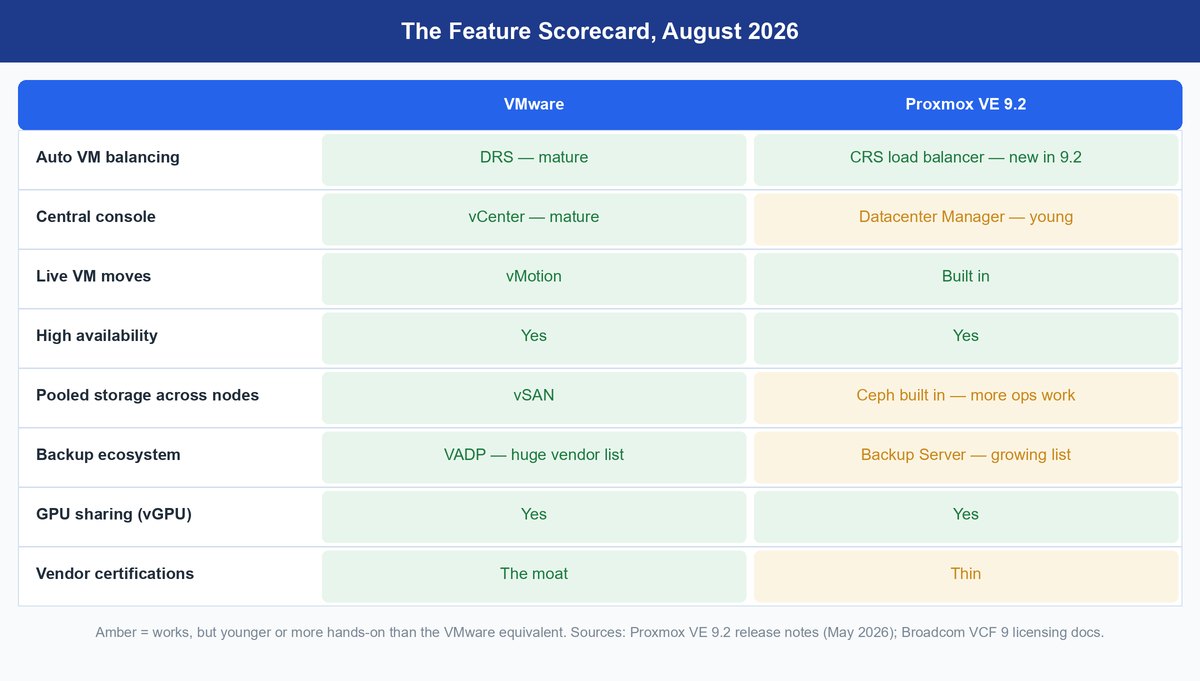
If your mental scorecard is from 2023, it’s out of date. Here’s the honest 2026 version. (New to Proxmox? Our plain-English Proxmox VE explainer covers the basics.)
| The job | VMware | Proxmox VE |
|---|---|---|
| Auto-balancing VMs across hosts | DRS, mature | CRS dynamic load balancing, new in 9.2 |
| One console for many clusters | vCenter, mature | Datacenter Manager, young |
| Moving a running VM between hosts | vMotion | Live migration, built in |
| High availability (auto-restart on a dead host) | Yes | Yes |
| Storage pooled across nodes | vSAN | Ceph, built in |
| Backup ecosystem | VADP, huge vendor list | Proxmox Backup Server, growing list |
| GPU sharing across VMs | vGPU | vGPU works too |
| Vendor certifications | The moat | Thin |
Three rows deserve plain words. First, the balancer. Proxmox VE 9.2 shipped in May 2026 with a Cluster Resource Scheduler that rebalances running guests across nodes using live metrics. That was the last big “VMware-only” feature, and it’s now in the base product.
Second, the console. Proxmox Datacenter Manager is the answer to vCenter, and it’s young — version 1.x, a couple of years old. It works, and it’s improving fast, but vCenter has two decades of polish. If you manage many clusters from one pane, weigh that honestly.
Third, storage. Ceph spreads your storage across your nodes, so one dead disk or one dead box doesn’t matter. It ships built in and costs nothing extra. But it asks more of you than vSAN does — more planning, more care and feeding. It’s the clearest example of the whole trade: capability included, skill required. GPU sharing, if you need it, works on Proxmox with NVIDIA vGPU as well.
What the Benchmark Everyone Quotes Really Measured
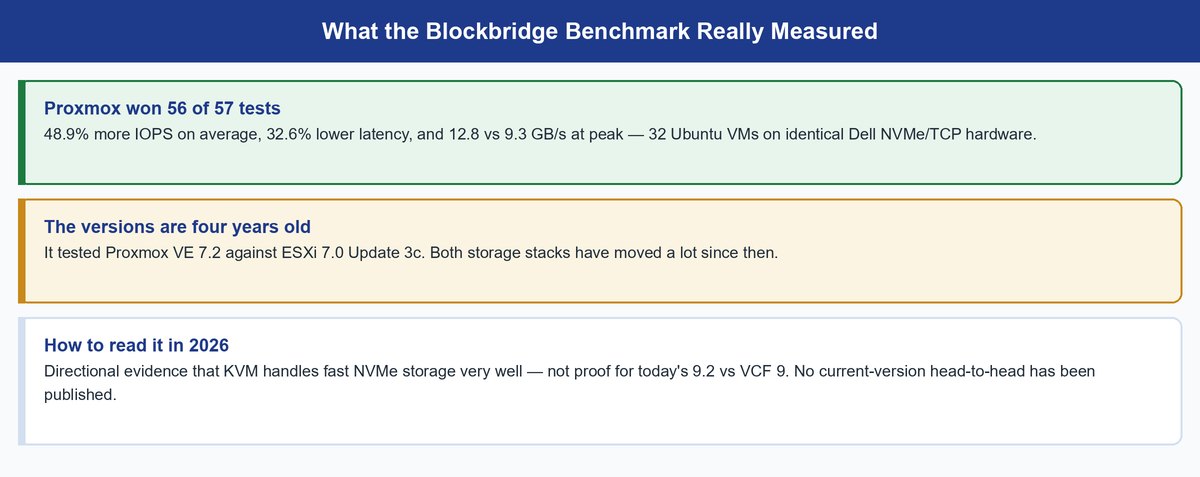
Search this topic and one hard number set comes up again and again: Blockbridge’s NVMe/TCP benchmark. Proxmox beat ESXi in 56 of 57 tests. It averaged 48.9% more IOPS — input/output operations per second, the standard measure of storage speed. Latency, the wait time per operation, was 32.6% better. At peak, Proxmox pushed 12.8 GB/s against ESXi’s 9.3.
Those numbers are real, and the test was clean: 32 Ubuntu VMs on identical Dell hardware. Here’s the context that matters just as much: the versions tested were Proxmox VE 7.2 and ESXi 7.0 Update 3c. Both are four years old now. Storage stacks on both sides have moved a lot since.
Reality check: as of this writing, no public head-to-head benchmark of the current versions exists. Treat Blockbridge’s result as directional evidence that KVM handles fast NVMe storage very well — not as proof that today’s Proxmox beats today’s VMware by 49%.
Why did Proxmox win those runs? Architecture, mostly. Proxmox uses KVM, a hypervisor that lives inside the Linux kernel itself, with VirtIO drivers — slim, direct paths that let a VM talk to hardware with less overhead. ESXi runs its own purpose-built kernel, tuned over decades. Both designs are fast. KVM’s short path pays off most in exactly the kind of raw-storage test Blockbridge ran.
Both Platforms Are Squeezing Your Upgrade Path This Year
Whichever way you lean, 2026 has a deadline for you.
On the VMware side, the old menu is gone. Broadcom’s licensing docs state that from version 9.0 you license through VCF or VVF, measured in cores. Perpetual licenses are history. There is a free ESXi again — version 8.0 Update 3e — but read it for what it is. It’s a standalone host. No vCenter means no cluster and no auto-balancing. No VADP means your backup product loses its supported hook into the hypervisor. Great for a lab, not a production answer.
On the Proxmox side, the clock is just as real. Proxmox VE 8 stops getting security updates on August 31, 2026. The current release is 9.2, out since May. As of August it also runs on 64-bit Arm servers — a first for the platform.
Also on the clock: if you’re still on Proxmox VE 8, the upgrade to 9.x is due by August 31 no matter what you decide about VMware. Fold it into the same maintenance window and you pay the disruption cost once.
Who Should Still Pick VMware in 2026
This is a genuine list, not a strawman. Plenty of estates should renew.
Your Software Vendors Certify Against vSphere Only
Certification means your software vendor has tested and blessed its product on a platform — and will support you when it breaks. Plenty of enterprise software, especially in healthcare, finance, and manufacturing, is certified on vSphere and nothing else. Run it on Proxmox and it will probably work fine. But “probably works” is not a support contract, and an auditor may care about the difference. If your critical apps carry vSphere-only certification, that’s the moat, and it’s real.
NSX or vSAN Carries Real Load in Your Stack
Most of VCF’s value shows up at scale, when NSX handles network micro-segmentation — walling off workloads from each other inside the network — and vSAN pools storage across many hosts. If those two products are load-bearing in your design, replacing them is a project far bigger than swapping a hypervisor. Proxmox’s SDN and Ceph can cover a lot of it, but not drop-in, and not without design work. Be honest about how deep those roots go.
Someone Above You Needs a Vendor to Own the Risk
This one is about your org chart, not your tech. A VMware contract buys a throat to choke: a vendor with an SLA who owns the problem at 3 a.m. Proxmox subscriptions buy real support too — up to 2-hour response on Premium — but your team is still the integration layer that ties compute, storage, and backup together. If your company can’t or won’t grow that skill in-house, paying the per-core premium is a defensible call. Write it down as what it is: insurance.
How to Make the Call Without Regretting It in a Year
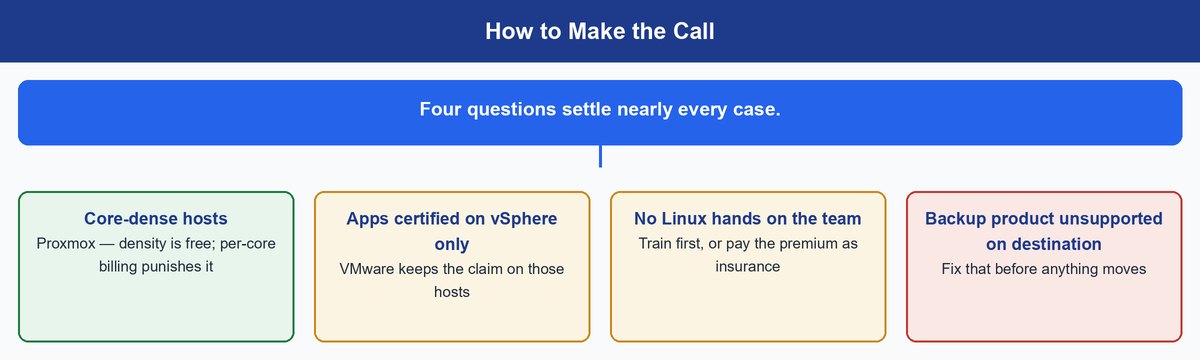
Four questions settle nearly every case.
Count your cores first. Dense chips punish per-core billing hardest. A dual-socket 128-core monster costs you nothing extra on Proxmox and a fortune on VCF. The denser your hardware, the louder the math argues for Proxmox.
Count your certifications second. List the apps that name vSphere in their support terms. If that list touches production, VMware keeps a strong claim on those hosts — even if the rest of the estate moves.
Count your Linux hands third. Most Proxmox estates are small — under ten nodes — and one comfortable Linux admin runs them happily. If nobody on the team lives in a shell, budget for training or hiring before you migrate, not after.
Check your backup path last. Your backup product must support the destination. Proxmox Backup Server covers Proxmox natively, and major vendors have been adding support, but verify your exact product before anything moves.
If the answers point away from VMware, don’t wing the move. Our VMware-to-Proxmox migration guide walks the actual steps, and if you’re weighing more than two options, the full field guide to VMware alternatives surveys the whole field — this post only decides between these two.
Frequently Asked Questions
Is Proxmox better than VMware ESXi?
For homelabs and small-to-mid estates, usually yes — same core capabilities, a fraction of the cost. For estates locked to vSphere-certified software, or leaning hard on NSX and vSAN, ESXi’s ecosystem still justifies itself. The honest answer is a cost-versus-risk trade, not a winner.
What about Proxmox vs VMware Workstation?
That’s a category mix-up, and it’s common. Workstation is a desktop app that runs VMs on your PC — Broadcom made it free for everyone, including commercial use, in November 2024. Proxmox is a server platform you install on bare metal. The real server-side comparison is Proxmox against ESXi and vSphere.
How does Proxmox compare with Hyper-V?
Different fight, similar shape: Hyper-V rides along with Windows Server licensing, so it wins in Microsoft-heavy shops, while Proxmox wins on cost freedom and Linux workloads. We break that one down fully in our Hyper-V vs Proxmox comparison.
Is VMware ESXi still free?
Yes, again — Broadcom brought back a free ESXi with version 8.0 Update 3e. But it’s a standalone lab tool. No vCenter, so no clustering or central management, and backup vendors lose their supported API hook. Don’t build production on it.
What does Reddit actually say about Proxmox vs VMware?
Homelab communities are heavily pro-Proxmox — r/homelab and r/Proxmox treat it as the default. Enterprise admin threads are more mixed: plenty of migration success stories since the price changes, but sysadmins in regulated shops keep naming certification and vendor support as the reasons they stay. That split matches the analysis above almost exactly.
Can VirtualBox replace either of these?
No. VirtualBox, like Workstation, is a desktop app for running a few VMs on top of your normal computer. It’s fine for testing. It has no clustering, no high availability, and no place running a server fleet. If you’ve outgrown it at home, Proxmox is the natural next step — or see our Proxmox vs Unraid comparison if storage is your main job.
The Bottom Line for Your Renewal Meeting
The feature war ended in 2026; the price war never really started. What’s left is a clean risk trade. VMware sells certified, supported, org-chart-defensible infrastructure at a per-core premium. Proxmox sells the same core capabilities per socket — often twenty times cheaper at list — and asks your team to be the integration layer. So walk into the renewal meeting with three numbers: your core count, your certified-app count, and your Linux head count. Those three decide Proxmox vs VMware for your estate better than any benchmark will.