Black Friday lands on November 27 this year, and karaoke machines are all over the deal pages. Most of them sound fine in the box. The trouble starts at the party. Your voice comes out of the speaker a beat late, or the mic howls when someone walks past it. A few months later, the song app asks for a monthly fee you forgot you agreed to.
The best karaoke machine fixes those problems before it brags about watts or lights. For most living rooms, that’s the Ikarao Break X2, a speaker with its own lyrics screen. A backyard host should look at JBL’s party speaker and its new AI mics instead. Below, we’ll show you why, and what each setup really costs over three years.
- Keep your voice on a cable or a dedicated wireless mic. Bluetooth delay is what makes singing feel off.
- The Ikarao Break X2 is our pick for most homes, because the lyrics screen and two mics are built in.
- JBL’s EasySing mics can strip the singer out of almost any song, but they only work with certain JBL PartyBox speakers.
- Over three years, the song subscription can cost as much as the machine. Short passes win if you only sing a few times a year.
- Loud gets risky fast. Every 3 decibels you add cuts your safe listening time in half.
What kind of karaoke night are you planning?
★ Your pick: JBL PartyBox Encore Essential 2
Loud, splash-proof and ready for JBL’s AI vocal-removal mics
★ Your pick: Ikarao Shell S2
An 8-inch screen in a box with a carry handle
★ Your pick: BONAOK Q37
A mic with a speaker inside, for kids and car rides
★ Your pick: JYX 66BT
Two wireless mics and a real speaker for under $100
★ Your pick: Singing Machine SML385BTW
Wired mic that can’t get lost, plus CD+G and disco lights
👑 Our Top Pick — Best Overall Value
Ikarao Break X2
Lyrics screen, two mics and karaoke apps in one box, no TV needed
Opens on our Top Pick. Tap an option to see the best match for you.
The Best Karaoke Machines for 2026
Each pick solves a different problem. We checked every model against the maker’s own specs on November 25, 2026.
Image: Ikarao.
1. Ikarao Break X2 Is the Best Karaoke Machine With a Built-In Screen
$400–$570 range10.1-inch touchscreen2 self-charging mics2-year warranty
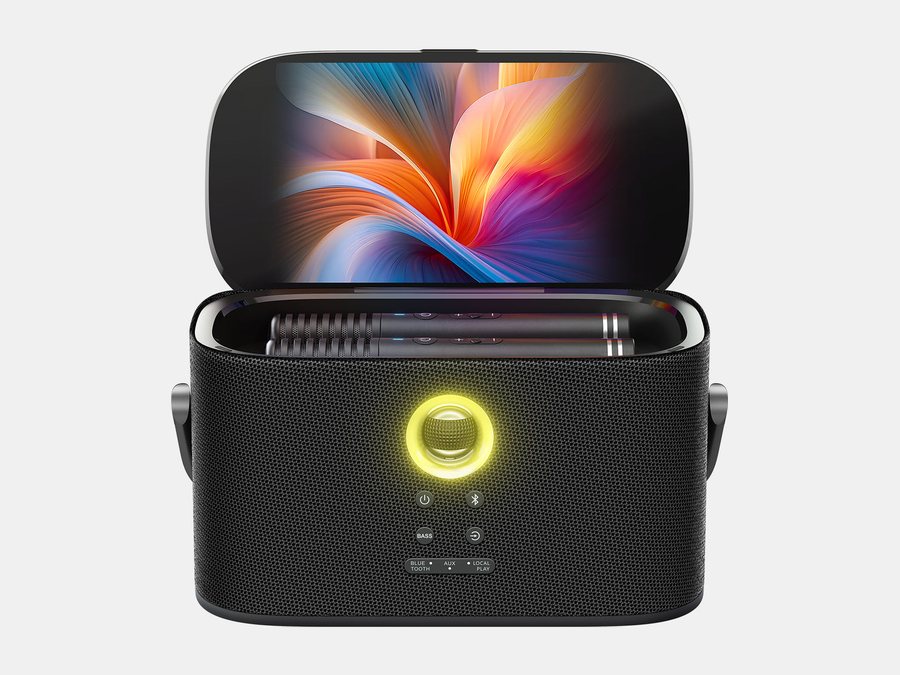
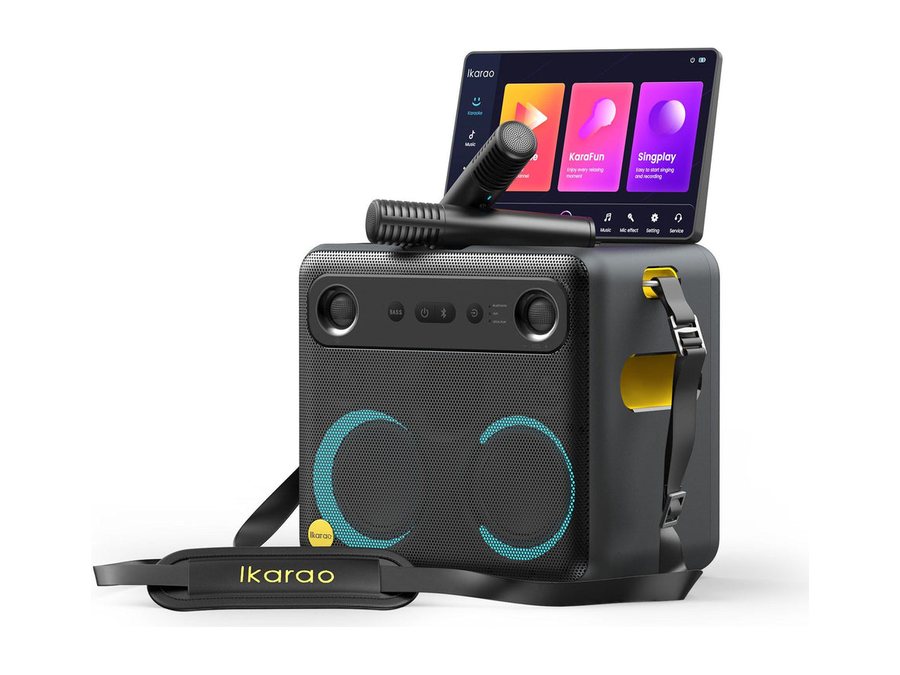
This is the one we’d put in most living rooms. It’s a speaker with a tablet built into the top, so the lyrics sit right in front of the singer. You don’t need a TV, a phone or a cable to get going. Turn it on, open KaraFun or YouTube, and pick a song.
The 10.1-inch touchscreen runs Android 13 and turns to face the singer or the room. YouTube, KaraFun and Spotify come installed. The two wireless mics charge in slots on the machine, and Ikarao rates them at up to 30 hours. The machine runs about 8 hours with the screen on, or 11 with it off. An HDMI port lets you put the lyrics on a big TV when the crowd grows.
Next to the Shell S2, you get a bigger screen, four speakers instead of two, and a two-year warranty instead of one. Next to the JBL setup, you get lyrics on a screen but lose JBL’s AI vocal removal. We couldn’t confirm a built-in vocal-removal mode here, so your songs come through the apps. Ikarao rates it at 300 watts peak through four speakers.
At about 15 pounds, it’s a two-hand carry, so it suits a home that keeps it in one room. Buy it if you host indoors. Skip it if your parties live in the backyard.
Pros
- 10.1-inch screen that turns to face the singer or the room
- Two self-charging wireless mics, rated up to 30 hours
- YouTube, KaraFun and Spotify built in
- HDMI port to put lyrics on a TV
- Two-year warranty
Cons
- The 10.1-inch screen is still small for a crowd, so big groups will want the HDMI hookup
- No confirmed hardware vocal removal
- About 15 pounds, so it’s not a grab-and-go box
- KaraFun’s full song library still needs a paid plan
Image: Ikarao.
2. Ikarao Shell S2 Is the Best Compact Karaoke Machine for Families
$300–$440 range8-inch touchscreen2 self-charging micsCarry handle
The Shell S2 is the Break X2’s little sibling, and it’s the easier gift. It has a carry handle, and the two mics dock in slots on top. That matters in a house with kids, where loose mics go missing. Grandparents can switch it on and sing without ever opening an app store.
The screen is 8 inches. You may see it called a 2.7-inch display elsewhere, but that’s the size of its two speakers. Ikarao rates it at 140 watts peak. The battery runs about 7 hours with the screen on and 8 with it off. You get Bluetooth 5.4, Wi-Fi, HDMI, USB and AUX, plus eight sound effects and an EQ. Ikarao also lists a feature it calls AI Pitch Tuning. Six months of KaraFun come in the box.
Next to the Break X2, you give up screen size, two of the four speakers and a year of warranty. In return you get a smaller box that’s easier to carry and store. At about 6.2 pounds, it weighs less than half as much as the Break X2.
The catch is those free KaraFun months. When they run out, you’ll pay monthly or switch to free karaoke videos on YouTube, and our cost table below shows how much that choice matters. Buy it for a family room, a dorm or a grandparent’s place.
Pros
- 8-inch screen in a box you can carry with one hand
- Mics dock on top, so they’re harder to lose
- Six months of KaraFun included
- Wi-Fi, HDMI and Bluetooth 5.4
Cons
- Two speakers, not four like the Break X2
- One-year warranty, half the Break X2’s
- The 8-inch screen is hard to read from across a big room
- KaraFun turns into a monthly bill after six months
Image: JBL.
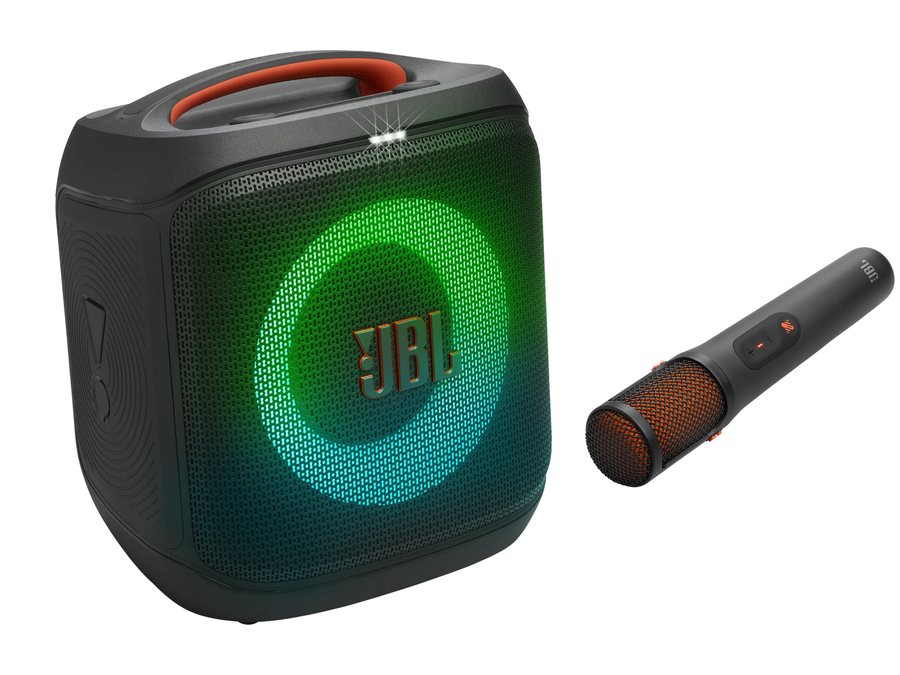
3. JBL PartyBox Encore Essential 2 With EasySing Mics Is the Best Backyard Karaoke Setup
$200–$330 speaker$130–$200 mics15-hour batterySplash-proof
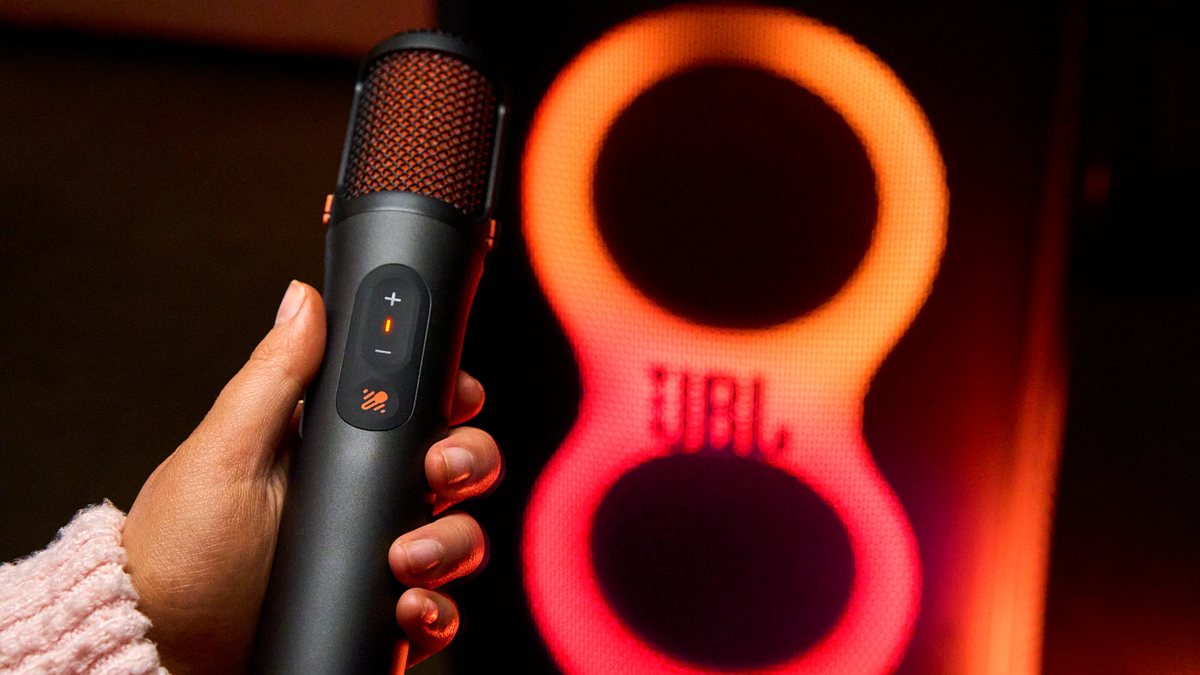
This is two products that work as one, and it’s the most interesting karaoke gear of 2026. The speaker is JBL’s PartyBox Encore Essential 2. The mics are JBL’s EasySing pair, which launched this spring. Their big trick is AI vocal removal. The mics strip the singer out of a normal song in real time, and you can leave 25%, 50% or none of the original voice. So any song from Spotify or YouTube can become a karaoke track, not just the ones a karaoke app has licensed.
The speaker puts out up to 100 watts and runs up to 15 hours. It has a mic input and a guitar input, with a karaoke EQ setting. It’s rated IPX4, which means it shrugs off rain spray but not a dunk in the pool. It weighs 13.7 pounds and has a light show. No mics come in the box. The EasySing mics add pitch support, reverb and feedback suppression. They run up to 10 hours and reach up to 30 meters, through a USB-C dongle that holds the AI chip.
The lock-in is real. EasySing only works with certain PartyBox models, such as the Encore 2, Encore Essential 2, On-The-Go 2, Club 120 and the Stage line. Next to the Break X2, you get more volume outdoors and far more songs, but no screen. Lyrics come from a phone or a TV. JBL also says the vocal removal is for home, non-commercial use only.
Buy this pair if you host outside and want guests singing whatever’s on the playlist. Skip it if you want lyrics on a screen without extra steps.
Pros
- AI vocal removal at three levels, in real time
- 15-hour speaker battery
- IPX4 splash rating for the backyard
- Guitar input with karaoke EQ
- Feedback suppression built into the mics
Cons
- EasySing only works with listed JBL PartyBox models
- No screen, so lyrics need a phone or TV
- The speaker ships without mics
- Two separate purchases to get the full setup
Image: BONAOK.
4. BONAOK Q37 Is the Best Karaoke Stocking Stuffer
Under $30Speaker in the micBluetooth or cablemicroSD slot
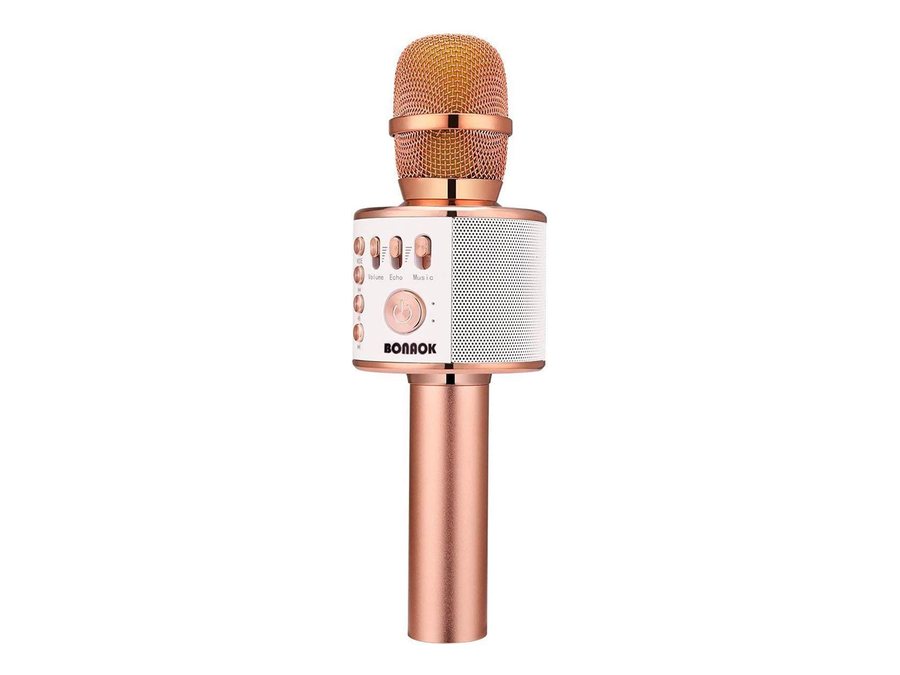
Not every karaoke fan needs a machine. The BONAOK Q37 is a microphone with a small speaker built into it. A kid pairs it with a phone, picks a song, and sings. It’s the kind of gift that gets used on day one, usually in the back seat of the car.
It pairs over Bluetooth from up to 10 meters away, or plugs into a phone with a cable. A microSD slot takes cards up to 32 GB, so it can play songs with no phone at all. Separate controls set the mic, the echo and the music volume. The battery is built in and recharges. BONAOK backs it with a one-year warranty. We couldn’t find a battery-hours figure from BONAOK, so charge it before a road trip.
Here’s the honest limit. A speaker this small won’t fill a room, and only one person sings at a time. Next to the Shell S2, it’s a toy. Next to a candy bar, it’s a great stocking stuffer. Got a kid with a tablet? Add a karaoke app, and see our tablets for kids guide if you still need one.
Pros
- Mic and speaker in one handheld piece
- Bluetooth or cable, plus a microSD slot
- Separate mic, echo and music volume
- One-year warranty
Cons
- Too small to fill a room
- One singer at a time
- No battery-life figure from the maker
Image: JYX.
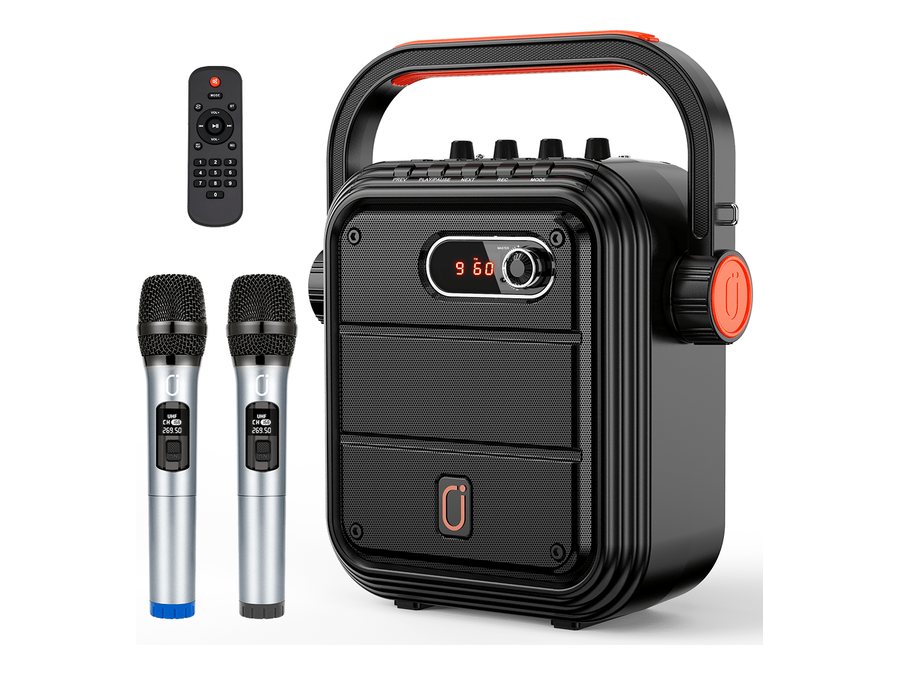
5. JYX 66BT Is the Best Karaoke Machine Under $100
$100–$130 rangeTwo wireless micsBluetooth 5.03-year warranty
If your budget stops at $100, start here. The JYX 66BT is a portable party speaker with two wireless mics in the box. It has no screen, so lyrics come from your phone or a TV. What you get for the money is a proper voice path, the thing this whole guide keeps coming back to.
JYX’s own product page says the mics are UHF. That means they reach the speaker over their own radio link, not over Bluetooth, which is the setup we’d pick to keep your voice in time. The music itself arrives over Bluetooth 5.0, a TF card, USB or an AUX cable. An echo effect adds some polish, and TWS pairing lets you link a second speaker later. We have no measured loudness for it, so think living room or patio, not a big backyard.
Next to the Shell S2, you give up the screen and the bundled KaraFun months. By our price ranges, though, you keep at least $170. JYX backs it with a three-year warranty. That’s three times what BONAOK offers and a year more than the Break X2.
We found no independent review of this exact model. JYX rates the battery at up to 8 hours, so charge it before a long party. Buy it for a home or a small yard where the budget is tight.
Pros
- Two wireless UHF mics in the box
- Bluetooth 5.0 plus TF card, USB and AUX inputs
- Echo effect and TWS pairing for a second speaker
- Three-year warranty
- Roughly $100 to $130, a fraction of the screen machines
Cons
- No screen, so lyrics come from a phone or TV
- No independent review of this exact model
- No measured loudness figure, so outdoor reach is a guess
Image: Singing Machine.
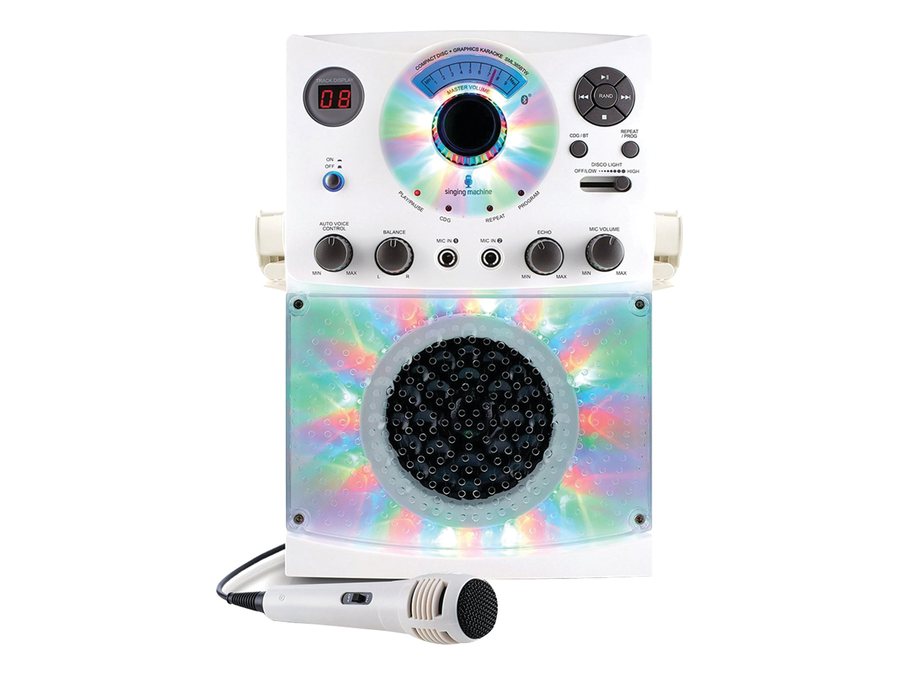
6. Singing Machine SML385BTW Is the Best Karaoke Machine for Kids
$60–$80 rangeCD+G playerWired mic included90-day warranty
This is the classic kids’ karaoke box, a CD+G player with Bluetooth added. The reason it suits kids is the mic. It’s wired. A cord can’t wander into another room, and there’s no battery to die halfway through a song. A second mic jack lets two kids duet once you add a mic of your own.
It has 54 LED disco lights with a dimmer, plus separate mic and echo knobs. Bluetooth plays backing tracks from a phone, and a USB port is there too. For lyrics on a TV, an RCA video out shows what’s on a CD+G disc. The whole box weighs under 7 pounds, so a kid can carry it to the next room.
Now the warranty, which is the honest answer to our headline. It’s a 90-day limited warranty. Bought today, it’s covered only until about late February, so a gift opened at Christmas has roughly two months of cover left.
Next to the Shell S2, you give up the screen and the apps, and by our ranges you save at least $220. The catch is the discs. Plenty of families don’t own any CDs anymore, and some owners complain about the sound quality. Buy it for a kid who just wants to sing, not for a party of adults.
Pros
- Wired mic that can’t get lost or run out of battery
- Second mic jack for duets
- 54 LED disco lights with a dimmer
- CD+G discs put lyrics on a TV through the video out
- Bluetooth for backing tracks from a phone
Cons
- Only one mic comes in the box
- Many families no longer own CDs
- A 90-day warranty is short
- Some reported sound-quality complaints
Skip the Machine and Run KaraFun on the TV You Already Own
Maybe you already have a good TV and a decent speaker. Then the cheapest good setup is an app plus a proper pair of mics.
KaraFun’s TV app installs on Apple TV, Android TV and Fire TV. Roku isn’t on that list. Picking a streaming stick this season? That’s a real reason to lean Fire TV, and our Roku vs Fire Stick comparison covers the rest.
The songs cost money. KaraFun’s free tier only plays 30-second samples, and as of November 25, Premium runs about $10 a month with no free trial. Singa, a rival app, charges about the same per month, about $90 a year, or about $6 for a two-day pass. YouTube’s karaoke videos are free, if you don’t mind ads and mixed quality.
Then sort out the voice. Plug wired mics, or a pair of 2.4 GHz digital wireless mics, into a speaker with a mic input. Don’t sing through the TV’s speakers or over Bluetooth. The next section shows why.
Handy shortcut: in KaraFun’s TV app, open Settings, then Remote Control. Guests can then queue songs from their own phones, so nobody fights over the remote.
Why Some Karaoke Setups Lag or Squeal
Most karaoke complaints come down to two problems in the voice path, the route your voice takes from the mic to the speaker. One is delay. The other is feedback.
Bluetooth Delay Puts Your Voice Behind the Beat
When you sing, you hear yourself twice. You hear it once through the bones of your head, and again a moment later from the speaker. If that second copy shows up late, it sounds like an echo, and you start chasing it.
Audio maker Shure says 5 to 10 milliseconds of delay is generally fine for stage monitors. A millisecond is a thousandth of a second. Above 10, singers start to notice, and in-ear monitors should stay at 5 or less. Now compare Bluetooth. Audio retailer zZounds puts its delay at roughly 40 to 250 milliseconds, depending on the codec, the format two devices use to squeeze audio. Even the low end is four times Shure’s comfort line.
So here’s the rule we’d follow. Your voice should travel by cable, or by a dedicated 2.4 GHz or UHF wireless mic, straight into the speaker that plays it. The music can go over Bluetooth or HDMI, because a short delay on the backing track bothers nobody. Sending your voice through a TV and then a soundbar stacks up delays, the same trade-off we explain in our soundbar vs speakers guide. If the TV has to be in the chain, switch on its Game mode, which skips some picture processing.
Feedback Squeal Happens When the Mic Hears the Speaker
Feedback is a loop. The speaker’s sound goes back into the mic, gets louder, comes out again, and turns into a howl. Shure’s fixes are simple. Keep mics away from the speakers, and behind them if you can. Don’t cup the grille, the metal ball on top of the mic. Turn off any mic nobody’s using, and go easy on big EQ boosts.
Distance is the big one. Shure’s rule is that each time you double the gap between mic and speaker, you can run about 6 decibels louder before it howls. That’s why all-in-one boxes squeal when you crank them, since the mic is often a foot from the speaker. It’s also why JBL built feedback suppression into the EasySing mics.
Do the math: going from one foot away to four feet away doubles the distance twice. By Shure’s rule, that buys you about 12 decibels of headroom, which is a lot of party.
Vocal Removal Went From a Stereo Trick to AI
Old vocal removers flip one stereo channel and add it to the other, so anything mixed dead center cancels out. That’s usually the singer. Audacity’s manual notes the catch: bass and kick drum often sit in the center too, so they vanish with the voice. The result also comes out in mono, and it fails when the singer isn’t panned right down the middle.
AI separation pulls the voice apart from the instruments instead, so the band stays whole. JBL’s EasySing does it live and can keep a bit of the original singer as a guide. That helps when you only half know the words.
What Home Karaoke Really Costs Over Three Years
This is our own math, using each maker’s prices on November 25, 2026, rounded into ranges. Black Friday prices will move this week, so treat these as estimates.
| Setup | Hardware | Songs over 3 years | 3-year total |
|---|---|---|---|
| Shell S2, KaraFun kept after the free months | $300–$440 | about $300 | $600–$740 |
| Shell S2, free YouTube karaoke only | $300–$440 | nothing | $300–$440 |
| JBL speaker and EasySing mics, songs from a music app you already pay for | $330–$530 | nothing extra | $330–$530 |
| Your TV and speaker, a wireless mic pair, KaraFun all 3 years | about $100 | about $360 | $450–$500 |
| Same, with a Singa two-day pass for 6 parties a year | about $100 | about $105 | $200–$250 |
Look at the last two rows. For an occasional host, the song plan, not the box, is the biggest cost over three years. A year of a monthly plan runs about $120. Divide that by the price of a two-day pass and you get about 20. So unless you sing on more than about 20 weekends a year, passes come out ahead.
The JBL row looks cheap because the AI does the work. It’s not quite the same as a real karaoke track, though. You get no lyrics on screen unless you pull them up yourself.
Where Karaoke Songs Come From Now
Karaoke began as coin-op machines in Japanese bars in the early 1970s. In the mid-1980s, CD+G discs from Philips and Sony hid lyric graphics in spare data channels on a normal CD, the format the Singing Machine above still plays.
Now the songs live in apps, and the hardware is turning into a front door for a song license. The clearest sign came in August 2025. Algorhythm Holdings, which owned Singing Machine, sold its karaoke business to Stingray for $4.5 million so it could focus on freight. Stingray runs a licensed karaoke catalog and plans to pair Singing Machine mics with it. The best-known name in home karaoke now belongs to a company that sells songs.
That’s also why every karaoke app charges monthly. Karaoke tracks are licensed recordings with synced lyrics, and those licenses split home use from public use.
Worth knowing: KaraFun Premium is for private use only. A bar, a restaurant or a paid event needs its Pro plan, which costs about five times as much.
How Loud Is Too Loud for a Karaoke Party
Karaoke gets loud, and singers stand right next to the speaker. NIOSH, the federal institute that researches workplace safety, sets its recommended limit at 85 decibels averaged over 8 hours. It uses a 3-decibel exchange rate. That means every 3 decibels you add cuts the safe time in half. At 91 decibels, the limit is 2 hours. At 97, it’s 30 minutes.
Here’s our math for a real party. Say the spot near the speaker sits at 94 decibels for a 3-hour party. NIOSH’s safe time at that level is 1 hour, so you’ve taken three times the daily dose. The WHO’s weekly guide is even stricter at the top end. It says 100 decibels is safe for only about 20 minutes a week.
We don’t have measured loudness for any machine here, so we can’t tell you where each one lands. A free sound-meter app on your phone gives you a rough reading. Hold it where the singers stand, not across the room.
Heads up: the WHO-ITU safe listening standard gives kids a lower 75-decibel limit for 40 hours a week. Adults get 80. Keep the kids’ volume down and the speaker a few steps away.
How We Chose These Karaoke Machines
We started from the problems that ruin a karaoke night, not from the spec sheets. Then we checked each pick against its maker’s own specs on November 25, 2026. We read owner reports and weighed every setup against the voice-path rule above. Where sources disagreed on a spec, we went with the maker’s own spec chart. We also passed on big outdoor speakers that take only one mic, because karaoke without duets is half the fun.
The Bottom Line on Picking a Karaoke Machine
Get the voice path right first. A cable or a dedicated wireless mic into the speaker beats any wattage claim. For most homes, the Ikarao Break X2 is the easy answer, with the Shell S2 as the smaller, cheaper sibling. Backyard hosts should pair JBL’s Encore Essential 2 with the EasySing mics. On a tight budget, the JYX 66BT brings two wireless mics for about $100 to $130. A kid who just wants to sing can have the Singing Machine SML385BTW’s wired mic. And if you already own a good TV and speaker, an app and a pair of mics may be all you need. Just watch the subscription, and keep the volume sane.
Frequently Asked Questions
What is the best karaoke machine for home use?
For most homes, it’s the Ikarao Break X2. Its 10.1-inch screen, two wireless mics and built-in apps mean you don’t need a TV. The Shell S2 suits smaller rooms, and the JYX 66BT is the pick under about $130.
What is the best wireless karaoke microphone system?
Pick mics with their own 2.4 GHz digital or UHF link straight into the speaker, not Bluetooth to a TV. That keeps the delay too short to hear. If you own a recent JBL PartyBox, the EasySing mics add AI vocal removal on top.
What is the best program for karaoke?
KaraFun is the easiest pick for TVs, with apps for Apple TV, Android TV and Fire TV. Premium costs about $10 a month. Singa costs about the same but also sells two-day passes for parties. YouTube’s karaoke videos are free if you can live with ads.
Which brand is best for karaoke?
Ikarao leads for all-in-one machines with a screen. JBL is the stronger choice for loud party speakers, especially with EasySing. Singing Machine is the classic name for CD+G machines, with the SML385BTW our pick for kids.
Is a karaoke machine or an app better?
An app is cheaper if you already own a good TV, a speaker with a mic input and decent mics. A machine wins when you want one box that just works. Over three years, the app’s subscription can outcost the machine, so count your parties first.
How do I stop a karaoke mic from squealing?
Move the mic farther from the speaker and stand behind it. Each doubling of distance buys about 6 decibels before it howls. Mute any mic nobody’s using.