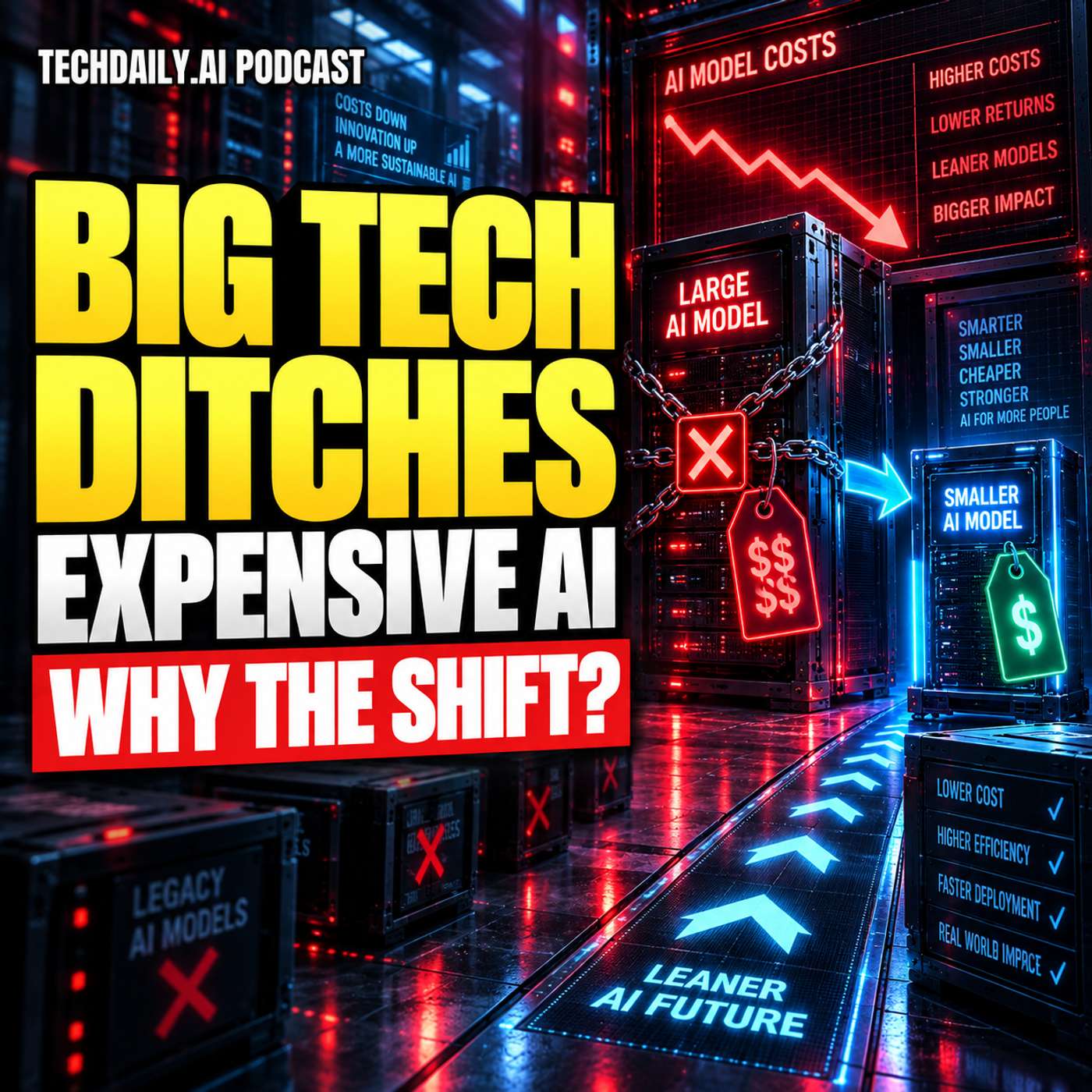


Enterprise AI has entered a new phase. After years of aggressive spending on powerful frontier models, major companies are now confronting AI “bill shock” and asking a much harder question: how do you keep the benefits of AI without letting compute costs spiral out of control?
In this episode of techdaily.ai, David and Sophia examine how companies including Uber, Pinterest, and AT&T are dramatically reducing AI expenses while preserving much of the performance their teams depend on.
Uber provides one of the clearest examples. After burning through its annual AI budget in just the first three months of 2026, the company began aggressively optimizing its AI infrastructure. Techniques including token compaction, caching, and lower default effort settings helped reduce the cost per AI request by 34% and the cost per AI session by 52%, even as usage continued to grow.
The conversation then moves to an even bigger industry shift: replacing expensive proprietary models with open-weight alternatives.
You’ll hear how:
• Pinterest reported AI transaction costs of less than 8% of comparable closed-model costs by running and post-training open models inside its own secure infrastructure.
• AT&T used intelligent model routing to move simpler coding tasks away from expensive models, cutting AI coding costs by 56% while seeing only a 2% decline in output quality.
• Companies are increasingly reserving frontier models for difficult work while directing summaries, routine coding tasks, and other lower-complexity requests to cheaper models.
• Open models and smart model routing are emerging as some of the most powerful tools for reducing enterprise AI costs.
• The economics of AI are beginning to affect model providers, hardware demand, company valuations, and infrastructure strategy.
The episode also explores a surprising infrastructure consequence: as AI agents move beyond generating answers and begin interacting with tools, files, and software environments, CPU demand could become increasingly important alongside GPU capacity.
But the biggest question may be about people.
If AI agents increasingly handle routine debugging, maintenance, and incident response, engineers could lose the everyday practice that keeps their diagnostic skills sharp. Drawing on the aviation industry’s use of flight simulators, David and Sophia ask what the equivalent should be for technical professionals whose routine work is becoming automated.
As AI moves from experimentation to economic discipline, the winners may not be the companies using the most powerful models. They may be the ones that know exactly when expensive intelligence is necessary—and when it isn’t.
Listen to the full episode for a closer look at AI cost optimization, open-weight models, model routing, enterprise AI infrastructure, and what automation could mean for the future of engineering.
Subscribe to techdaily.ai and share the episode with someone thinking about the economics of deploying AI at scale.